Posted by: puebloman | April 3, 2010

Garzon

ABC has a large front page photo of the National Court Judge, with the headline – ‘The accused bench is waiting’. The paper says the Supreme Court has dismissed the appeal made by the judge and opened the door to him being charged for perversion of the course of justice.
El País has the dramatic headline ‘The Supreme Court backs the Falange and puts Garzón on the accused bench’. It notes that the magistrate has said that he will show his innocence. El País also has an editorial today entitled ‘The Falange win’.
El Mundo says that two courts are now following the alleged crimes of the judge, with the Supreme Court investigating his look at the deaths during the Franco years, and the Madrid high Court declaring his recordings of lawyers in the Gürtel case as null and void.
ABC also notes that the Madrid High Court has now declared all the prison recordings ordered by the magistrate in the Gürtel case as null and void, and La Razón adds that the court compared the judge’s methods to ‘torture and the inquisition’.
La Razón headlines ‘The fall of Garzón’ and says the Supreme Court has put his back to the wall and opened the door for his suspension, for investigating the Franco years.

Read more: http://www.typicallyspanish.com/news/publish/article_25566.shtml#ixzz0jVv3mjAH

Posted by: puebloman | April 2, 2010

All the sad young men . . .

When somebody dies on the road, the nearest available fixed object is used to create a memorial to the dead person, and this is kept up like flowers on a grave. Photos icons and tokens are also used

Decorated telegraph pole near the bridge at Benamargosa

it is the memorial to a young man killed on his quad bike. Fresh cut flowers, photos and a wreath of fresh flowers are replenished at each fiesta and religious festival

Posted by: puebloman | March 28, 2010

Bach to the future

I was brought up in the Church of England and Judy is Jewish so neither of us is religious. Nevertheless, after three months of incessant rain without a day off, we decided to have a night out in Malaga whatever the entertainment and were looking through the theatre listings .

Judy: What about the “Teatro Cervantes”? They have some Bach on . . .

Me: It’s Easter. It’ll be the St Matthew’s. Or the St. John’s . . .

Judy: It’s the St. Matthews . . .

Me: Let’s go for God’s sake. It can’t be worse than another night indoors on the piss. . .

So we go.

We put on our best togs and we leave an hour and a half to get to the theatre although it only ever takes an hour. It isn’t  enough because we hadn’t calculated for the Malaga Santa Semana rehearsals. All the feeder roads were clotted and the underground car parks full.

Staggering from a car park at 9.30 after a long queue  (the concert started at nine), we are almost flattened in the street by a huge tronos (float) bearing the scourged Christ carrying his cross and garlanded with royal robes and a crown of thorns.

The surging crowd is accompanied by tubas drums and police whistles. We push between it. This was only a rehearsal for the Catholic orgy of Easter, while we are fighting our way towards a protestant orgy of God and man without benefit of clergy.

We finally made it late  and had to sit on a hard bench with limited vision but very good acoustics.

It was fine. it was a rest. I sat back, listened to the music and took in the frieze on the ceiling while the choir  opened up the closing chorus of the first half “O Mensch, bewein dein’ Sünde groß”. There were about 40 amateur children in the choir and they brought a windy enthusiasm into this glorious chorus, unaware of the doleful text :

“Oh man, be aware of your great sinfulness”

The first half finished. The audience arose and fled to the steps outside the theatre. Judy clearly thought that it was all over. It’s a Jewish thing. Jews have a very boundaried relationship with God.  A couple of hours is quite sufficient for wallowing around in sin.

Of course Bach doesn’t agree.

We made our way back into the Theatre, giving up the ticket we had been given “in case we wanted to return”. Some confidence!

One of the nice things about Spanish theatres is that everybody’s dying for a fag. So while Jesus was in Gethsemane saying “My God my God, take away this cup from me”, the entire audience was watching him saying to themselves “My God my God, take away this craving from me”.

Because evryone was outside lighting up, no one was at the the food and drink kiosks and we were able to get a cold beer and a flabby sandwich without queueing at all. We could even go to the toilet.  Even Judy, without queueing.

Unbelievable.

In the second half there was a lot of chat. “Recitative”, they call it. Well, I know the story and the happy ending, so I got to drift off and  look around the theatre to see where I was and what I was doing.

I was in a strange, neoclassical setup. A semicircular auditorium, with the second tier all “boxes”, no “pit” and no substantial “Gods” at the top. It felt like something Napoleon might have built on his way to Elba. But very scruffy.

Then there was the choir. Amateurs in the chorus, professionals in the leads, but all very competant and well trained.

The Spanish surtitles were wonderful and gave a brand new take on the Passion. St Peter translates “Pedro” in Spanish, so during the exchange between Jesus and Pedro about the cock crowing thrice, we had the surreal impression of Don Quixote and Sancho Panza. Only in Spain.

I watched the chorus. There were about fourty young to middle aged men dressed as though in the garb of monks looking for all the world like a Catholic paedophile convention, separated from the chorus of pubescent children by sixty amply endowed women  . . . .

Posted by: puebloman | March 21, 2010

Occasional Diary 3: Three sheets to the wind

Saturday at www.vivasiesta.com

9am It’s Saturday but we don’t do weekends. Guests often arrive and leave at the weekend. They don’t today but today’s “prep” so I get to slouch around in my dressing gown while I catch up with the ironing ahead of next week’s arrivals in all three lets. Judy cleans the flat. Then she cleans it again. And again. It’ s made with “rustic” materials – you can’t clean it. My favourite things to iron are pillow cases.  Flat and compliant they are instant gratification – you can do one in a couple of minutes. My least favourite are “fitted sheets”. You can’t lay them down. They have bits of elastic in them. You have to go all round the edge then all over the middle and you always miss bits. It doesn’t help to remember that  fitted sheets never fit. Next time I buy a bed I will get the bed, the mattress and a fitted sheet all at the same time thus ensuring that I don’t end up trying to fit a “queen” to a “double” or a “king” to a “queen”.

10.15 Jon comes round. Jon’s an artist. He’s in his late 50′s like us but looks 80. Gaunt and shaky, he has spent his life rejecting medical care and taking wierd quack potions made by wierd quack gurus by the waxing and waning of the moon. He has long had arthritic conditions that have now damaged his liver. He wants us to print a new book he has made but our machine rejects his flash key with red virus warnings. Like owner like flash key.

2pm I have done about 4 hours of ironing. On radio 7 I listened to the last episode of “Hard Times”, a Colin Dexter short story, three episodes of Alan Bennet’s “Telling Tales”, and on radio 4 to the news, tomore news and to Melvyn Bragg chatting to three academics about Miracles. Thank God for British radio. Thank God for “listen again”

2.45 The peeping of the bread machine signals lunch. The bread is made with a German bread mix from Lidles. Hot and spongy. Jude produces some glorious sandwiches.

3.45 I trail down to the veg garden, splattered by inevitable raindrops. The sky has been dark and threatening all day. We are halfway through strawberry time and it still feels like winter. In the garden there is chard and ruby chard, onions, purple sprouting, Lombard red cabbage, broccoli, celery, parsley, spinach, early tomatoes and broad beans. The haricots died in the cold and dark. Chillies that I planted out are dead for lack of sun and heat. My lettuces are huge and going over through the massive surfeit of water. I cut three lettuces and some “come again” leaves, some rocket. I leave half with us and take the rest to Beatrice at the Chemists.

5.30 I am working at the computer and suddenly find myself asleep, slumped over the desk. Hypoglycemia. These diabetic attacks have become more sudden and stronger in the past few weeks. There is not quite enough suger running my brain for it to instruct my muscles, so I can’t move. I seem to hang as though  in the air for years and years and. . . Judy puts a bottle of coke in my hand. “Drink it, Drink it all” she says. I do as I’m told. My head clears. Coke is the most powerful suger rush known to medical science. I’m soon sentient again. Now I really do want to sleep, and sleep deep as though sleeping off a huge hangover. . .just curl up and sleep . . .

Posted by: puebloman | March 20, 2010

‘efebofilia’ – the Pope redefines pedophilia

In advance of the Pope’s “pastoral letter” to Irish Catholics, the Vatican has put out a propaganda statement through the broadcasting and media instruments it controls. The statement is followed by questions from Vatican functionaries.

The statement was made by Monsignor Charles J Scicluna.  Msgr. Scicluna is the Pope’s “hard man” – the “promoter of justice” of the Congregation for the Doctrine of the Faith. He is effectively the prosecutor of the tribunal of the former Holy Office, whose job it is to investigate the crimes the Catholic Church considers as being the most serious of all including crimes against the sixth Commandment (“thou shall not commit impure acts”) committed by a cleric against a person under the age of eighteen.

Charles J. Scicluna explaining why Catholic priests rape and sexually molest minors

Q: How many (pedophile priests) have you dealt with so far?

A: Overall in the last nine years (2001-2010) we have considered accusations concerning around three thousand cases of diocesan and religious priests, which refer to crimes committed over the last fifty years.

Q: That is, then, three thousand cases of paedophile priests?

A: No, it is not correct to say that. In more or less 60 per cent of the cases, it is a question rather of acts of ‘efebofilia’, that is to say, of physical attraction for adolescents of the same sex. 30 per cent involve  relations with heterosexual adolescents and the remaining 10 per cent is real pedophilia, that is to say, of a sexual attraction for prepubescent children.

This statement is incredible. Efebofilia is a fancy word for the sexual attraction of an older man for an adolescent boy. It suggests that the Vatican condones pederasty, the sexual molestation or rape of adolescent children and that it distinguishes this from the “real” pedophilia, presumably the rape of babies. Scicluna goes on to suggest that this 10% – “real” pedophilia is lower than the incidence of sexual crime in the Protestant and Jewish faiths and in the family. He then asks why these institutions are not similarly  being held to account.

By engaging in statistical manipulation and counter accusation the Vatican is doing what every child molester in denial does – seeking to turn itself – the abuser, into the victim.  No-one is fooled

Baltasar Garzón was born in 1955 in Villa de Torres (Jaén), in Andalucia, Spain. He became a provincial judge at 23, and a High Court Judge (National Court) at the age of 32.Garzón is now one of six investigating judges for Spain’s National Court. He investigates cases assigned to him by the court, gathering evidence and evaluating whether a case should be brought to trial. He does not try cases himself.Garzón, is a member of the Audiencia Nacional,  the highest criminal court of Spain.

In office he has instigated the following cases:

  1. In 1999 he attempted to extradite Chilean dictator Augusto Pinochet from Britain in order to try him in Spain for genocide, terrorism and torture.
  2. Investigation of the murderous actions of the Basque separatist organization ETA
  3. Investigation of the anti-ETA death squads established by the Felipe González Socialist Workers Party (PSOE) government in the 1980s.
  4. Ordering the arrest of Osama Bin Laden.
  5. Attempting to charge members of the United States government, including George Bush, with crimes against humanityfor its actions in Iraq, Afghanistan and Guantanamo Bay
  6. Attempting to charge members of the Israeli government with crimes against humanity for war crimes committed in Gaza.
  7. Active in exposing Argentinian junta members to prosecution on genocide charges for the murder of Spanish citizens.
  8. Summoning Chinese government ministers to testify about the crackdown on protests in Tibet.
  9. Presently investigating corruption inside the opposition Popular Party (PP).
  10. Presently investingating and indicting the perpetrators of crimes committed under The Franco dictatorship.

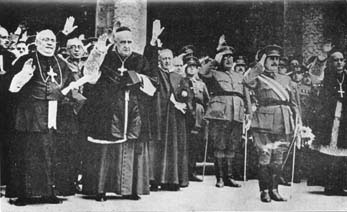
In September 2008, Garzón started to investigate Franco-era killings. He accepted petitions from families, grouped together in Historical Memory societies, who wanted to find the remains of their loved ones and clarify the circumstances of their deaths. As a result of his investigations Garzón accused Franco and 44 former generals and ministers, plus 10 members of the Falange, of crimes against humanity. He demanded the opening of dozens of mass graves where over 100,000 of their victims were summarily shot and buried. Garzón also raised the case of the forced separation, mainly by the Falange’s Foreign Service, of an estimated 30,000 children from their parents, usually political opponents of the regime. He pointed out that the Spanish courts had never carried out a criminal investigation into any of these crimes and not a single perpetrator had been brought to justice.

Garzón was forced to drop these charges after lawyers appointed by the PSOE challenged his authority to pursue the investigation. They argued that Garzón had breached a 1977 law granting amnesty for atrocities passed as part of the so-called “peaceful transition to democracy” following Franco’s death in 1975.

The PSOE’s action demonstrates the Spanish government’s capitulation to pressure from the Popular Party opposition, the Catholic Church and the media. Encouraged by its actions, two proto fascist organisations, Manos Limpias (Clean Hands) and Libertad e Identidad (Freedom and Identity), have launched a petition for Garzón’s prosecution on charges of “corruption in the performance of his functions”

This charge was accepted by the courts. If indicted, Garzón would be immediately suspended pending trial.

The action against Garzón is a clear sign that the Spanish ruling elite is determined to intimidate anyone who attempts to question the “pact of silence” about Francoist crimes agreed by the right wing, the PSOE and Communist Party (PCE) during the transition. Many of today’s ruling elite and top officials, including those in the court that indicted Garzón, are direct heirs of the Franco regime.

Posted by: puebloman | March 15, 2010

Viva Siesta!

Exploring the possibilities for "Siesta" on Nerja beach

The following report was carried in “Typically Spanish” 14th March

Following the intention of Esperanza Aguirre, the Partido Popular regional President of Madrid, to have bullfighting declared as a BIC Item of Cultural Interest, in order to block moves who want to ban the spectacle, now comes the suggestion that the Spanish Siesta should also be declared to be of cultural interest.

The idea comes from Daniel Dorado, a lawyer who specialises in the protection of animals. He has now presented an application in the registry of the Madrid Regional Government calling for the siesta to be declared a BIC, Item of Cultural Interest, considering it meets the same conditions for being so, as bullfighting.

In his arguments he says that the siesta is ‘a cultural fact of special relevance and significance, an art which deserves protection’. Following the claims made for bullfighting to the word he said ‘it has been for time immemorial part of Spanish culture’.

Nobel prize winning author, José Cela, described it as ‘Iberian yoga’ and said it should be carried out with pyjamas, the lord’s prayer and a urinal. The art was followed by figures such as Albert Einstein and Winston Churchill.

Daniel Dorado continues that unfortunately the siesta is threatened by our hectic way of life, and he claims that if it disappears the country will fall into chaos. He therefore considers the Madrid regional government is under the obligation to protect it by, for example, the installation of beds in the street.

Read more: http://www.typicallyspanish.com/news/publish/article_25415.shtml#ixzz0iHS4YjDC

Posted by: puebloman | March 13, 2010

A history of Cútar in Objects: 4 The Fountain of Paradise

The word Cútar is said to come from the Arab word “Kautzar”, which means “The Fountain of Paradise”. Here it is:

Arab fountain and date palm

The fountain is the only surviving Arab fountain of its kind in the Province of Malaga. It is to be found at the entrance of the pueblo. Beautiful and understated, it is set off by two mature date palms. It has been restored and is carefully maintained by the village.

Behind the fountain, stone steps give way to a ricketty wooden staircase that winds up under the road that curls over it across an ancient bridge that fords a little gorge.

The elderly population of the village remember fetching water from it in their youth, and still do at times. Beatrice, who runs the village “farmacia” says the water is no longer drinkable because of the chemicals that are put on the fruit trees above. The hills are not high enough to filter out the pollution.

Nevertheless the fountain stands as a beautful object and a testimant to the benign rule of Islam. The village is developing arab gardens on the surrounding land to contextualise the fountain.

See more at www.vivasiesta.com

Posted by: puebloman | March 8, 2010

Occasional Diary 2

From www.vivasiesta.com Wednesday 3rd March

I am in the car by nine having had the exact same conversation I have with the neighbours every Wednesday

Where you going? Almachar?

No I’m going to school to learn Spanish. Haven’t done my homework!

Ha! He’s got homework! (hilarity) You don’t need to go to school – you can speak to us!

You don’t speak Spanish!

That’s right we don’t! We speak Andaluce! Don’t  learn from us, no one else will understand you (hilarity)

I’m in the car on my own. Judy is doing a course in Raku pottery with a wonderful group of Swedish potters who have come to Cutar to experiment with glazes.

Apparently you biscuit fire your clay, then you get a metal oil drum with the top cut off and a hole punched in it. You put in your pots – painted – and then fire them with a huge propane flamethrower that spirals a flame round the drum. Then when they’re quite black, you chuck them in cold water stuffed with straw and/or olive leaves. Then you spend ages cleaning them . . .

The weather forecast is, as always, wrong. Catching on to the fact that it’s rained continually since mid December, rain was forecast. It is, au contraire, a beautiful day as I drive away to Velez-Malaga.

It is like a bright breath of spring in a long miserable wash of seemingly endless drizzle, and springtime is characterised by the glorious Bermuda Buttercup that streams down the hills in its hundreds of thousands at this time of year. The Bermuda Buttercup behaves like a sulking cowslip in dull weather. It hangs its head and folds its petals and disappears from the landscape, which reverts to miriad variations of olive green. When the sun comes out the buttercup lifts up its face to the sky and the landscape streams with yellow. The white almond blossom, the flowers of winter, is starting to go over, but the blossom still hangs on the landscape like frost.

I look down to my left where the land falls almost sheer three or four hundred metres to the river bed. Usually dry as a bone and used as a highway or carpark, today the bed actually has a river in it – a twisted ribbon of boiling mud. In two places water has washed away the soil from under the twisting mountain road. The macadam has collapsed making the ride  momentarily eventful. Other events include boulders in the road, helpfully indicated by extemporary exclamation mark road signs. There are also mud slurries and falling trees (mercifully small, in these parts no tree is allowed to be taller than a Spaniard).

9.45 A breakfast of “Pan con tomate” – macerated tomato on a lightly toasted split roll with salt and oil on the side, plus cafe con leche. Absolutely delicious

10am There is a new person in our class, so we start by introducing ourselves again. Each time the challenge is to find a different way to do it. Or even to remember something that might distinguish you from the sludge of humanity around you.

We then revisit the subjunctive. Certain words and phrases throw one inevitably into the arms of the subjunctive. We were all given phrases and asked to talk for a minute on a subject given by the teacher. I get phrases like “It is possible”, “Most probably” and “It may be so” and am asked to extemporise on the subject “Is there life after death?”. My views on this subject are clear and very strong. Unfortunately I don’t know the Spanish for “superstition” “mendacious falsehood” or “lying priests”. To my horror I find myself meditating on the “possibility” that a spark of God resides in all of us and that “it is probable” that they return when we die to the eternal light . .

12am As I set off in the car to raid Lidles for 2€ chicken carcasses and cut priced red wine, I reflect on the possibility that I have been linguistically tricked into Catholic chat . . .

Posted by: puebloman | February 24, 2010

Recipe: Potage of spring vegetables, Andalucian style

The English word “potage” is the same word in Spanish. It means “substantial soup”, halfway between a soup and a stew. Here in the Axarquia it usually means a stew of beans or garbanzos (chick peas) mixed with unmentionable bits of pig and black pudding. If there is a vegetable in it, it’s usually cabbage. The dish is invariably delicious, delicately spiced, filling . . y muy economico . . .

Last week I ate a soup in Bar Andalucia in the town  of Velez Malaga. It was called “asparagus soup”. Rough, lumpy and lovely.

This potage uses the greens that are coming onto the market now in the Axarquia. At the moment they are forced, but in my garden I have several types of lettuce greens and beans that will be available in a couple of weeks. At the moment in the markets we have wild (thin) asparagus, artichokes, broad beans, potatoes and lettuce. At some point add a big knob of butter. Butter is French, not Andalucian, but it tastes good!

ingredients for 4

1 kilo broad beans, shucked.

8 small spanish artichokes, peeled and cut in quarters.

2 spanish onions or a bunch of “cebollitas”. Stripped.

Some good sliced bread and some strong flavoured olive oil

3 cloves garlic, skinned mashed and pulped to a paste with salt.

Bunch of thin asparagus, the “woody” part cut off.

1 lettuce chopped small.

2 handfuls rocket or watercress chopped small.

one and a half litres veg stock (your own or water with 6 teaspoons of Marigold bouillon stock powder).

4 good fresh eggs.

Bunch of flat parsley, chopped small.

Method

1 Dissolve the stock in  the water.

2 Finely chop the onion and stew in olive oil on a low heat til it goes gooey and golden.

3 Meanwhile make the croutons in the oven. Heat oil in a roasting pan with a crushed clove of garlic, put in crustless squares of good bread. Cook til golden and turn. When done, drain on kitchen roll.

4 Mix the garlic with the onion in the pan. Cook a couple of minutes. Heat the stock and pour over the onions and garlic. . . . .liquidise.

5 Bring to a slow simmer and add the asparagus chopped into 3 cm lengths and the artichokes chopped into four. Simmer for fifteen minutes until almost tender.

6 Add the lettuce and rocket or watercress and bubble for a couple of minutes, add the beans and poach the eggs in the soup for four or five minutes.

7. Serve the potage, each dish with a poached egg and croutons scattered over. Finish with the parsley.


« Newer Posts - Older Posts »

Categories

Follow

Get every new post delivered to your Inbox.