Posted by: puebloman | October 15, 2009

Ace restaraunt

I am going to share with you the well kept secret of one of the best restaraunts in the Axarquia. Its called “El Acebuchal” and it’s in the village of that name, between the villages of Frigliana and Competa. the village was decimated by Franco because it was a centre for the resistance under the dictatorship. The villagers were turned out of their homes to fend for themselves and the village rendered uninhabitable by the police.

A few years ago the son and grandson of one of the families revisited the village and began to renovate the buildings. “El Acebuchal” is part of that project.

The food can best be described as “slow”. It consists of a selection of slow cooked casseroles. It features chicken, rabbit and lamb, plus locally sourced game – typically red legged partridge and wild boar. Potatoes are slow braised. There are also locally sourced vegetables in season, slow cooked and delicious. The spicing is Moorish. Saffron, mint, cumin and garlic, the stock thickened with almond.

We took our son Stan there. Stan is a French trained chef. Stan and I had the “Jalabi” (wild boar). We were served with a huge plate each, which we could hardly eat. Flavoured with cumin, saffron and garlic and thickened with ground almonds it was delicious. The spicy heat was black pepper rather than paprika – an authentic moorish touch. We could have shared a single plate.  Judy had the lamb. It was lamb scrag, spiced with fresh mint garlic and saffron and thickened with almonds. We ordered a side dish of potatoes, slow cooked with onions, in water olive oil and garlic in the oven. Superb. We had the vegetable of the day – pumpkin, similarly spiced and slow cooked, and a huge portion. We would have followed up with some fresh fig ice cream, but the waiter cum maitre d’hote cum chef had to whip down to the coast to the bar that actually makes money, where he was due to do a shift.

The El Acebuchal is open 1pm to 4pm every day except Monday. Go there. Its a couple of miles down a dirt track. You think you are lost. You aren’t. You are heading in the direction of a great meal. For clear directions see http://www.elacebuchal.es or info@elacebuchal.es. GO TODAY! (unless its Monday!)

Posted by: puebloman | September 17, 2009

Grapes of wrath

The recent weather has totally buggerd the lives of the grape growers (everyone) here. One or two heavy showers a day keep everyone on their toes. The canvas “tents” that protect the drying grapes from rain also sheild them from the sun and prevent them from drying. Whole families pull the canvas over for the cloudburst and pull it back for the sunny spell. This is supposed to be a lucrative hobby. You can’t make a living growing and drying grapes. Even moscatels.

Mercifully we only have “dessert” grapes. We have no “moscatel” and are not therefore shamed into pretending to dry ours. After all, who wants twenty stone of raisins all full of pips?  Dessert grapes are incredibly sweet but flavourless compared to the moscatel and I have been planting grape rootstocks and trying moscatel grafts with little success.

The hot air that feels like a fan assisted oven in August has given way, under pressure from the cloudbursts, to a cool damp atmosphere – something more suited for humans to live in.

I examin our vines – which are now so laden with grapes that they have broken the frames they hang on. We can neither eat them(I am diabetic and Judy doesn’t touch fruit), sell them (they are too stringy) or give them away (everyone’s got too many stringy dessert grapes).

I now find that they are starting to take on mould. It seems that as soon as the climate threatens to support sentient existence, every bit of low-life spoor gets its filaments into your fruit.

The triumph of autumn is the asparagas. We couldn’t get any crowns here. Assistants at the Spanish garden centres said ” why do you want to buy aparagas? It grows all over the campo. When it rains, go out and pick it”

We had to buy crowns  at B&Q – an English hardware chain store. We planted them, they grew and seemed to have been burned to death in August. However, with the first autumn rains they have shot green shoots everywhere and were clearly lying doggo – only pretending to be dead.

I am expecting to have to fight off the locals . . .

Posted by: puebloman | September 9, 2009

In the (garlic) soup

045I am back in Cutar after a fine “Ajo Blanco”. Jude decorated the wall below our house with photographs of past fiestas and Paul and I sang Lorca in Spanish to bemused passers by.  Almachar’s top plaza is decked out as a market place/disco/bonfire area. Pasas (raisins) higos (dried figs) and the two local wines – “Dama de la Vina”, sweet moscatel wine and “Pasera”, wine made from moscatel raisins. Crisps are fried. Plastic toys in lurid yellow pink and green, festoon makeshift stalls. A fiesta route is designated all around and through the village and there are stations all along the route where everyone can enjoy a “degustacion” (sampling) of wine, grapes and ajo blanco. The music of the afternoon is the “Verdiales”, the folk music of the Velez-Malaga area, whose finest musicians are based in Comares.

The singing, due to begin at 9pm started prompt at 10pm. We were shocked to see a substantial part of the audience walk out when Paco Jimenez and Ana Fargas came on. Later we were told that they all had to run out to the fields to cover their pasas (drying raisins) because the old boys had forecast a cloudburst that night. Unlike the weather forecast, the old boys are invariably right and we had a cloudburst around 1 am. For those who missed the show, here is Ana in her full glory:

Posted by: puebloman | September 2, 2009

The Blues – southern style

We are approaching the season of autumn festivals, often celebrating aspects of harvest and food. Almachar’s “Ajo Blanco” refers to the white gazpacho soup made from ground almonds, bread, garlic and grapes. It is one of a multitude of examples of the way in which the moslem tradition remains ebedded in modern andalucian culture. Ajo Blanco is a fiesta of traditions. Almachar prides itself on its Flamenco traditions. There is dancing all day and singing all night. The song is the gypsy Cante, called cante Jondo or “Deep song”. It is Andalucians equivalent to “The Blues”

I suggest the family of the genius flamenco guitarist Paco Javier Jimeno get you in the mood. Here Paco is with his brother David Jimeno and his wife, the incomparable Ana Fargas. They top the bill at the 2009 Ajo Blanco

Posted by: puebloman | September 1, 2009

A cock and bull story. . .

cock fight
cock fight

Cock fighting was outlawed in England in 1849 , at a time when the British authorities felt more kindly disposed towards chickens then they did towards people (bare knuckle fighting was still allowed). Today in England a fighting cock is a show bird – big, well muscled, beautiful plumage and a good meal. So I was astonished to discover while surfing the net  that “VélezMálaga is one of the last places in Europe where public cockfighting is conducted”. Velez Malaga is down the road from us – our nearest town. This statement appears on several sites, but the fact that all the statements use an identical form of words suggests a certain amount of lazy cutting and pasting from from one unverified source. In fact the statement is bullshit. Cock fighting is illegal throughout Spain. There is no cockpit in Velez Malaga and no Sunday cockfighting. Not officially anyway.

The Spanish government recently confused animal rights campaigners by supporting bullfighting while at the same time extending legal rights to the great apes, in what is thought to be the first time a national legislature has granted such rights to animals. Critics of the government point out that Spain in fact has no great apes, and that their so called “rights” don’t extend to being released from zoos (to whence? you may ask). Professor Roger Scruton has pointed out that rights are intrinsically bound up with responsibility and since animals can have no responsibilies, they can have no counterbalancing rights.

The domestic chicken did not come into being from man’s need for eggs, or even meat. The chicken was originally bred from the Indian jungle fowl for its aggression – as a fighter. It was in fact a sacred animal. As was the bull. I say this not to sentimentalise blood sports – I don’t especially care for blood sports. However, any meat eater who sits on a moral high horse should get out a bit more and, for example, spend a day in a slaughterhouse. There, the stench of fear shit and blood, the screaming of terrified animals queueing up to be stunned, to have their throats cut or have a bolt shot through their brain, would make any sentient being yearn for the cockpit or the bull ring.

Animals selected for fighting rather than slaughter are carefully and humanely reared in the best possible setting with the best possible food and shelter. They are at their absolute physical peak when they go to the ring. When the time comes for them to die, they are not subjected to a process of degradation. The fact is, killing animals, however you do it, isn’t very nice.

The bullfighter Frank Evans “El Ingles”, who at 67 years of age staged an elegant comeback yesterday by killing two bulls at Benamaldena bullring sporting a titanium knee and a quadruple heart bypass, has little time for those who think bullfighting is unfair or cruel.

Frank from Salford

Frank from Salford

“Generally they come from sheltered backgrounds” He says “They’ve never seen an animal die”

As usual unimaginative politicians are passing laws and “jobsworth” beaurocrats issueing edicts which bear no relationship to the everyday experience of ordinary people and do not command their respect. The big political issue is this: there are two blood sports in Spain. Cock fighting is as intrinsically Spanish as is Bullfighting. Yet one, the poor man’s sport has been banned, and the other, the sport of the wealthy, is tolerated.

Disused Cockpit, Mallorca

Disused Cockpit, Mallorca

I go to the village bar late at night. As always, no one is there and the family who run the bar – Paco and Marisol, Moses their son and Antonio who is Paco’s dad, are sitting out under the stars wondering whether to shut up shop.

Me: Antonio, do you know if there are cockfights in Velez?

Antonio: Of course there are. Do you want to go to a cockfight?

Marisol: No there aren’t any cock fights

Antonio: My grandson breeds fighting cocks

Moses: That’s right and they’re all called “Ingleses” all the different types of fighting birds (he laughs)

Marisol: (crossing her arms) I said there aren’t any fights. Its illegal

Me: Because I saw on the internet that there are fights on Sundays

Antonio: Every Sunday, that’s right. Do you want to go?

Marisol: It’s against the law. We don’t do it

Me; A lot of people round here seem to be breeding fighting cocks. . .

Antonio: That’s right, I’ve got some

Moses: Its illegal. But it’s done, everyone does it, but its against the law. If you get caught – whoa! Big fines. But you don’t get caught. Its “costumbre”. . . .


Posted by: puebloman | August 29, 2009

Poetry is a smoking gun . . .

When we came to Spain we were given some CD’s by our friend Paul Griffiths , the well known carpenter and Hispanophile. Paul is presently living on a remote island near the arctic circle where his partner, who was once briefly a midwife there, is now worshipped as a fertility goddess by the incredibly small gene pool that makes up the island’s community. When he left the UK, we gave Paul a copy of “The Wicker man”, which seems to have left him unaccountably nervous.

paul, nervous

paul, nervous

The discs Paul gave us were the songs of Paco Ibáñez, who makes songs from Spanish poetry. Because of the directness and simplicity of the poetic language, the clarity of Ibáñez’ diction and his powerful communication skills, his songs are a perfect introduction to the the musicality of the Spanish language, also its beauty and its fondness for the subjunctive, without which all outcomes would be certain and life would not be worth living. As a tribute to Ibáñez, and because I can’t find much on Google in English  that makes sense – even in Wikipedia – here is a monograph on him.

Paco Ibáñez

paco ibBorn in Valency in 1934, Ibáñez, (Francisco Ibáñez Gorostidi) spent the early years of his childhood caught up in the turmoil of the Civil War. He spent his early yers in Barcelona and is therefore sometimes referred to as a ‘Catalan’ singer. His mother was from the Basque country, so he is sometimes referred to as a ‘Basque’ singer.  He is both, and many other types of singer besides. His father was a carpenter and an Anarchist, so the family quickly found itself in exile in France as the fascists tightened their grip on Spain.

In 1952 he began to study the guitar. He enrolled on to courses at the Scola Cantorum in the Latin quarter of Paris, where he met and studied under the classical guitarist Andrés Segovia.

He read poetry and especialy the satirical works of Brassens, whom he still considers to be his master and mentor. He began to devote himself to communicating Spanish poetry through song. His first album in 1964 consisted of Spanish poetry set to his music, half them by Góngora, a contemporary of Shakespeare, and half by Garcia Lorca the twentieth century poet murderd by Granadian fascists in 1936. The work was illustrated by Salvador Dalí, the well known fascist. The album was in its time a radical work, and when it came out, the record was seen as an assault on traditional notions of “Spanish song”.

In 1967 he returned to to sing publicly in Spain  for the first time, during a brief lull in censorship under the dictatorship. He was able to give recitals in Madrid and Barcelona. While in Paris Ibáñez had developed a highly individual style – classical and flamenco guitar technique applied to the poetry of Spain in the context of the Parisian “chanson” – the popular song as part of the cafe culture of the streets. Although the didactic political song was never part of Paco Ibáñez’ repertoire, his choice of material, invariably that of Spanish poets persecuted by fascists, and his championing of poetry as an essential to the collective human spirit, bought him into conflict with the dictatorship. He performed, for example, the poem “Andaluces de Jaén” by Miguel Hernández on television. The poem praises the olive workers of Jaen and the miracle of the olive, and is in the tradition of Spanish pastoral poetry. It was however a highly controversial performance, because Hernandez had died in one of Franco’s concentration camps in 1942 and was one of the poets whose work was banned under the dictatorship. The same can be said for his rendition of Celaya’s poem that ponderously translates “Poetry is a weapon loaded with the future”, which confronted the dictatorship not with political opposition, but with a simple philospophy inimical to it.

In 1969, Ibáñez set Rafael Alberti’s poem “At the Gallop”. Alberti had been in exile in Argentina since 1939 and was another proscribed poet. The song was a fantastically successful “hit” for Ibáñez, and made him a symbol of the struggle against the pro-Franco dictatorship. Ibáñez was able to perform his song with Alberti reading his poem at the Alcala in Madrid in 1991.

In 1969 Ibáñez returned to France to with a triumphant concert at the Olympia, Paris. For the first time the programme included his Spanish (Castilian) translations of Brassens. A double album was made of the live recording. In 1970 in Paris, he met Pablo Neruda  the Chilean Nobel laureate, whose poetry he had set to music. Neruda was the Chilean ambassador to Spain during the fall of Madrid. He was a friend of Lorca.  On hearing his poems sung Neruda said “You have to sing my poems, your voice is made to sing my poetry …”.

Paco Ibáñez was able to remain in Spain until 1971, but returned again to France then, partly as the result of pressure from the Franco administration. He was considered to be one of the most openly critical of the resident dissidents of that time.Paco

Nineteen seventy three could be said to have been the pinnacle of  Paco Ibáñez’ carreer, when he was prohibited from performing throughout  the whole of Spain by “la Dirección General de la Seguridad”.  By including Paco Ibáñez in its list of prohibited artists, the Franco government entered his name onto a role of honour that included the flower and glory of contemporary Spanish artists all murdered, exiled or otherwise persecuted.

Since Franco’s death and the establishment of democracy in Spain, Ibáñez’ work has has continued to increase in availability and popularity. At seventy seven years of age he continues to perform in great stadia and on the streets, a living reproach to those fascist ideas that survived the second world war and are furtively maintained in Spain and elsewhere today.

Posted by: puebloman | August 23, 2009

Getting my goat

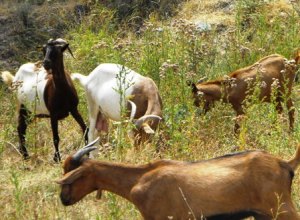
I sit in the silence of a summer evening, a silence punctuated only by the gentle farting of goats.

Our neighbour Antonio uses every spare space in the village to rear animals. Last year a building site, secured by plastic and bedsteads was given over to a gang of terrifying Xmas turkeys who sat on the roof and screamed at passers by. A little disused garden became home to a race of fighting cocks, an old stable became a warren of ‘campo’ rabbits. Last year three baby ostriches appeared in what had been the pony’s pen. They emerged each morning to spin round in wild fandagoes and dervish dances until they in their turn mysteriously disappeared. So now it’s goats, and Antonio’s herd has grown to about half a dozen from a single nanny and her kid.

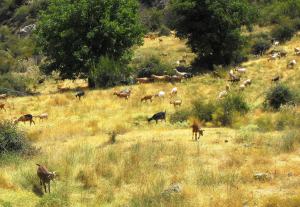
Every pueblo has its own huge herd of goats each with its designated goatherd.

Grazing goats

Grazing goats

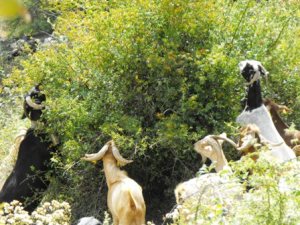
During the spring and autumn months the goats are run along the mountain roads to get a bite of fresh herbage. The trouble is, they will and do eat more or less anything they come across. Our neighbour Antonio feeds mango leaves to his with apparently no ill effects, though I have been burned more than once by the sap. No wonder they fart.

Goats will eat anything

Goats will eat anything

I feel indulgent towards goats in spite of their many stomachs because I’m acutely aware of a severe shortage of local goat meat. I find myself eyeing them up as stew and there is nothing so delicious as stewed elderly goat. Goats here are kept for thier milk, which is widely available straight from the udder. A delicious clean tasting cheese is produce that you can get ‘fresh’ or ‘cured’.

The present shortage of meat is due to the exeptional productivity this year – the result of exeptional rainfall. Adult goats that yield no or insufficient milk are slaughtered and sold as meat. On a Friday evening a couple are taken to a local butcher who cuts their throats and prepares them for sale the following morning. Unfortunately the butcher is often drunk and his skills are therefore not consistently available. I used to get a whole leg on a Saturday morning, sometimes two – but I quickly learned the protocol – not to take more than my share – a leg joint, a shoulder, a rack of ribs. The long queue of mujers will comment if you take too much. This meat is quite different from young billy goat meat.  Billys are slaughtered young, as is most commercial meat but nannys are slaughtered at the end of their productive life, life an old hen.

The meat of a mature goat (“mutton” goat) produces absolutely delicious daubes and stews. There is not a single part of the animal that isn’t tough as hell though the meat looks dark and red like well hung beef. In fact it is best treated like forequarter of beef. The fat should be painstakingly cut off and thrown away, unless you want to dubbin your boots with it. Cooked, it will taint the dish. Without it, the dish is entirely free from the classic goat “tang”. To enjoy this meat, any joint will do – the cheaper, the more work to prepare. Leg is easiest but tends to dryness. You need a kilo and a half of meat for four (buy more to ruthlessly discard fat and other tissue), half a dozen carrots, four big sweet Spanish onions, three sticks of celery, three cloves of garlic, half a preserved lemon, fresh chili, a spring of fresh bay and a bunch of fresh rosemary. Salt and pepper. Stock

1. Cut the meat into chunks and brown in a heavy skillet (brown, not grey!)
2. Tip this into your stew pot or slow cooker, add a splash of olive oil (not extra virgin!) to your pan and fry the chopped up onion and carrot til the onion is soft. Add the garlic, crushed with salt, at the end so as not to burn it. Add the celery, finely chopped, at the same time.
3. Stir this into the meat, adding the bay and rosemary. Strip out and discard the pulp of the lemon and cut the skin into thin strips. Add this.
4. Boil enough water to nearly cover this mixture. Add good quality stock powder (marigold is the best) until the flavour is strong and not too salty. Or make your own stock of course. Add to the meat and veg.

5. Cook at a slow simmer – a slow cooker is perfect, for up two hours, or until you can cut the meat with a spoon

6. Strain off the liquid and add a tiny amout of chili. You want to feel a little heat without it destroying or competing with the other flavours. Boil the liquid hard to reduce it by two thirds or until it starts to coat if you pour a little onto the meat. Taste it all the time for chili-heat and seasoning. If you’ve made it too hot, drop in a whole peeled potatoe to take out the heat. When the liquid is a rich and dark sauce pour it over the meat and veg. Warm through

7. Ladle  it onto a heap of saffron rice

8. Motto: Eat them before they eat us!

Goats eating Andalucia. Eat them before they eat us!

Goats eating Andalucia. Eat them before they eat us!

Posted by: puebloman | August 20, 2009

St Roque rocks – nights of fire

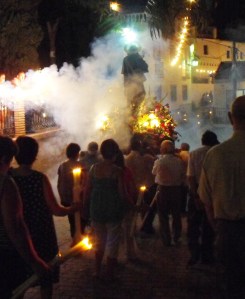
Entry of San Roc into Cutar If you want to be God Almighty in an Andalucian village you’d better get off your backside and do something for the community. Only local Gods are worshipped here – the many goddess manifestations of the Virgin, the multidudinous versions of Jesus and of course local gods, protectors of specific villages who are pacified and won over by the people of the pueblo who honour and make sacrifice to them. This panoply of gods and goddesses feels more like the society of classical Greek Gods who fought with each other and whose women renewed their virginity in the sea, than it is of the distant rituals of the church of Rome. The virginAnd this in the most Catholic of countries! Milton, writing in the seventeenth century observed that, while God Almighty might be perfect, he’s not much good as a mate to have a drink with, and to tell your troubles to (I paraphrase Milton). Anthony Beavour (The Spanish Civil War) shocks us with the statistic that at the start of the Civil War less than 5% of Spaniards attended church – a lower proportion than in Norway. Franco of course changed all that by force. That the Catholic Church has historically stood for the opression of poor people is not lost on Andalucians. You will not find a single picture of the Pope in the Axarquia.

Local Gods, however, have earned their place in the village church. Almachar’s Santo Cristo de la bande verde saved his pueblo from an earthquake. Cutar’s San Roque saved Cutar from the plague. That is why women continue to lavish care upon their images and deck them with flowers, and why their men bear them through the village in thrones set on great hurdles and why the village designates them feast days. They represent the puelbo itself and this is a tradition of Roman culture , itself derived from classical Greece, whose communities were always protected by local gods.

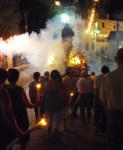
Cutar’s mid summer Fiera is in honour of St Roque. It begins with a series of exploding “bomb” rockets. In defiance of northern namby-pamby health and safetyitis, a man holds a rocket in his right hand, lights the touch paper with his fag and waits until redhot flaming sulphur spirts all over his hand until releasing it. These rockets regularly set fire to the opposite hill where the scrub is dry as tinder, so instead of banning the activity, the local fire brigade and red cross stand by in expectation.

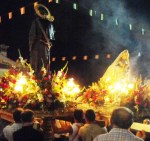
After dark as a prelude to a three night orgy of noisy partying, paella and wierd musical and other acts on the improvised stage in the car park, San Roque, looking suspiciously like Jesus, is taken from the church on his “trono” (throne). So is a verson of the virgin. They are paraded round the village to hand held candles and Roman candles, the men bearing the saint and the women the virgin. The two groups meet outside the church, where they perform a stately “Okey Cokey”, a sort of ritualised mating dance though I’m sure that mating is the last thing on their minds.

No one knows why they do this. The procession, punctuated with the cry “Viva St Roque” as a sort of football chant, finishes with the same motto lit in fire. A rare and truely pagan night.

Posted by: puebloman | August 11, 2009

Funky chicken

Thank God bird ‘flu turned out to be one of nature’s little bluffs. The idea of quarantining chickens in a place like this, where everyone lives cheek by coxcomb, is ridiculous. Once we went to tea (sic) in a Spanish neighbour’s immaculate parlour. Feeling our feet being pecked we looked under the tablecloth to discover a hen sitting on a wooden crate with six chicks under her. People in the villages live like this – all mixed up with their animals, and it’s not unusual to find the whole of the lower floor of a house given over to livestock.

I’ve been holding off getting poultry, not wishing to have to slaughter them if they catch cold. Not that the Spanish government cared much. They watched the Britsh in a mad panic running around like, well headless chickens, and explained that they are taking no measures or precautions because there is nothing to worry about. They did this because they wanted to keep hold of their supply of ordinary ‘flu vaccine, which was used up in the UK by a panicking population, though everyone knows perfectly well that ordinary vaccine is useless against ‘flu mutations. Ordinary ‘flu kills an unreported 20,000 people each and every year in the UK alone. Well, thank goodness we’ve now moved on to swine flue, which is a great comfort to us because even Spaniards don’t keep swine under their dining tables. At least I haven’t met one who does. Yet.

Freed from the fear of pandemics I have permitted my thoughts to turn once again to supplementing our patch of fruit trees, chard, cabbage, tomatoes etc., with meat. I have this fantasy that Jude and I shall become pseudo self-sufficient. Our meagre diet would be supplemented of course (by means of hard cash) with serrano ham, manchego cheese, balsamic vinegar, chocolate, tea, coffee, cream . .all essential to the modern larder. When world food prices rocket, as they are set to in the next few years (and here the fantasy gets a bit hazy) . . .we would already be growing our own wholesome, ethical and affordable food! We would, in some vauge way, barter figs and bits of chicken for cash commodities such as salt and flour. Huge numbers of starving people would presumably come from elsewhere in Europe and Africa to stand round our bit of land, congratulating us on our foresight and wishing that they too had thought of doing what we are doing. . . . .

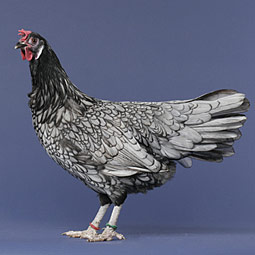
My research into animal husbandry has so far have brought me face to face with the magnificent “Andalucian Blue” chicken – a prolific egg layer, flighty yet able to withstand the hot and punishing climate of southern Spain. “Blue”, as is usual in blue animals, refers to their steely grey colour. The colour is recessive, so a pair of “blue” adults will produce 25% each of whites and blacks the the actual dominant colours for the Andalucian blue. Unfortunately the Andalucian has been bred so as not to be able to sit on its own eggs, so you need a “broody” mongrel chicken to follow it around. Hopefully the mongrel’s desire to sit on eggs would somehow correspond with Andalucian’s desire to lay them. . . . Mmm.

Studio_BluAndlsnHn_5316_M

How fascinating that this chicken in fact contributed to Medel’s studies of recessive genes!

Armed with this information, I took off to the agricultural supplies warehouse in Velez-Malaga, to engage a professional in my quest for suitable poultry stock. I hung around a cage crammed with yellow chicks until the manager passed by.
“What are those birds?” I enquired.
“They’re chickens” he replied wearily, throwing a look to the Saturday help, who sat slumped and bored on a pile of sacks. The Saturday help made a sucking noise, the meaning of which I didn’t understand, though I took it to be less than complimentary.
“Ah yes” I rejoined ” But what sort of chicken? What race of chicken, what pedigree? Are they fit for egg production, or meat production or are they, as we poultry farmers have it, “dual purpose?”.
“Look” said the manager, summoning up all of his patience ” These here are hens. Hens lay eggs. Understand? These in here (he indicated a second cage) are cocks. Cocks are for meat. Got that?” He cast a look to the Saturday help. “He thought those geese were ducks” said the Saturday help, indicating a third cage, and slowly picking his nose.

Posted by: puebloman | August 9, 2009

August is the cruellest month . . .

We are sailing into August, the month of heat and dust. Andalucia’s winter. It’s a hot winter in which nothing can grow. The toughest perennial weeds shrivel up. The damage that ice does in England is done here by dust. Your brakes start to squeal as the heat kicks in. Jude and I move the bed out onto the terrace and drape a huge net over it so that we aren’t eaten alive by flies. Ants take the place of worms here in the south but are infinitely more agile. They encrust anything edible.

Mangoes and grape ripen their fruit now and are miracles of nature. How does the fruit swell without water? Only through unimaginably long tap roots that together bind the crumbling rock, and hold up the very hills. The caulk around the almonds has split. The crop is ready. It has to be harvested before there’s any hint of dampness in the air or the caulk will close and stick to the nut and you’ll break your fingernails trying to peel it off.

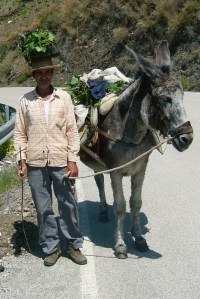
The muscotels are almost ripe. Muscotels and mango are your two chances to get money from fruit. Grapes hang from the vines without benefit of wires. The hills are so steep the grapes hang free in the air. Everything here has to be done by hand, so you lead your donkey where no machinery can go. You pick your grape and pack bunches into little wooden crates on the donkey’s back, each lined and covered in vine leaves, just like the Romans used to do. Then you trek your donkey, load at a time, to your raisin beds. It’s 40 degrees and a thermometer left in the sun will explode.

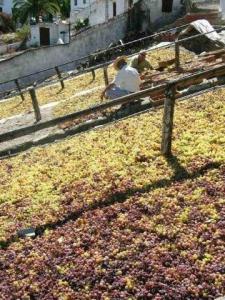
Raisin beds are a feature of the Andalucian landscape. A series of little white concrete triangles top lozenges of carefully cleaned bare earth. The grapes are placed directly onto the earth and turned every day by hand for two weeks to a month, depending on the weather. They turn yellow, then gold, then bronze, then deep brown, and so does the entire landscape. You have tens of metres of canvas piled at the top of the beds. If there is even the smell of rain, the whole family charges down to the beds and pulls the canvas over the little white triangles to make tents over the drying grapes. A spot of water on the drying raisins, and its a year’s work down the drain.

grape drying in cutar

When the raisins are ready, bring out the poor old donkey (and yourself) one more time into the blistering heat and load him up as before. Take him and the raisins to the biggest garage your family has, and your family will be waiting for you – your sons and daughters, their children, cousins, aunts and uncles, sitting between the spare donkey, the dogs and caged partridges kept for the winter hunting and a few singing goldfinches. Everyone has a set of clippers and as they begin to clip the raisins from the vines a chorus of sound arises like the patter of autumn rain. It goes on for a fourtnight.

The raisins are clipped and graded. The very best are left in shrunken bunches for “best”. Some are put aside for the rich brown wine called “pasero”. The sweet luscious wine made from fresh muscotels is called “Dama de la Vina”. This stuff is drunk as a passing pleasure like sherry, not with food. Raisins retail at around 10€ a kilo, and “Dama” is 6€ for a 2 litre jug so no one gets rich. The whole of the operation is directed by the over 70’s, so when they die, so does this sort of summer.

Man and donkey with their dinner

« Newer Posts - Older Posts »

Categories