Fans of this blog will have noticed that it has been lying fallow for some time. the truth is, I haven’t been able to do anthing at all because all my time’s been taken up trying to obtain an Andalucian fishing licence.
The process of getting a licence in Andalucia (all the regions of Spain have different rules), says quite a lot about Spanish administration and the rule of law. In Andalucia, you need a licence to fish in the sea – one to fish from the shore and a different one to fish from a boat. However, it’s freshwater fishing that really gives you a headache. Aliens like myself could be forgiven for thinking that the rules were made up at the department of the environment not by fishermen or even by sportsmen but by whey faced beaurocrats with nothing to do but bugger up the tourist industry.
In the first place they make no distinction between hunting and fishing so fishing for minnows in a stream is treated exactly the same as striding through the scrub with a double barrelled shotgun blasting away at wild boar. Consequently, to go fishing you need personal liability insurance, presumably in case you maim or slaughter people with your bobble float.
A fishing licence, like a hunting licence, requires you to have passed an examination not unlike the written part of a driving test. It is in a number of sections, takes 40 days to mark, and you can pay to go on a course and to buy sample test papers to maximise your chance of passing, but don’t expect to simply pick up a licence for a weeks holiday fishing. And don’t expect to be asked sensible questions either. Questions like “how do you cleanly and safely remove a hook from a fishes mouth” or “what are the advantages of returning fish to the water” are not allowed. Instead questions like “How are the waters in the lower depths of reservoirs oxygenated?” Suggest that the they are compiled by a team hand picked from the Saturday help, non of whom have ever gone fishing. Or anywhere.
Once you have passed your examinations, been taken out by your family to a celebration dinner, hired an insurance agent to obtain your comprehensive personal liability, you are then in a position to receive your personal authorised fisherman’s number. I haven’t yet got this far so I’m not sure if it comes through the post like a congratuatory telegram from the Queen, or whether you are summoned to the offices of the department of the environment to have it bestowed personally upon you by the chief assistant to the assistant chief examiner of fishermen.
However you receive it, once you have it in your grasp you are – at last! allowed to pay for it. You take your number, your insurance, a formal means of personal indentification and the fee to one of the banks authorised by the department of the environment to receive moneys from, and disburse licences to, fishermen and hunters.
How do ordinary Spaniards deal with this? How come the Andalucian tourist fishing industry isn’t in a state of utter collapse? Well, as with all convoluted Spanish beaurocracy and petty regulation there are “ways and means” dear reader, some of which I shall expound in later missives . . . .
Fishy Business. . .
Posted in Me in Andalucia | Tags: fishing in Spain, How to get a Spanish fishing licence, Spanish tourism
From the horses mouth
Today Jude and I took a day off and toured west into the hills toward the Rio Gordo. The sun is now consistently hot and has burnt away the poppies. The wild pea that festooned everything in April is now frazzled to a crisp and its pods explode like hand grenades if you touch them, showering you with seeds. The hills are now yellow with summer broom and flowering fennel creating a yellow swatch that’s broken up with white flecks of cow parsley and wild oats. We travelled out of the rocky plantations of mango and olive and were soon in a softer landscape, sometimeimes flat enough for wheat. We passed through the Rio Gordo pueblo and spent a few hours poking around the actual Rio which, exceptionally, still has water in it. The river was once strong enough to power nine flour mills, but now only one functions, the river being reduced to a little torrent running past slack shallows clotted with weed. There are hundreds of frogs too quick on the hop to identify, in water seething with tadpoles, larvae and water fleas. We saw an aquatic tortoise the size of a small dinner plate. Martins fed their fat babies. At the bridge there were shoals of baby trout and on a pad of blanket weed lay coiled a viperine snake in a state of bliss, its belly in the cold water and its back soaking up the sun. Wild oleander and pomegranate blossom splashed pink and orange all over the river bank.
Returning, we came back to reality along our own dusty dry river bed as we watched men setting up for the Romeria, the annual horse fair with gypsy camps, barbecues, horse, donkey and moped racing and general showing off. A couple of years ago we took our friend Tina to a Romeria, knowing she was fond of horses. She found a young man beating his horse, went up to him and punched him flat in the face saying (I’m afraid I can’t do the accent) “That one’s for you, ya bastard!”. The man in question ran off, presumably never before having been punched in the face in public by a woman. We too withdrew gracefully, glad to avoid an international incident.
Later, at dusk, I discovered Tina placing little piles of food around the outside wall of our house. I explained to her that the village cats wre all well fed, even though many of them didn’t have owners. “Ah” she said “But this’ll be for the little night creatures” “You mean the rats?” I said
Ah well, with each passing year we become a little more senior . . . .
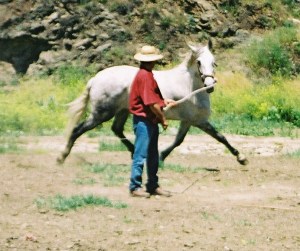
Horse training on the dry river bed, Almachar
Posted in Me in Andalucia | Tags: Andalucian horses, Romeria, wildlife Andalusia
The Mediterranean Diet
Good eating and longevity were two reasons for coming to live in the Axarquia. Here all the old boys ask “How old do you think I am?”. “Thirty-five?” you reply, resisting the temptation to say “Ninety-four”. Well, it turns out that they all are ancient but still fit and strong. If we are to believe English colour supplements, this is due to the “Mediterranean Diet” – fresh vegetables, virgin olive oil, spring water and other wholesome comestibles promoted by doctors and directors of taste and fashion as the shortest route to eternal life. All these products certainly exist here, along with the finest seafood in the world, much of it from Scotland.
So I was surprised to find that all the villages are full of diabetics. The littlest shop is stuffed with sugar free chocolate and biscuits and the disease is very well established, regarded in the commmunity as almost normal. When you look at what people actually eat as opposed to the “diet”, you start to get the picture. You could be forgiven for thinking that the Mediterranean diet consists of fat, salt and sugar.
Walk into a cake shop for instance. There are cakes with red cream, green cream, brown cream, white cream and they all taste exactly the same. The “cream” is of the sort we used to get in England in the ’50’s – whipped fat and sugar with or without colouring. Real whipped cream is not widely used here. Cows milk and its products are not traditional to this region of goats. Favorite is “squirty” cream that comes in an aerosol and is full of sugar.
Pig fat as an item of diet is highly prized. Christians for a long time menaciously extolled the medicinal value of pig fat over olive oil because pig is Christian and oil is Muslim and Jewish. The other day in the village shop I was offerd a piece of “manteca”. Manteca is like streaky bacon without any lean in it. It was explained that I should slice it thin, fry it til golden, and sprinkle it with salt. Delicious. No, it really is delicious.
If you eat out at lunchtime you will rarely find any vegetables on the table. Although you may detect some cabbage and potato in the first course “potage” or the soup, the second course of fish or meat is served on its own or perhaps with chips.You can order a salad, and sometimes one appears as part of your “Menu del Dia”. In our favourite bar the salad consists of chopped iceberg lettuce with good tomatoes and local olives with a tin of tuna on top. Unusually, it also has chopped crabstick, onion and avocado. However if you have had your heart attack or even if you are only about to have one, its wise to ask the chef to go easy on the salt. Salt features strongly in the batter mix and flouring of the famous Malaga fried fish. Prawns and sardines are usually rolled in salt prior to grilling.
Diet here as everywhere is less a matter of region than of wealth. What does it matter that the Axarquia is the fruit and vegetable basket of Europe? We no longer eat what we grow where we grow it. Poverty can be advantageous given that you have enough to sustain a basic nutritious diet. Many dietary problems here may come from the relative new found wealth of the region. I am told that vegetables are seen as the food of the poor, so when a family goes out to eat it tends to eat meat or fish. A diet of fat used to fuel a life of hard labour, just as a full English breakfast used to fit the life of a ploughman. All of us who can now borrow the money for a car no longer have to walk or travel by donkey. Old men here will live a long time because they worked hard physically in clean air and didn’t used to get much to eat, not because they ate lettuce.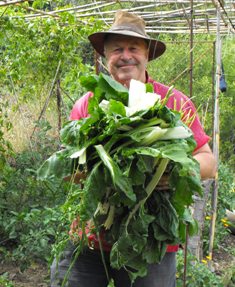
Here in Cutar the passionfruits hang from the vine like bunches of smooth green testicles.
Tomatoes and courgetts are in flower.
This is the chard harvest and I am still pulling the last of the cabbage and the lettuce.
Posted in Food | Tags: diabetes, mediterranean diet, menu del dia
South of the border
The day I left England, got into my car under the gaze of the CCTV. I drove to the supermarket, trying to avoid being photographed by speed cameras. Walking through Tesco’s car park surveillance I entered the world of the in-store security cameras and made my purchases. I paid by card which noted the time and amount of the transaction and I received a receipt on which was recorded the detail of my purchases so that Tesco could send me intrusive emails suggesting what else I might “like”. Waving goodbye to the cameras I made my way via speed traps into the train station’s camera surveillance and from there to the Southern Train’s anti-vandalism carriage video system. This took me to airport security where, under the cameras, the process of regulation and control began to assume a human face.
The border guards that keep us safe from terrorism and protect our liberties decided to take my luggage apart. “Books!” They gave me a suspicious look as though I had conspired with person or persons unnamed. “Ah, birds eggs of Britain and Europe” said the female goon, passing it to her testosterone laden companion “You’ll like this” “Ah!” he retorted “The shorter Pepys, I see!” Short but presumably deadly, like a Deringer. “A very eclectic collection” he whispered as though broad mindedness had just become an offence. They went through my personal effects item by item. Intrusively, offensively, passing comments as they did so.They handled each item with obscene intimacy like a priest handling a child’s bottom.
“And why are you going to Malaga Sir?” inquired the officeress “Off for a bit of sun?”
“No I don’t like the sun” I replied “I’m going for the surveillance”. “There isn’t any”.
Narrowly escaping a full body search and the temporary confiscation of my passport, the usual punishment for members of the public who are less than ingratiating to customs officers, I boarded the plane.
Three hours later I was standing in the darkness on the edge of Malaga airport. Due to the expansion of the site (14million passenger throughput increasing to 26 million in five years) and the building of a motorway, it looks as though it has been hit by a bomb. I sat in my car, noting the isolated road trailing across an expanse of bare churned earth lit by small pools of light supended from temporary lamposts. Nowhwere to hang a camera. In later, darker times, lovers and conspirators would have to plan the new world in places like this. As I took to the road and headed for the hills I was confident that, whatever electronic trail I had set up in the UK, this would be where it disappeared. . . .
Posted in Me in Andalucia | Tags: CCTV, speed cameras, surveillance
An English “Fiesta”
Last week in England I was pleased to be able to attend an English village fiesta at Eversley Village Hall, similar in some respects to the fiestas of Spanish white villages, and perhaps of all villages everywhere. As in Spain the event involved eating, singing and dancing. Most of the audience were performing and those who weren’t had song sheets so everyone could join in. The programme was somewhat ad lib and the timing spontaneous, as in Spain. Unlike Spain there was an admisson price of £10, though I remember feeling obliged to pay 20€ in Cutar for a scabby bag of supermarket veg at the Fruit and Veg fiesta (see below). While the English event was in aid of charity, the Spanish “take” usually goes towards the cost of the next party.
We started much earlier than in Spain, at seven. Villagers bought raffle tickets. We were asked to sit at tables in parties of six because that was how the food had been organised. Each table was decorated with a flower on a table centrepiece with a lit candle. There was a bottle of wine. The food was portioned and on trays. On each tray a scattering of iceberg lettuce, twelve cherry tomatoes (2 each), six slabs of pate, six of cheese, six slices of Wiltshire ham. This accompanied by a basket of bread. None of your Spanish pushing and shoving.
The show began with a risque sketch involving a woman, a park attendant and a duck. The applause had hardly died away when the entire female staff of the village primary school in stretch black outfits launched into an ABBA tribute medly. Their hot refrain:
“Gimme Gimme Gimme a man after midnight”
Set running the juices of those of us who still had juice to run. For others there were song sheets.
The event progressed with a rollercoaster of music hall, variety, talent spots and alternative comedy. No sooner did the spoof Fandango by an elderly Spanish dancer with a bad back come to its comic climax, than we were transported into the Edwardian sitting room where a husband and wife duet played and sang:
“I’ll walk beside you through the world today
While dreams and songs and flowers bless your way
I’ll look into your eyes and hold your hand
I’ll walk beside you through the golden land”
The singer had complete mastery of her range but not quite the confidence to maintain her tone of voice. This produced a vulnerable naked soprano that was very moving, bourne up by the careful pace of her husband’s piano. It created a unique moment in this English village setting.
The show came to a rousing conclusion with a sing-along medley and a vote of thanks, three and a half hours later. Everyone agreed that it had been both a fundraising and a social success.
The English village events programme, like the Spanish, combines “Fiestas” (traditional parties sometimes with a religious theme) and “Fieras” (more modern occasions with a market and trading theme). In Spain all Fieras and Fiestas are holidays. Obviously this isn’t possible in England because the economy would collapse. Nevertheless the programme of celebration is as follows:
June
Village School Summer Fair (Fiera)
Free Family Fun day (church event – Fiesta)
Village School Summer Ball (Fiesta)
July
Village Hall 50 year birthday celebration (Fiesta)
St Mary’s Summer Fete at the church Rectory (Fiesta)
August
Lamb Roast on the Lower common (Fiera)
September
Village Produce show at theVillage Hall (Fiera)
Village Church Patronal Festival. Bell ringing, church tours, cream teas, childrens’ events (Fiesta)
Harvest supper with theatre event (Fiesta)
December
Candlelit Carols with mince pies and mulled wine (Fiesta)
Posted in culture | Tags: English village
Dogging, Spanish style
Here in Almachar it’s lovely April and the start of the dog shagging season. Every Spanish house dog feels the nasty itch of springtime in one of its repulsive crevices and before you can say “Ole!” has found itself locked into a gang bang of unlikely partners. The annual shag proves definitively that dogs lack a sense of humour. There they stand, presumably waiting for the earth to move (which, in fact it did in the 1775 earthquake).
If they only looked at themselves – a terrier in an alsation on a boxer in a terrier and so on, they might at least burst out laughing. Instead they look as though, had they known what they were getting into, they would never have started. Their mournful faces remind me of my grandmother (may God give her rest) who used to describe sex as ” a lot of pushing and shoving to no good purpose”.
Spanish people, unlike granny, have a refreshingly benign attitude to sex – an example of their divergence from the views of the Vatican and the Rat. It was recently proposed by Council at Velez Malaga for example, that the lights should be turned off between 11 and 12pm on the beach at Caleta so that young people, forced by unemployment and penury to live with their parents, could go down the beach to have it off. To a Spaniard, what is good enough for a young person is certainly more than enough for a dog and thus villagers are inclined to edge carefully and respectfully around those bundles of mournful ecstacy that clot the streets at this time of year. But I digress.
I’m having a feud with the animal in the house opposite – a lozenge of middle aged dog fat with a leg at each corner that has conducted a campaign against me ever since I moved in. Day and night it stands and howls at any passing thing that doesn’t smell of its own backside. This war of attrition is punctuated by criminal activity such as chewing the ends off my very expensive fly curtain, or simply shitting on the step. “Its because you are a foreigner” explain my neighbours unhelpfully.
I know that he who rises to petty provocation is destined to look ridiculous in the eyes of his neighbours. I am aware that lobbing rocks down a concrete street with concrete walls is a pointless and dangerous exercise and that running after an animal with a bucket of water screaming abuse is unlikely to contain, let alone resolve the issue. I have learned that Spanish people, observing this outburst from an otherwise phlegmatic northerner, treat me as though I’m ill. “Are you alright? Would you like to sit down? Can I get you something? What on earth happened? Well. . .obviously. . . its because you’re a foreigner” they say unhelpfully.
This dog is an unfortunate. It’s from what English social workers call a “chaotic” family background. Its owner, the optimistically named Juan Carlos, was the “El Dupe” (driver of the Dumper truck) of Almachar. He emptied the rubbish every day and carried materials from bricks to fridge freezers all around the village. The “lozenge ” would trot ahead of him, shrieking and howling that the dumper truck was on its way. One day he got a better job as the driver of the school bus, and the lozenge’s world fell to bits. It couldn’t manage to run ahead of a bus, so it took to hanging around on street corners and taking up with bad company .
Our house in Almachar stands about fifteen feet above the street in which this creature lurks. I have tried lobbing buckets of water at it but it simply stops barking, watches the water descend and at the critical moment, calmly sidesteps and avoids a soaking. It then looks up as though to say:
” I am only a dog of the streets. I have not been chosen by God to rule over His creatures or to attain the crown of glory – eternal life, yet in the face of your pathetic and intemperate rage I myself am able to remain both temperate and cognate, to perceive the consequences of your action, assess and time the descent of the bolus of water and avoid it with the minimum expenditure of energy on my part.”
Closeley observing the “lozenge” in the act of coitus however, I have noticed that packs of dogs thus engaged are totally unable to move. A well placed bucket of water over a coital clump might seem reasonable to a Spaniard given that English people are supposed to be shocked by sex. I know in fact, that you can’t interrupt a shag by throwing a bucket of water over a dog because its penis swells into whatever crevice it has stuck it and can’t be removed until it ejaculates. Nevertheless, that doesn’t mean it’s not a good idea, and revenge is certainly a dish best served very very cold. . . . .
I have decided that it would be inappropriate to illustrate this post
Posted in culture, Me in Andalucia | Tags: Dogging, spanish dogs
A free lunch
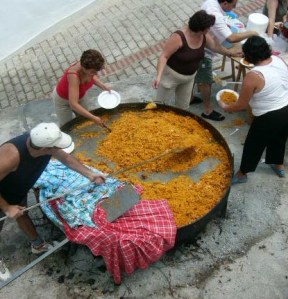
Serving paella. Note the paella paddle
Paella (pronounced Pa!-eYa) is part of the traditional peasant fare of Andalusia. It used to be basic rice and stock with whatever meat, fish or sometimes snails and veg was available. In paella a little goes a long way. It was cheap because the Valencian paella rice crop was reliable and relatively local. It used to be cooked in the fields in vast pans over wood fires for agricultural labourers so they didn’t wast time going back and forth for lunch. Today, ridiculous “fast food” versions are available to Costa tourists, and more traditional but richer versions are offered as part of the “Menu del Dia” in village bars. Bar Lopez in Almachar has it every Friday. It’s made in nearby houses and rushed into the bar’s little kitchen ready for lunch. It’s served as a starter course. The paella in the photos is different again, it is part of the hospitality of the pueblo, a massive dish made in the open air at an annual fiesta when free food and drink is given away to all.
In case you want to do this for your community, the following recipe gives rough quantities that will feed a whole village plus friends, family, hangers on, and the band of scroungers who trail from fiesta to fiesta looking for a free lunch.
Paella del Pueblo: Serves 500 people as a small plate light lunch.

Chef demonstrates pan and paddle Benamargosa 2009
What you will need:
Two massive paella pans 1 to 2 metres in diameter, on stands.
- Two long steel paella paddles
- A large supply of seasoned wood. Olive is best but almond and lemon wood are also good
- Two large chefs in stained t shirt and shorts to mix the paella
- Two assistants with hoses to hose down the legs of the chefs
- Two or three assistants to serve
- 500 little paper plates
- 500 little plastic forks
- Ingredients (more or less):
- 100 litres of water
- 50 kilos of paella rice
- 50 kilos of mixed frozen seafood (100g per person) Including prawns, squid, mussels and small clams frozen in their shells. The seafood should be thawed but still slightly icy.
- 8 kilos chicken wings (optional)
- 5 litres Olive oil (not virgin or extra)
- 1 kilogram sweet pimiento powder
- 200gr saffron powder
- The “secret ingredient” that no-one will tell you about but I think is fish stock powder and garlic powder to taste
Method
- About an hour before you want to start cooking light a fire under each pan
- Pour in the oil and fry the chicken wings til light golden, stirring with your paddles
- Soak the saffron or make a paste with water
- Add the rice to the pan straight from the bag. Coat the rice with the oil and the fat from the chicken and let fry a little, stirring with your paddle
- Throw in the pimiento and garlic. Stir to coat
- Add the water
- Dilute the saffron and add to the mixture. The liquid should be brightish yellow to orangish (see photos)
- Add stock cubes or mix powder to a paste, add to the mixture and taste. Be careful not to over salt. If your stock is cheap and commercial, it is just salt and fat. Ideally you’d have 100 litres of your own home made stock . . .
- The water will take ages to come to the boil. Go and have a beer. Walk over occasionally and poke the mixture as though you know what you’re doing but do not stir, beyond checking that the rice is not sticking.
- Keep drinking but keep your eye on the rice once the mixture has come to the boil.
- The rice will quite suddenly start to absorb the liquid. As soon as it starts to do this, chuck in some seafood. As the water comes back to the boil chuck in some more util it’s all in.
- Let the mixture simmer for 15 minutes, watching carefully and testing for sticking. Taste the rice for doneness. It should be very slightly al dente because it will continue to cook while you serve it. Use your senses of smell and taste to let you know when its about to be ready . .
- When there’s hardly any liquid left, toss the mixture with your paddles. Assistants hose down your legs so the fire doesn’ burn them.
- Serve immediately on paper plates with plastic forks, piping hot.

Experienced chef apalled at the extremely small paella and the improvised paddle
Posted in Food | Tags: Andalucian white village life, Andalusia, fiera, fiesta, paella rice, Recipe for paella, village hospitality
The Beaux Gendarmes
There are no police at all in Cútar, so you had better get on with your neighbours because they effectively police themselves. They certainly decide what is and what isn’t important. When our wheelbarrow was pinched they said “oh, never mind!” And when we found it chucked down a ravine with the wheel missing they said “there you are then – it was just kids!”
Criminal activity in Cútar is is very rare and is always blamed on “gypsies”. This could mean real gypsies who steal your babies, but usually means Roumanians who are blamed for everything.
Almachar on the other hand has all sorts of police. There is the “Local” policewoman who is the arm of the law in the morning and works in the sweet shop in the afternoon, so if you are going to commit a crime, do it after lunch. She appears in full fetish with cuffs and truncheon on Friday market mornings and civic occasions such as Fiestas. She is local, well liked and more or less ignored.
Almáchar is also policed by the “Guardia Civil”. They are the military police, the Gendarmes of Spain, the state police force so feared and hated during the Franco dictatorship. They have housed themselves in the biggest building in the pueblo. Purpose built, huge, square and sited right on top of the hill it stands as a monumental response to “bandit country” by which this region has always been known. The terrible terrain of the Axarquia – its steep hills upon which a donkey can hardly stand, its dog-leg tracks, its earth like broken glass, its passes and rock outcrops ideal for an ambush, makes it the last redoubt for refugees from the state.
During the sixteenth century, “the Monfi”, bands of outcast Muslims driven by Christians from their homes and livelihoods, escaped the Inquisition by fleeing into these hills. They robbed travellers and descended upon settlements to take their revenge upon priests and innkeepers who had betrayed them to the authorities. Now Cútar commemorates them with a fiesta.
During the nineteenth century bandits of the romantic sort flourished here , including the notorious “El Bizco” (the Boss-Eyed) bandit of El Borge – the village between Almáchar and Cútar. Bizco’s real name was Luis Muñoz Garcia, the “Billy the kid”of the Axarquia. Bloodthirsty, depraved and treacherous, his violent life story is tangled up with folklore. He was born in 1837 and was gunned down by the Guardia Civil in Lucena in the province of Cordoba on May 21st 1889. Today, Bizco’s house is a restaraunt.
After igniting a civil war in 1936 against the democratically elected government, Franco — aided by Hitler and Mussolini — finally conquered Spain 1939 and ruled it for the next 36 years. He sent political prisoners to concentration camps and homosexuals to mental asylums. Women were not allowed to work without the permission of their husbands. For many in the Axarquia, the post war period was a time of terror deeper than the war itself. Villagers were caught between the violence of the Guardia Civil, brutal and unaccountable, and Republican ‘terrorist’ Guerillas who waited in vain for the allies to take on fascism in Spain as they had in Germany and Italy.
After Franco’s death in 1975, collusion across the Spanish political spectrum maintained a “pact of silence” about the Civil War to ensure, it was said, a peaceful transition to representative government. The dark side of of “peaceful transition” was that Francoist criminals kept their positions and remain unaccountable for the crimes they had committed. So there is not yet a restaurant or fiesta to commemorate this particlar era of killing. Too much remains unresolved.
Today the Guardia continues to patrol its stamping ground, the rural areas, maintaining its duties in the areas of civil order, immigration, customs and terrorism. They have lost their feared black capes and tricorn hats and have assumed additional responsibilities for traffic and the environment. Officers can sometimes be seen lounging on their cars round the deserted grape fountain in Almáchar, slightly ridiculous with mirror sunglasses and automatic weapons, ready to arrest teenagers riding scooters without insurance.
Their mottos “El honor es mi divisa” – Honour is my emblem and “Todo por la patria” – All in the service of the Fatherland do not yet acknowledge accountability and mutual consent, two vital aspects of policing a democratic country. Their emblem emblazoned across the bonnets of their cars is a bundle of rods round a double headed axe. It symbolises “strength through unity”, a favorite motto of Franco’s and an icon of the Roman Empire, the “fasces” chosen by Mussolini to symbolise the fascist movement he invented. Perhaps Prime Minister Zapatero under his new law of “Historical memory” will recall this too and make some changes. . .
Posted in History, Politics | Tags: bandits, civil war, Guardia Civil
Gimme that old time religion
Pope Benedict XVI, Joseph Alois Ratzinger known by those who dislike him as “the Rat”, will not be seen in picture or effigy in the shops or business premises of our villages. This marks rural Spaniards as strongly different from Catholics of the Irish or Italian persuasion who positively smother their enterprises with Popish ephemera. In Ireland and Italy photos of the holy father are “de rigeur” in every establishment, but in Spain? “No!” I don’t know why this should be so.
It can’t be because of the Holy Father’s odd attitude to AIDS or his sympathy for fascists, so I guess it’s just that Spaniards distrust authority at a distance. Andalucians find the authority of Madrid pretty distant, let alone the authority of Rome.
On the other hand no village shop would dream of opening without a version of the crucified Jesus or the interceding Madonna on the wall, or more usually, of the local saint – San Roque for Cutar, or Santo Christo del Bande Verde for Almachar. These gods, nature deities reinvented as versions of Jesus or Mary, are particular to the pueblo, and are part of that community of gods who preside over the fortune of each village. Could it be that Spanish villagers are superstitious rather than religious? Could these versions of Jesus, Mary and the Saints hark back to the Roman and Greek societies of nature Gods?
Today is holy Saturday. Tomorrow will be Easter Sunday. In Cutar the village square is being prepared for a fiesta. The square is covered in earth moulded in ridges. Into the ridges are stuck carrots, turnips, cabbages and other vegetables and at the the head is placed a figure of the Christ child. Libations of wine are poured onto the earth. The villagers dance. Vegetables from local plots are sold for fundraising purposes. The whole event is staged in the hope and trust that God will smile upon the vegetable raising activities of local people. This religious activity tries to maximise the chance that the people will eat. It is powerful sympathetic magic that significantly predates the time when Jesus was no more than a twinkle in his father’s eye.
Somewhere or other, somewhere else, Christ is apparently rising from the dead . . . .
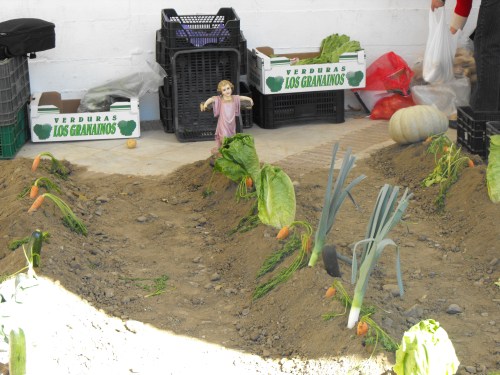
Baby jesus of the fruit and veg
Posted in culture | Tags: Joseph Alois Ratzinger, Pope benedict XV1, The holy father, the Pope


 Village life in Andalucia
Recent Comments