Posted by: puebloman | August 6, 2013

The “crisis” in Cutar

"Crisis? What crisis?"

“Crisis? What crisis?”

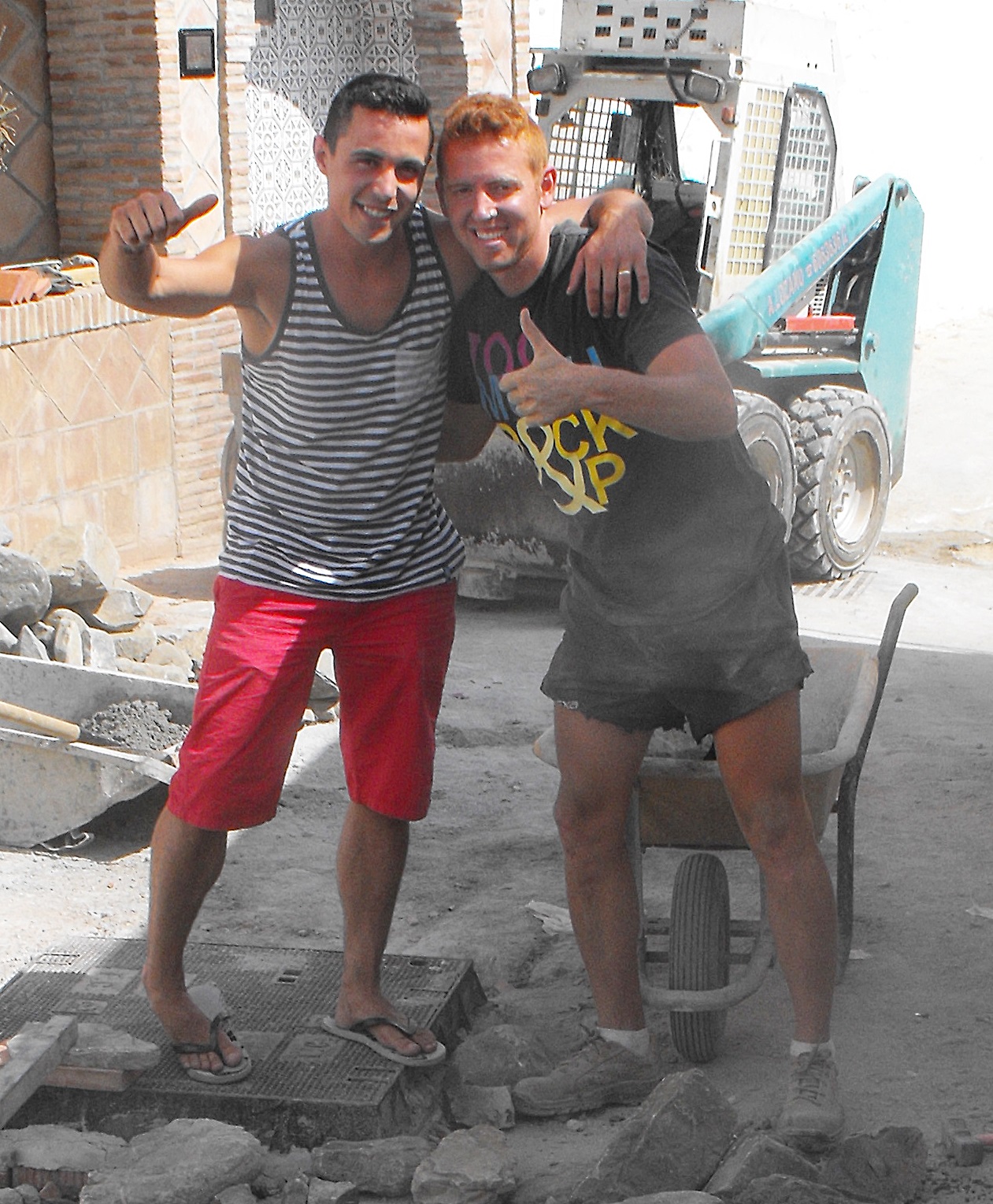
These men are resurfacing the main road through Cútar. They will edge and shape beds with traditional “ladrillo” bricks, then fill the beds with pebbles which they will grout and seal to create a smooth, dead level road all lined up with the manhole covers that top the brand new waste system their colleagues have put in. They are bright, optimistic, “can do” men with the energy and skill to bring in a project on time and at the required standard. They had better be on time, the annual Féria is only a week away. It is the summer fair and will attract a lot of “strangers” so the village had better be spruced up with that prosperous, polished feel to it. Ask any old lady. The Mayor always starts building projects in July – the month of dust, usually two projects, breaking the road up at either end of the village so no one can get out. Then everyone and especially the workers have a good incentive to work hard, get the job done and clean up before the big party

The guys learned their craft from their uncles and fathers. As youngsters they had been keen to learn because even six or seven years ago earning money from the building trade was their way to get out of the village, and everyone here knows that leaving  the village is a  clear sign of success. The Mayor for example, born in the village, now lives in Torre Del Mar and that’s partly why they vote for him. You can have confidence in a man who has got out.

A little way back in their teens, they might have dreamed of a life in Velez-Málaga, the nearest town, in a modern easy to clean flat, with a car paid for on credit. They too could aspire to the world of commercial trash proposed as normal every day life by dubbed American television. But five years ago it all went pear shaped, the banks became unaccountably ethical and the credit dried up. With unemployment at 40% the lads had to go back to the villages and live with their parents.

Social security in Spain lasts 18 months and then stops. If you want any more you have to get a job. David Cameron ought to be proud of Spain, though he hasn’t yet said so yet. Five years ago pundits were predicting a crime wave as the jobless were faced with the prospect of stealing or starving. It hasn’t happened here and that’s just as well because we haven’t got any police.  No, the ravening wolves in this village are kept at bay as they have always been kept at bay by some slight of hand from the town hall. Everyone gets a little bit of work in turn. Just enough to get them back on the social. Men make roads and renovate drains, women sweep the streets and do the painting. And the jobs are getting slightly less gender specific. This winter a team of women cleared, repaired and re rendered the main sluice drain that takes storm water through the village without smashing up the houses.

None of this is new. It’s always been like this. There hasn’t been work or money in Cútar for as long as anyone’s grandparents can remember. So when people in Cútar say “Crisis? What crisis?” they are not playing stupid. They are echoing people of the north of England when they say “Recession? What recession? Oh aye. That’ll be more nowt”.
Posted by: puebloman | August 5, 2013

Water snakes of Andalucia

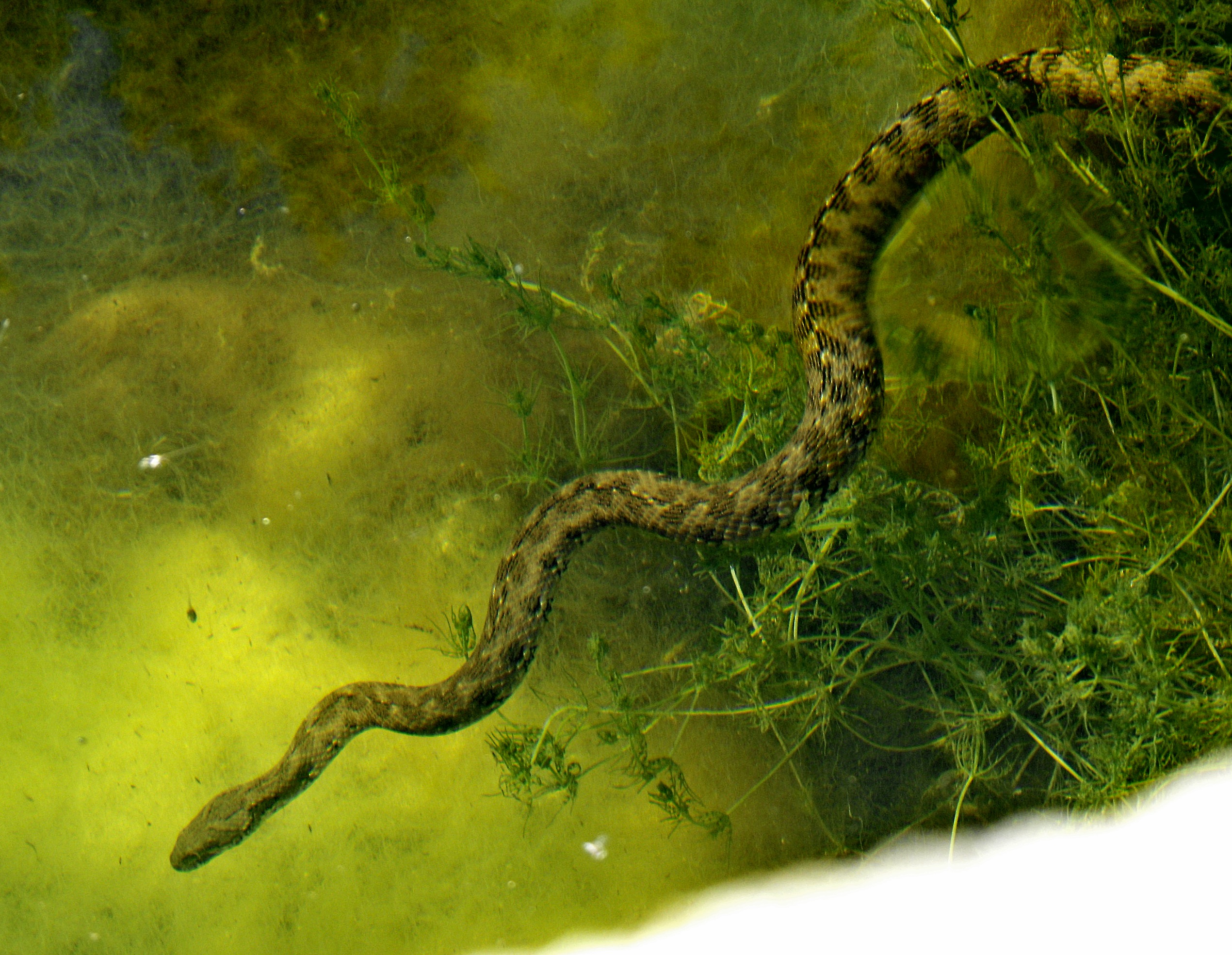
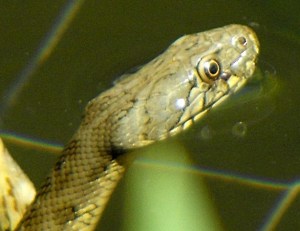
Head of female viperine(?) in our water deposit 1st August 2013

Head of female Viperine  snake (?) in our water deposit 1st August 2013

Snakes are of course the Marmite species of the animal kingdom. You love them or hate them. I love them, and in a previous life  kept boa constrictors and a variety of King snakes. They are beautiful, gentle, clean animals. When we decided to come to Spain I looked up the snake population expecting to find that the ecologies of Europe and Africa had overlapped producing a wide variety of serpents from both continents. I was disappointed to find that there were a measly thirteen types of snake in the whole of Spain, none more poisonous than the common British adder. The biggest Spanish snake is the Montpelier, a back fanged snake. This means that it’s poisonous, but has to chew all the way up your finger before it can even think of poisoning you.  I once asked Manolo, our friend who runs the farmers’ cooperative in Almachar, whether there were poisonous animals around here. Here looked at me and said “The only poisonous animals in these parts are human. Watch out for them” Manolo sometimes forgets that life is for living and that living is fun.

DSCF3863

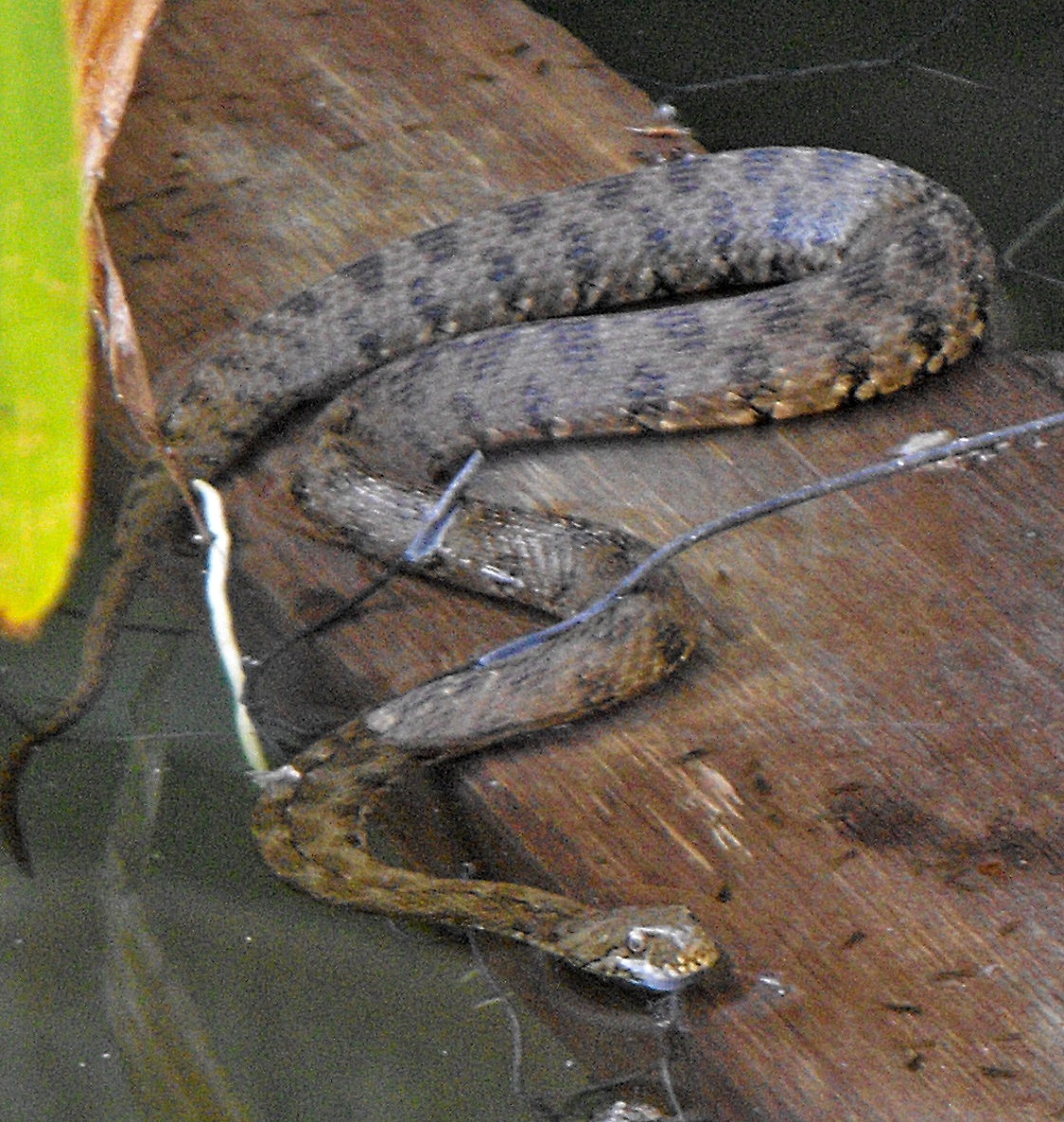
Here she is again, basking on a piece of floating wood

Anyway, about three years ago, a snake arrived in our water deposit. She usually turned up in June – tadpole time – and realised that for tadpole eating snakes there is in fact such a thing as a free lunch. So she came back last year and here she is again, with someone else who could be a mate. I say she because she is stockier than her “mate” and has a clearly defined short tail. “He” is about twice the thickness of a pencil, slim and very active. Yesterday he “snaked” across the water, his head breaking the surface of the water, while she reclined in the bottom. When he was above her he stopped, allowing himself to drift across her on the bottom. Very sexy. Readers will recall that snakes have a double-headed spined penis. They have penetrative sexual intercourse that can last for days. I don’t know how they do it in the water though – they have to come up to breathe. Maybe that’s part of the fun.

I’m not exactly sure of the species, but I think that they are Viperine snake natrix maura. Most viperines I’ve seen have better developed diamonds on their backs. They imitate and behave exactly like vipers but they are neither venomous nor of the viper family, they are the family Natrix – same family as the grass snake, Natrix natrix. She looks like a grass snake but without those distinctive yellow dabs behind the ears. Both Grass snakes and Viperines are very fond of water, and completely at home there. Hopefully we will see babies before the water runs out?

Here she is lurking in the blanket weed. There are no fish so she must be feeding on tadpoles and baby frogs

Here she is lurking in the blanket weed. There are no fish so she must be feeding on tadpoles and baby frogs

Posted by: puebloman | July 31, 2013

Hill farming in southern Spain – how we get water

Dry Rio

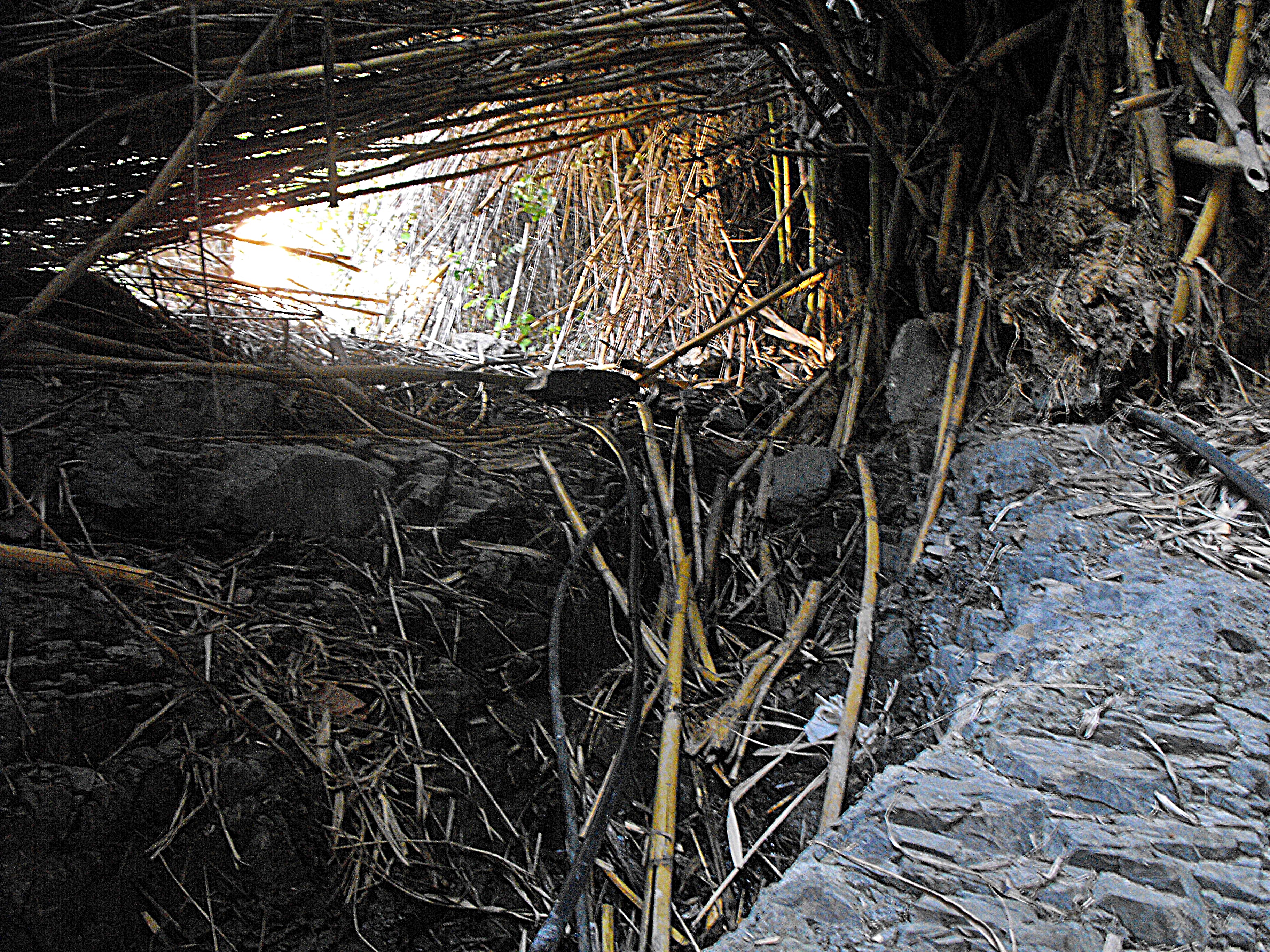
This little river looks like a trout stream in winter, clean as a whistle, clear water over slate. Today its choked with canes and not a drop of water to be seen

Well, it’s July going into August – our hot “winter” when nothing can be planted and the trees and vegetables hunker down to survival routine. Due to the long tap roots of the muscat grape and mango, cutting up to 15 metres into crumbling pre-Cambrian shale, water can still be tapped so that the fruit can swell. It’s grafting time for mangoes now, because during grafting the temperature must never drop below 70 degrees F day or night. As I write, at 11pm,  it’s 82.5F (30C). But you’ve got to have water.

Water is the basis of everything here and without irrigation everything would drop dead within hours under the blistering sun. Shade is also important and this year I neglected to rig up shade sails. Consequently my local cherry tomatoes, which have given a bumper crop are now too weak to stand and have been burnt to a crisp.

As the year advances, my time is increasingly taken up getting water. As the weather hardens into July the earth becomes baked solid and weeding becomes impossible without water to pre soak the soil. I run black plastic 15mm piping from the water deposit next to my very steep land, up stream above the level of the deposit searching out those little puddles that are all that’s left of what in March looked like a cheerful little trout stream with pools and waterfalls.

The work is treacherous and difficult. The stream is fringed with big canes, called cañas in Spanish. They resemble huge bamboos but have nothing like the strength of a bamboo, quickly collapsing and disintegrating. Shiny and slippery, they are hard to traverse and the spikes of sliced  canes cut you like a knife.

The heavy rains at the turn of the year means that there is still some to be had now, but every other day I need to crawl up the cane choked river bed to encourage the pipes to keep producing.

A little spring in the rock to the right acts as a water source until August. I crawl up “stream” to find more.

At this time of year I have to collect as much water as I can in the big deposit at the bottom of the valley, then pump it up to the ridge where it is stored in a deposit. Then the cocks are opened and the trees can be watered by gravity.

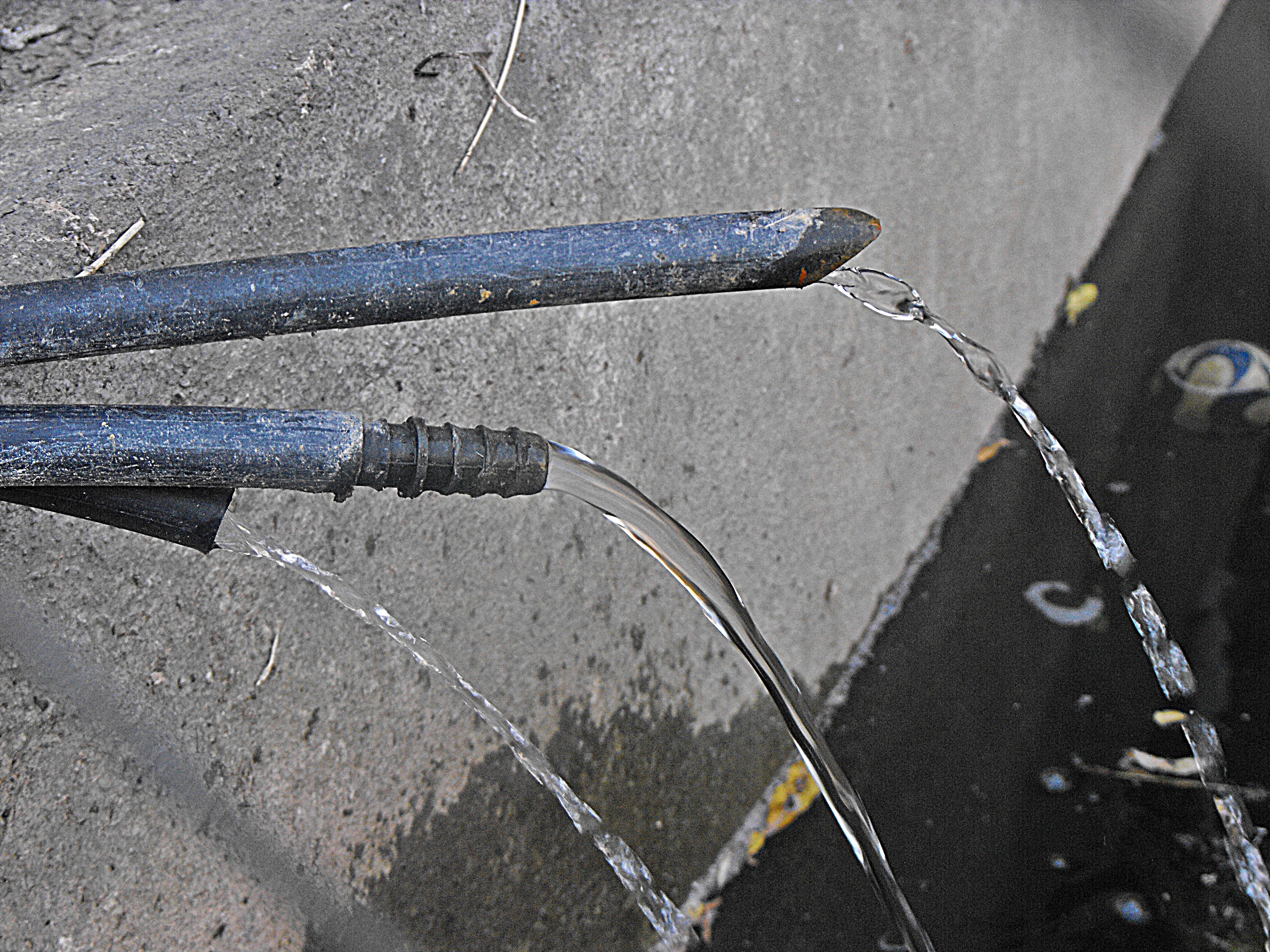
Here is July’s water, running into the lower deposit. the three pipes together produce 5 litres per minute. That’s 300 litres per hour or 7200 litres per day or 50,400 litres per week. Wish us luck in August and rain in September!

Normal 5 litre flowWritten from http://www.vivasiesta.com  July 2013

Posted by: puebloman | June 18, 2013

Hill farming in Southern Spain: climate change

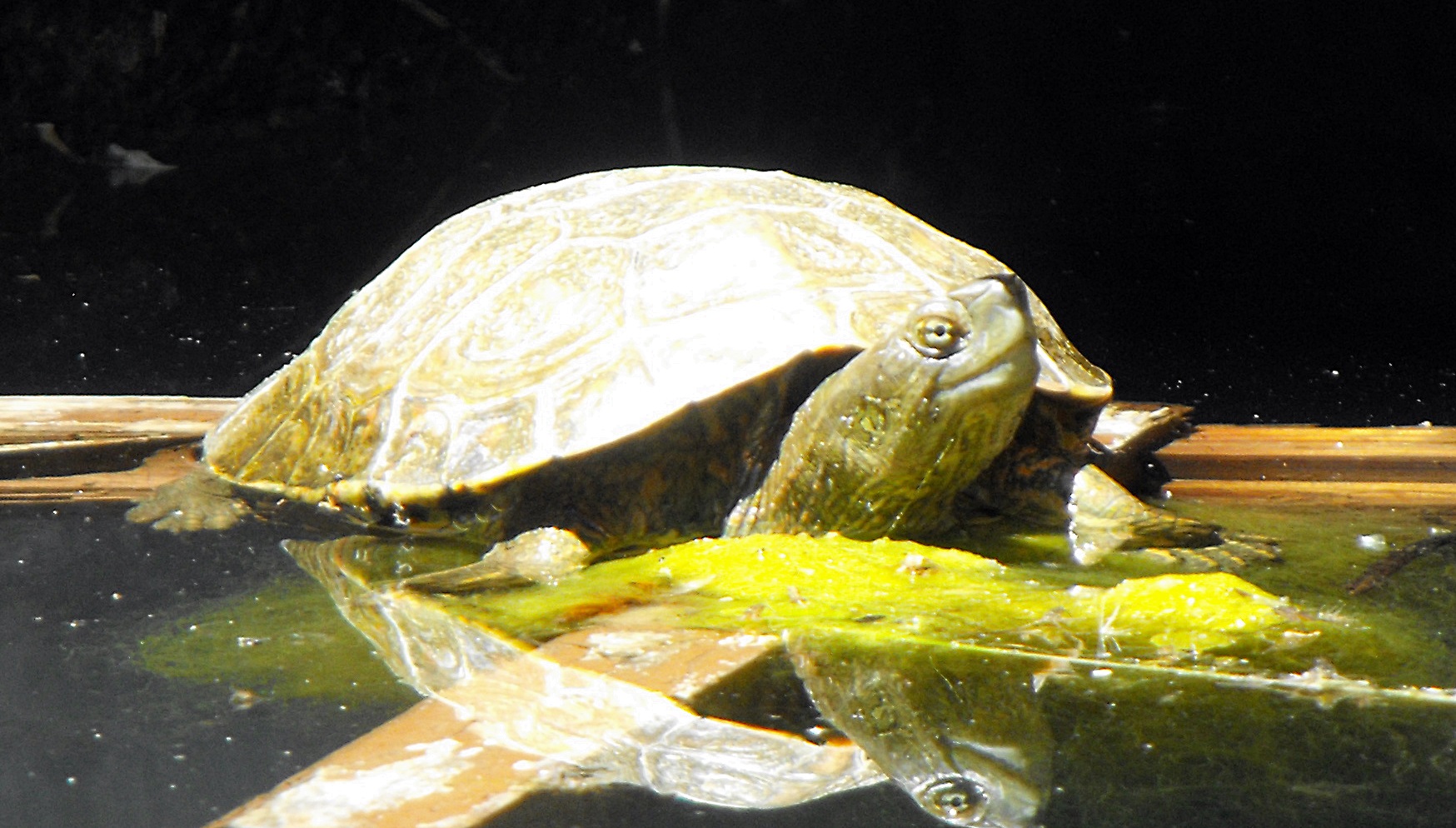
Our Iberian water tortoise in bright sun, enjoying the June river water, piped into our water tank

Our Iberian water tortoise in bright sun, enjoying the June river water, piped into our water tank

I farm a little piece of land near the tiny village of Cutar, just north west of the town of Velez Malaga. Velez is the old military garrison north east of Malaga city where the Moorish army was stationed before the Christian reconquest.

We have properties to let in Cutar and in the bigger village of Almachar, a few kilometres down the road. We ran this little letting business with great success for seven of the ten years we have lived here, and less successfully for the last three years – the years of the “crisis”.

During the seven “fat” years, customers from the UK and Netherlands  were regularly telling me  that my beautiful bit of eastern Andalucía – the Axarquia, would be like the Sahara desert in twenty years. That was ten years ago, yet just as these amateur statisticians and curators of arboritoria were rationalising us out of their holidaymaking plans in the white heat of the banking crash, down came the rain. In 2010 it rained from December right through until May, filling up Lake Vinuela that previously had been only 20% full. This year the streams that feed my lower water deposit were fattened up by the winter downpour and are still running.

So no Sahara yet, oh professional and educated amateur weather forecasters. The goats  that are controversially herded down the road from every little village, continue to mangle the herbage and the herbage continues to sprout through. This June is as green as grass, much greener that when we arrived here ten years ago.

God forbid that I should appear to be a “climate change denyer”, those heretics of science –  the new religion –  whose high priests are always right until they’re wrong.

Of course, come August, the hills will be scorched and russet brown in the airless heat of the hot winter we get her every year as sure as the UK gets ice.

It was Mark Twain, my favourite weather forecaster of all time, who said “Climate is what you expect, weather is what you get”.

written from www.vivasiesta.com

Posted by: puebloman | February 6, 2012

The Pebble man of the Playa Cañuelo

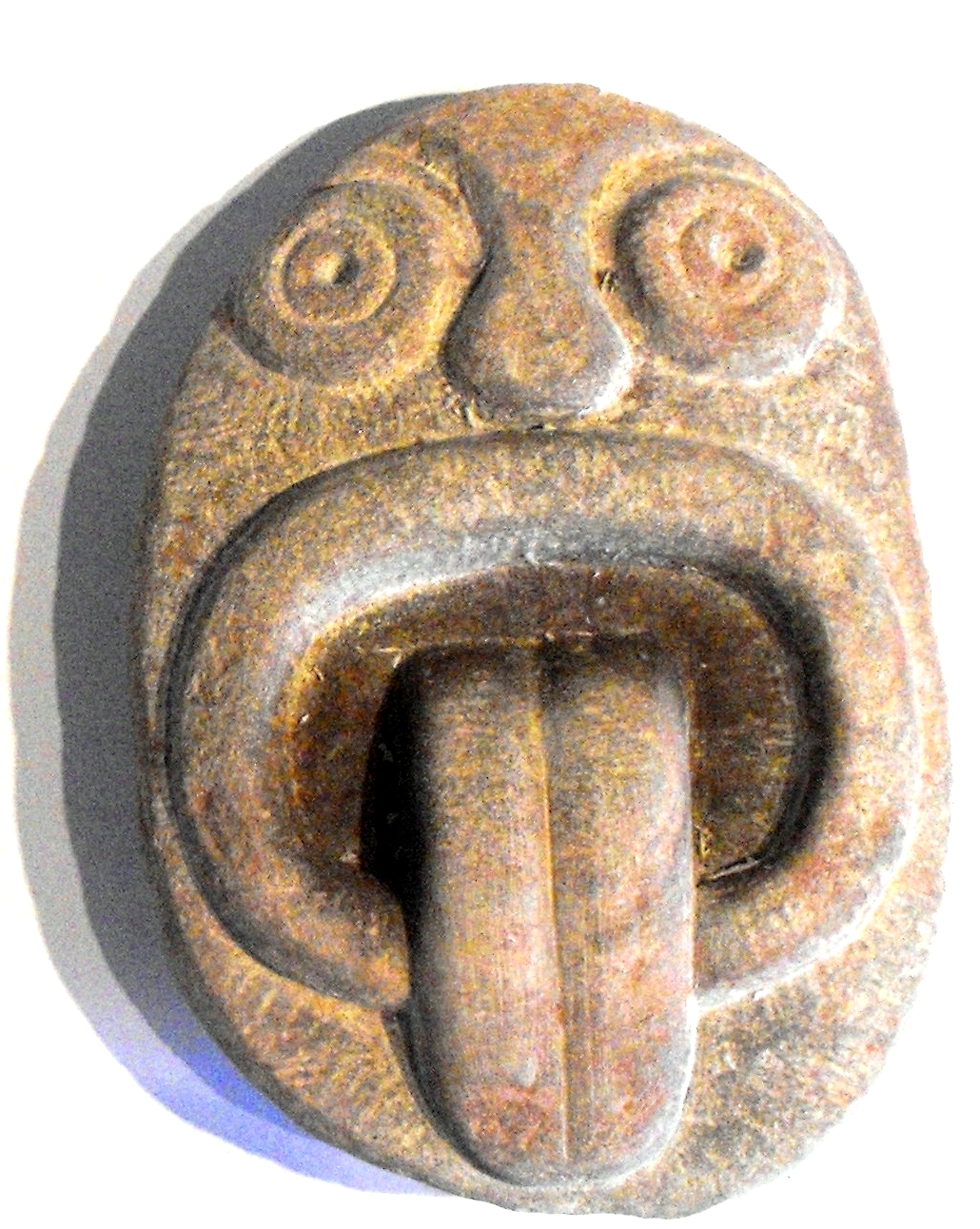
This pebble was hand carved by the pebble man

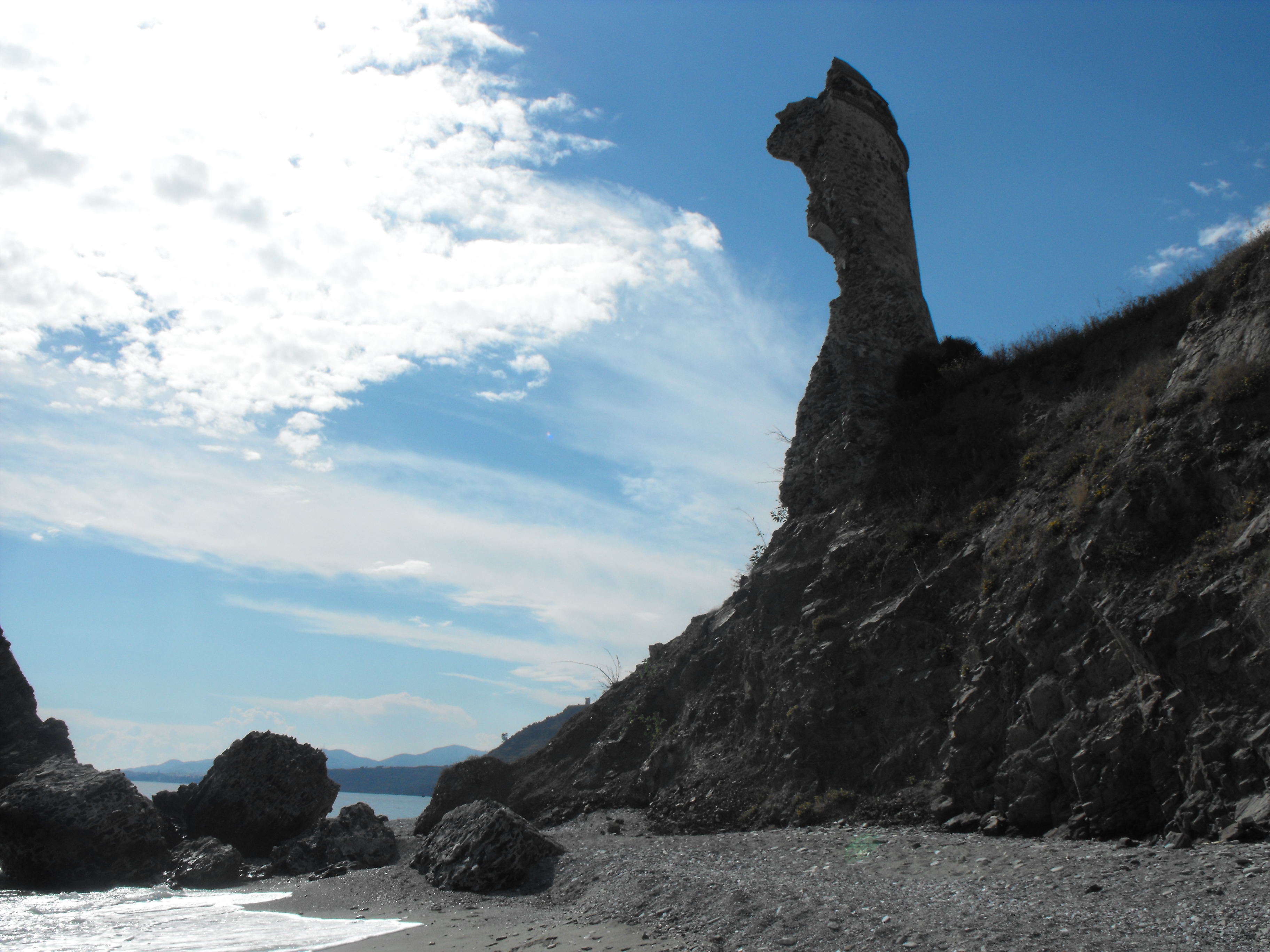
The Playa Cañuelo is a drive of about 30 minutes from our cottages. Drive down past Velez-Malaga to the autovia. Head towards Nerja but pass it by, turning off the N340 at Maro. Pass that too, driving east  along the cliff edge of the coast road until you reach a little car park – hardly more than a scrape. Take the track down to the playa (beach). In the summer months mini buses transport people up and down, but we never go at that time of year.

Out of season this beach is a natural haven for the solitary soul, being part of a marine nature reserve and therefore entirely undeveloped. Since it was featured in the “Daily Telegraph” it has become almost famous for its crystal clear water, its teeming coastal and marine life and its nudists.

Judy and I were hunting for driftwood but there was little flotsam and even less jetsam due to the very atypical weather – no torrential winter rain, no heavy storms, nothing but a strange pseudo-spring climate cut by an icy breeze apparently pushing south  from Siberia.

There was no one but us on the beach and we passed a couple of  fresh water springs that someone had formed into little lakes and waterfalls. A few hundred metres along the deserted beach was laid out a towel with a dozen beautifully carved pebbles on it: a tortoise, a gecko, an erect penis in the shaker style, a Persian flowering “yoni”, some Eskimo style hieroglyphs, some buddhisty  icons, a dolphin and so on. No craft or sales person in sight.

We discover the pebble man on our way back. He is lying out of the wind under a canopy of those long cañas, whose great grandparents used to be sugar canes. He is lying on his back, his crotch pointing out to sea. His name is Gerard. He is French and has lived on the beach for about a year. The police know about him but leave him alone so long as he doesn’t light fires. This is a nature reserve he explains, though not everyone shows respect.

No fires is OK he says – you just put on more clothes. This is what Gerard had done today. He had modified his nudist principles and is sporting an old green t-shirt against the bitingly cold wind. This makes him respectable at least from the waist up. He tells us he did badly at Xmas. He had a big commission from a drug addict who failed to come up with the cash. Business is bad at this time of the year too because of the cold. “People walk quickly by” says Gerard. In the summer they can lay about and think about buying something. The down side to summertime is that they steal his stuff. “Why don’t you sit next to it?” Judy asks “Ahhh” he replies, waving his arms. “We could take some pieces home and show them off in our cottages” I suggest “Our guests like hand-made local stuff” “Ahhh” he waves his hands again.

I buy one of his pieces at a grossly inflated price.

He needs a meal.

He’s a nice guy. . . . .

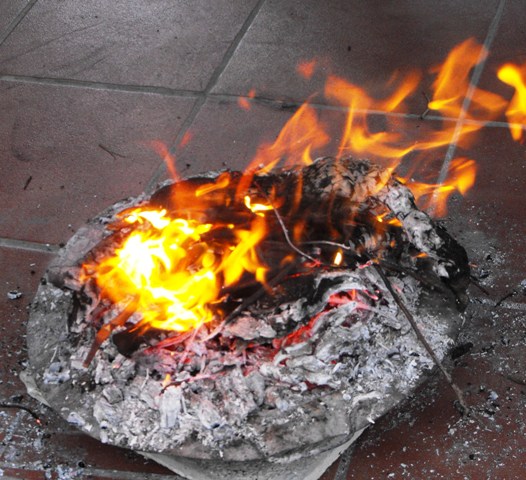
Preparing the brasero with buring vine prunings

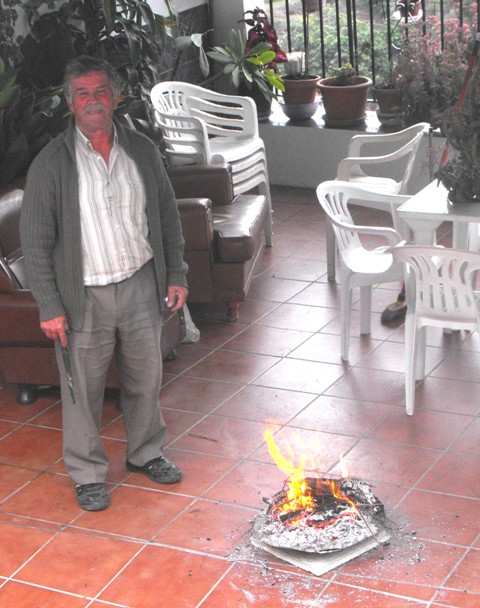
It's raining today so Antonio is preparing the brasero on his terrace

It was pretty cold yesterday. It had dropped to near 10 degrees and I was seriously considering putting on my long-sleeved shirt. Villagers, on the other hand, regard this season as deep winter. They go swamped in pullovers and fur. They are masters of the  traditional pseudo consumptive hacking cough, which crackles round the streets. I know it’s winter here because each morning my neighbour, Antonio Pino, places a bunch of dry vine prunings tied in a leathery tendril by his patio gate. Sometime during the afternoon he brings out his brasero – his brazier – and sets fire to the twigs. Only, he says, to drive off the smoke. He is practicing the very ancient art of Neolithic central heating. He assures me that it’s absolutely safe – safer than electricity (I can believe that!), clean because there’s no smoke, and free because the fuel is a by-product of grape production. Although wood is relatively scarce here, vine cuttings are plentiful and free.

The brasero is an ancient device, supposedly invented by Etruscans, though referenced in the Iliad in the form of princely engraved bronze or copper fire bowls. Antonio’s version, the poor man’s peasant fire bowl is made of plain iron and sometimes has legs. It is supposed to have been brought to Spain by the Romans.

Antonio explains how it works. First you must line bowl with “lima”. In my dictionary this means sand, which I suppose would do as well. In fact Antonio is referring to fine wood ash. He lines the bowl with a thick layer of this and lays the dry prunings on top. He then places the bowl in the road for “safety”, leaving just enough of a gap for a small car to squeeze between the fire and a concrete wall opposite if any of us want to leave the village. The ash, he tells me, insulates the bowl and stops it getting too hot, while directing the heat (upwards I suppose) and conserving it. The wood burns fiercely, driving off steam and smoke, and Antonio carefully heaps ash around it in a sort of miniature version of the charcoal burners’ technique.

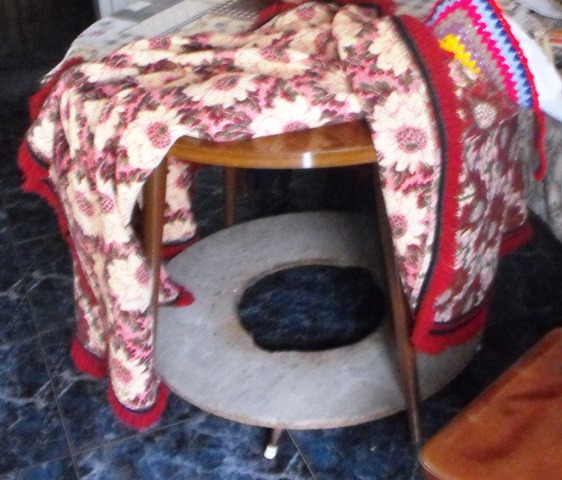
The brasero burns for about an hour. “An hour to burn it down gives twelve hours heat” says Antonio. The brazier can be simply put into the middle of the sitting room without fireplace or chimney. There are no fumes or smells. However the traditional way is to use  a “mesa camilla”. This simply means “round table”, but a shelf underneath has a hole to take the brasero. The brasero is seated in this lower shelf and the family sit around the table which is covered with thick blankets. Their legs are warmed under the  table by the brasero. Most older couples in the villages regard this as normal “central heating”, often to the disgust of the younger members of their family who complain that you must be glued to the table in order to stay warm!

The mesa camilla, ready for the brasero, note the thick blankets, ready to cover cold knees!

Posted by: puebloman | November 8, 2011

The euro. Britain shits on Europe. A view from Spain

photo by Daquella Manera

It has been sickening during the last week to listen to the Americans and British talking about the future of the Euro. The southern states of Europe have been subjected to veiled racist abuse, and European leaders admonished by politicians who lack the courage to do anything to reform their own back yards – their corrupted banking systems that created this mess in the first place.

Britain is playing a nasty little role in the present euro debacle. It was the British failure to regulate banks, many of which were bought up by the relatively excellent Spanish banking system, that introduced financial collapse into Europe.  British Conservatives have spent the last  fortnight boasting that because they are “trusted”, because their “austerity measures” inspire “confidence” they are able to borrow money at preferential rates.

What exactly does this mean? It means that Britain can borrow at 3% and charge Greece 7% for a loan. And Portugal. And Italy. And Spain. No wonder the British command international respect. This usury is cloaked and presented by the toadying BBC as “bail out”.

Britain flirted with the ERM, wasn’t man enough to stay in  and subsequently steered clear of the euro under Gordon “when the time is right” Brown. If there was any lack of leadership in Europe was to allow Britain to bully its way to a position where it could free trade with Europe while  retaining its alien currency. Free wheeling rights without responsibility.

How has Britain used this privilege? Over the last ten years it has quietly devalued sterling relative to the euro. When my wife and I bought our house in Spain six years ago, you could buy a euro for sixty-eight British pence. Today, six years later, a euro will cost you eighty-six pence, sometimes ninety pence.

What does this mean? Now that sterling has fallen by thirty per cent, British goods have effectively got 30% cheaper when sold to Europe and European goods – Greek and Spanish goods for example are 30% dearer to buy in Britain. Effectively Britain is undercutting its European competitors in spite of being part of a free trade community by using a slowly devaluing currency. Nobody on radio 4 – which is staffed by British patriots – mentions this fact when questioning euro sceptics, or even europhiles.

So what’s my solution to the euro crisis? Should Greece leave the euro? Should everyone except Germany and Holland leave it? On the contrary, Europeans should stand solid and together for the first time in their history.

I propose a devaluation of the euro at least 30% across the board. This would slam the trade door shut in the faces of the British, the Americans and the Japanese, whose goods would increase in price overnight by at least 30%. Britain might wish it were part of the euro, Barack “we lead from behind” Obama might complain, but this is a crisis – there is no room for sentiment. Everything they produce could be produced by the Germans Dutch and the industrialised north of the euro zone at no increase in price to euro customers. Having wiped out American and British competition, German and other industries would take an extra growth leap forward, creating employment possibilities and extra funds to support the weaker south. Within the Euro boundary, all prices will remain the same.

Brits as old as I am will remember Harold Wilson’s statement when he devalued the British pound during the 1960’s, that “The pound in your pocket” would not be affected. He was lying of course, but then he was the Prime Minister of a little country totally dependent on imports. Europe on the other hand is the one of the greatest, potentially the greatest economic community the world has ever known. It can handle itself on its own.

But what about the bankers? How will they get their money back? Well, they lent in euros so they’ll get euros back. And those euros will hold their value if traded within the euro block. If any banker tries to sell them, or trade outside the euro block, they will lose an awful lot of money.

This solution is the obvious first step out of the crisis. It is simple and just, which is why no one will even consider it.

Posted by: puebloman | October 31, 2011

“The spirit of woman” an exhibition by Ann Westley

The reflection

I went last week to see an exhibition of recent work by the artist Ann Westley who lives and works in Cutar, the village where we live. If you happen to be touring the Axarquia during the coming month, it will be well worth your time to drop into the gallery at the town hall, Velez-Malaga, where she is exhibiting her work.

The exhibition consists of watercolours, prints, illustrations and acrylics.

The acrylics each catch a moment in which the subject and the setting resonate with, and transform each other. For example in the picture “The girl above the rooftops”, her big boots hardly touch the tiles of the cottage roof as she stands suspended above the rooftop, naked and weightless, light as the air and of the air. “The Woman of the fountain”,  or “The woman of the source” is set in the still water of cavernous pink baths.  The woman’s limbs and the water are exactly the same tone and colour. Her swollen belly, the bird gazing at her from the tip of her finger and her  bright robes show her absolutely still, but pregnant with life.

The painting “The Canary woman” was perceptively translated by Google as “The woman in the Canary”, which I like.  In this picture we catch the amazed face of a heavily bodied woman as she outwardly sprouts wings and inwardly goes to pieces, presumably in song, against a canary yellow oblong set against sky.

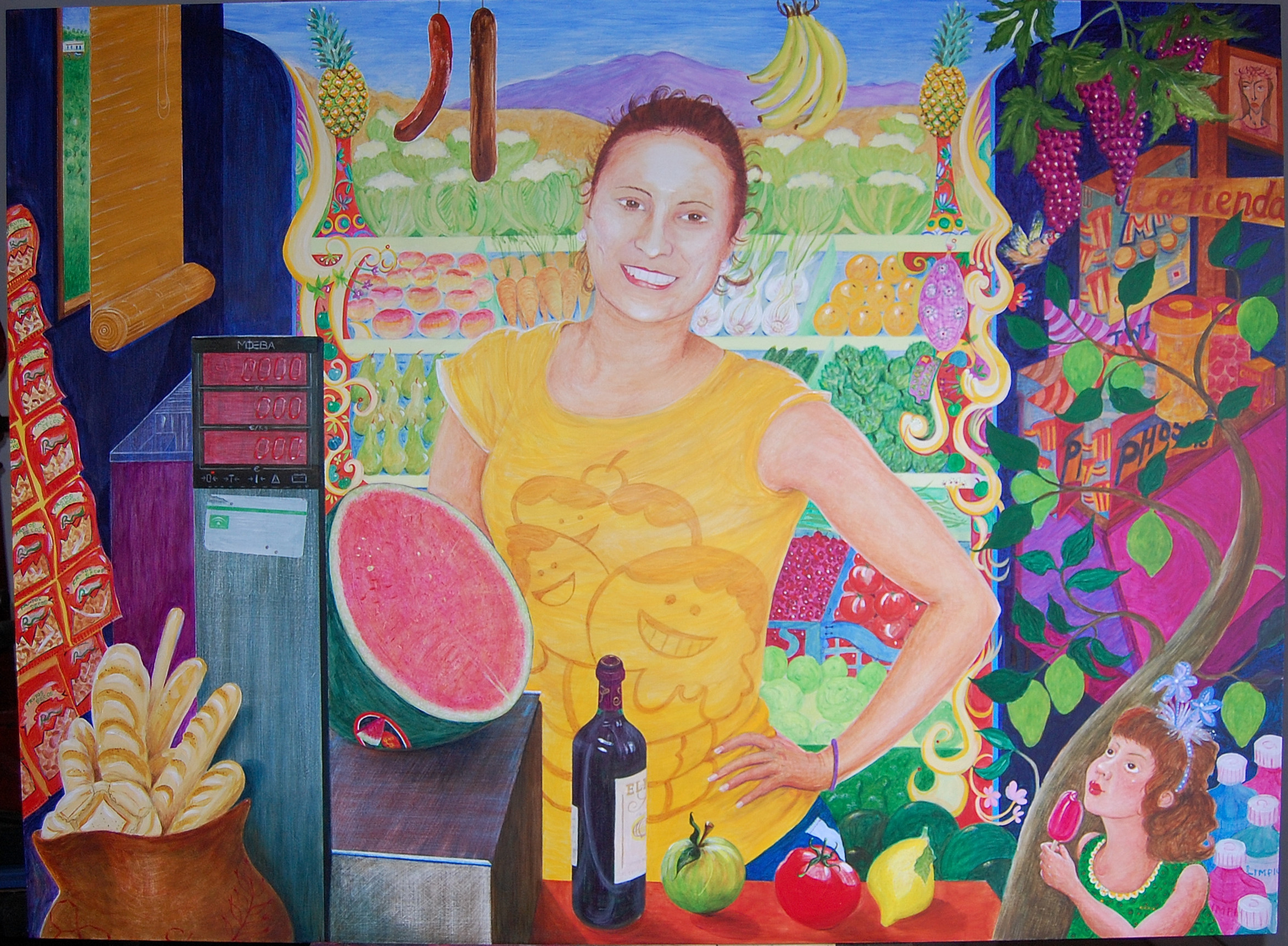
Jessica in her shop

The picture that moved many locals was “Jessica in her Shop” (above). The shop closed a few weeks ago. Like the school and the bar it was a lynch pin of village life and is much missed. This picture is now all that remains of it. The shop is not, however, depicted as it was – gloomy, with provisions piled against the shelves and smelling faintly of mice. Instead it’s transformed into a glorious cornucopia, bursting with good things and stuffed with life. It is endowed with the energy of the woman who runs it and brought to life by her optimism. There are many small stories woven in the detail of the picture, it reminds me of a Stanley Spencer resurrection. This vigour, strength and confidence is typical of an exhibition that radiates positive energy and never slips into sentimentality.

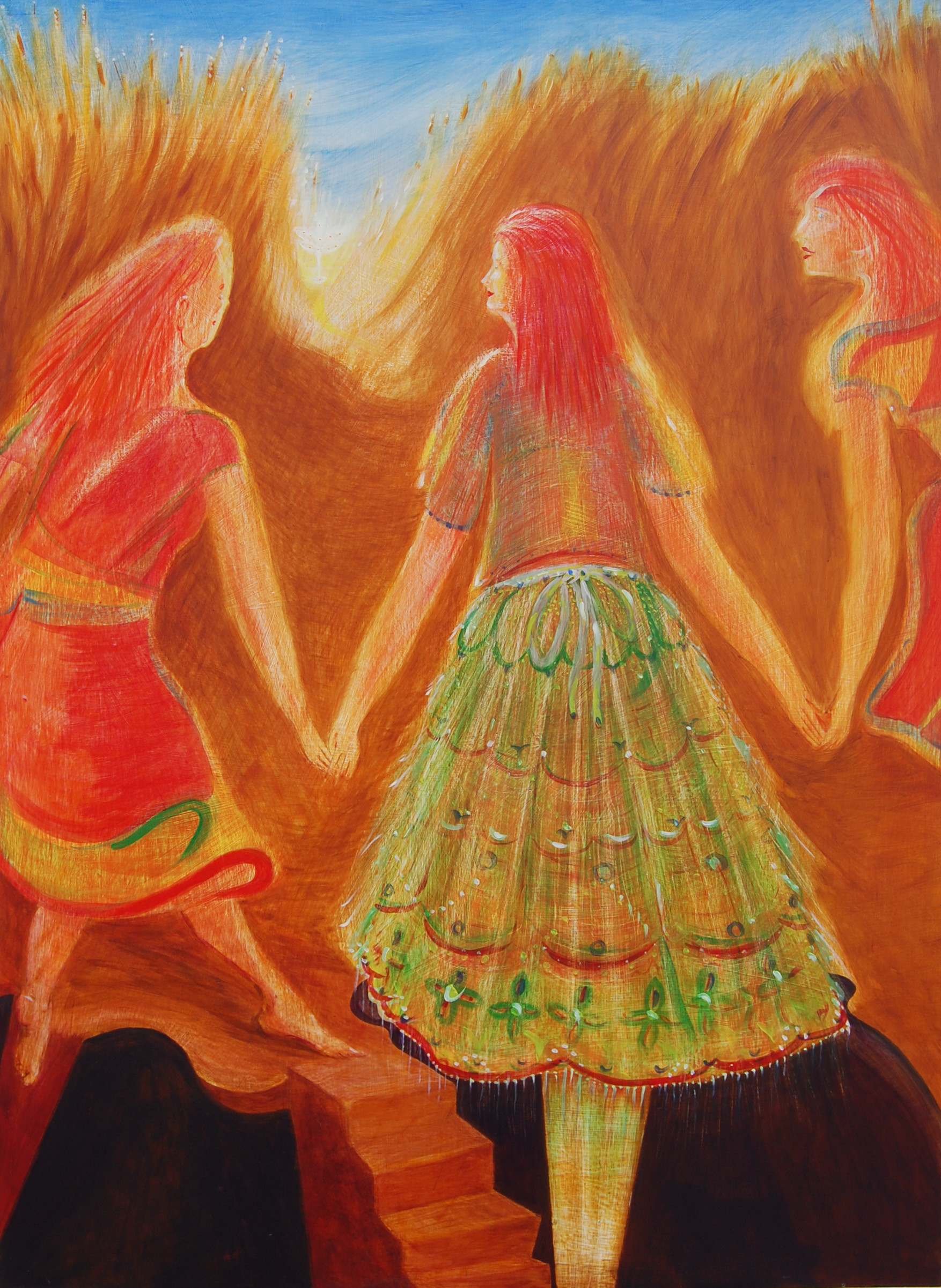
Fuego

“Fuego” (above) is the painting that I like best of all. Three girls hold hands in a cornfield, their hair the colour of the corn. At the bottom is  revealed the gaping black void and a staircase only just attached to the world above. The central figure is not climbing up the steps, she rather  “arises”, her ankles together as she floats weightlessly back into the world, guided by two handmaids, their bare feet firmly on the ground. This is Persephone released from Hell and from the arms of Hades. It is the moment when she returns to the world and Demeter her mother permits the harvest once more. So the field is blown by the wind into a raging inferno of corn, magically parted for the goddess in the way that the red sea parted for Moses. It is a very pagan picture. In the catalogue Westley, describing her process, talks of a little patch of yellowing weeds through which the neighbours have trod a track. The myth began to take shape as she worked upon this scene, visible from her kitchen window. It is the process of a true artist – a universal theme arising out of work upon an ordinary moment of everyday life. And the process is innocent. It allows a theme to arise rather than trying to force and control the subject matter. At the same time it does what an artist ought to do for her community – transforming everyday moments into universal themes.

I have posted the catalogue at the bottom of this log so you can appreciate the range and quality of the exhibition. Westley is less well-known than she should be because she has cloistered herself in our little village. At €300 – €500 for major pieces of work, the artist is selling herself at a price well worth investing in, even at this time of “crisis”.

Catalogo Ann Westley

Posted by: puebloman | August 25, 2011

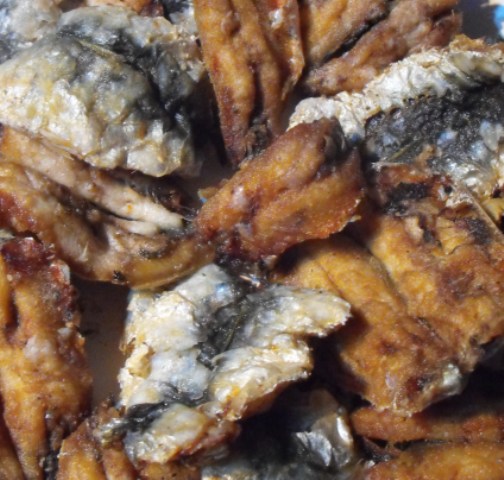
Cheap Spanish food 3. Sardines filleted and deep fried

Deep fried sardine fillets

If the great jewel in the crown of cheap English food is the Cornish mackerel, then its Spanish equivalent has got to be the sardine. The difference the English and the Spanish is that Spaniards don’t despise this, or any food just because its cheap. The sardine is “celebrated” – cooked and eaten everywhere from the posh dinner party to the beach shack barbecue.

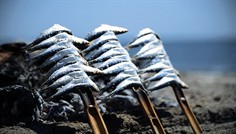
Sardines, head on gut in, spitted and roasted on the seashore

The simplest way with sardine is to roll them in coarse salt, stick a wooden skewer through half a dozen and grill them over charcoal. This is how its done at Spanish fiestas and street parties. The fish is cooked whole – gut in head on. The cooked flesh is chewed off the bone and the spine and head discarded.

Beach shacks and Chiringuito bars that spring up along the beaches during the tourist season usually gut and head their fish – they’re for foreigners after all.

You get an old clinker built rowing boat and fill it with sand, threadle an industrial quantity of sardines onto a yard long wooden skewer, stick it in the sand and roast your sardines over a smouldering hunk of olive wood.

Or you can head, gut and fillet them and deep fry them til they’re crisp.

Buying Sardines

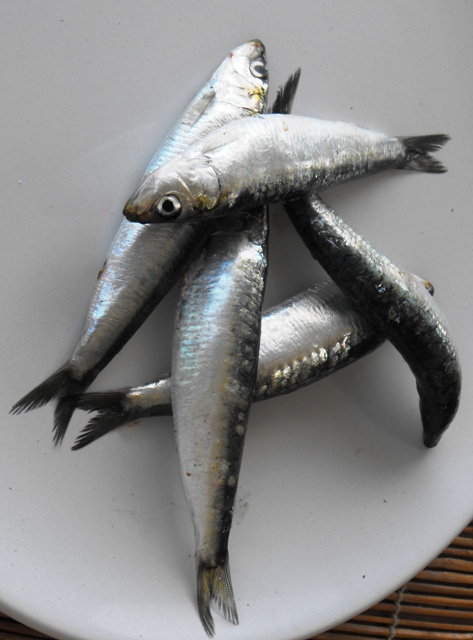
Sardines on a plate

Use the same common sense as you would when buying any fish.

Don’t buy on Monday because they don’t fish on Sunday so your fish is already two days old. Don’t eat fish in a restaurant on a  Tuesday by the way in case you get palmed off with Mondays leftovers. This is really old fish! Wednesday, Thursday and Friday especially- great. Saturday you may be getting the dog ends of the stock as they clear the  deck for Sunday and Monday. On the other hand, you may get some bargains.

Signs of fresh fish: Bright eyes, not sunken. Gills bright pink or red, not dark – and ask to see them. That’s what a Spanish housewife does! No smell. Go on – have a sniff! They should look slimy. And not flabby. Slightly stiff. Like these:

I bought forty of these for two euros. Forty. 

How to fillet and fry Sardines

Lets assume you’ve bought the best sardines, big and bright, the fishmonger mortified if you imply that they weren’t flapping on the slab an hour before you turned up.

Go home with your catch. wash your hands. Wash your sardines. You don’t need to scale them.

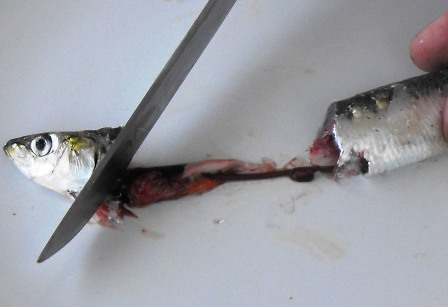
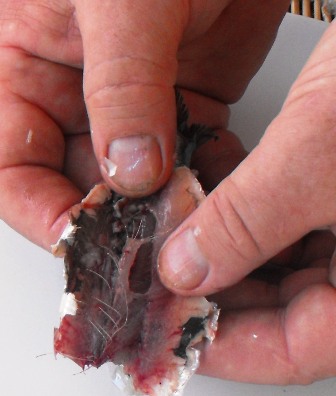
Get a sharp, small, non serrated knife. First behead your fish. Then draw the head away, taking the trace of gut with it

thus:

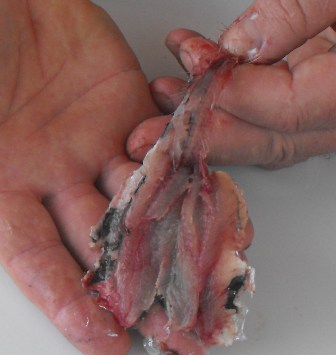
You can do this very quickly. Once you have beheaded and gutted all your fish, take each one in turn and massage the spine away from the flesh of the fish. You can do this by turning the fish spine up on a slab, and running your thumb along the spine. Or you can open the gut cavity and slide your thumb and forefinger along the spine from the inside of the fish. Either way it’s slightly messy, but takes no time at all.

When you have loosened the spine, lift it free from the butterflied fillet thus:

Good. All thus will seem messy and fiddly when you start but you soon  develop a technique. I did forty sardines in fifteen minutes.

Open the fish and massage the spine

Lift the spine gently from the flesh

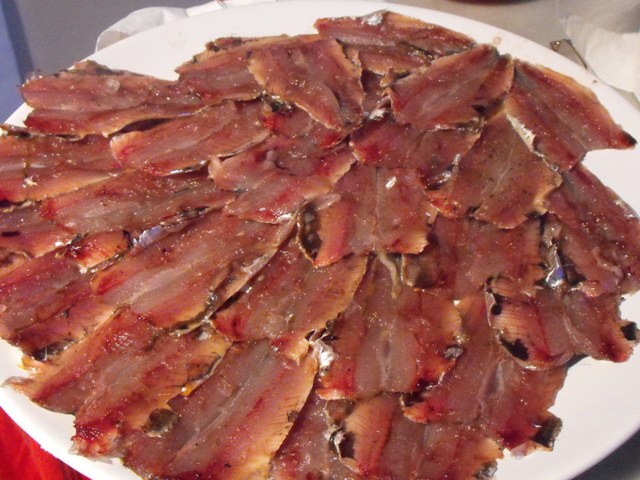
Forty fillets. I did these in 15 minutes

The final stage is easy. Use a fish fryer, or if you don’t have one a wok with a good two inches of sunflower oil in it. Heat the oil until a little crust of bread sizzles as soon as it hits it.

Prepare some flour, seasoned with plenty of salt, a few screws of freshly milled black pepper and a good pinch of Provencal herbs. Spanish flour is milled to a fineness fit for purpose, so look for Harina Fritos y Rebozados, which is fish frying flour. Put it in a plastic supermarket bag. Drop all the fillets in and shake so that they are all lightly coated with the flour. Drop them into the oil about half a dozen at a time and don’t take them out til they are golden. Grey fillets taste the same but look horrible so no one wants to eat them. When done, drain them on kitchen paper. You can eat them hot or cold, with or without sweet or hot paprika sprinkled over. Plenty of Spanish fishmongers and supermarkets will  sell you these already filleted, but its less satisfying than doing it yourself!

Posted by: puebloman | August 7, 2011

How to buy Serrano Ham

Next time you come down to southern Spain for a holiday – and you won’t be able to stay away for long, instead of returning home with a fluffy donkey or a mexican hat, consider a quality souvenir that will give pleasure to you and yours for a good six months. I’m talking about a leg of Serrano ham.

Just as “cafe con leche” is superior to “cafe au lait”, so Jamon Serrano is superior to Parma ham, though by the price of the latter you wouldn’t think so. Serrano ham is also cheap Spanish food. In the sense that it is “best value” Spanish food.

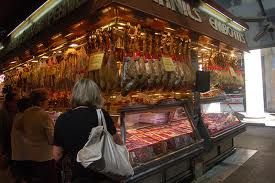
Jamon Serrano (literally sierra meaning ‘mountain ham’) is dry cured ham. It is covered with salt for two weeks to draw off moisture and preserve the meat, then the leg is washed and dried for six months and then hung in sheds for at least another 6 months at cool, high altitudes (hence ‘mountain’ ham). As always, in hot countries you don’t need smoke when the heat of the sun is free!

Serrano ham curing while it sells

There are four aspects to a serrano ham’s quality:

The type of pig

The pig’s food

The cut (leg or shoulder)

The curing process

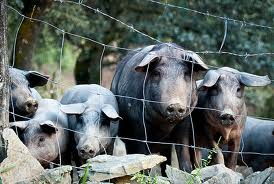
Beautiful, acorn stuffed Bellotas

These are the four categories of ham, starting with the highest:

Jamon Iberico de Bellota or Iberico de Montanera : Made with free-range acorn fed Black Iberian pigs (cerdo Iberico). Highest quality. Accounts for only about 5% of sales

Jamon Iberico de Recebo Acorn : The same pigs, part free range and part compound fed

Jamon Iberico : Same pigs, compound fed. This is known as Jamon de Pata Negra

Jamon Serrano, Jamon Reserva, Jamon Extra, Jamon Curado : Compound fed large white pigs

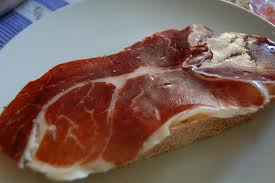
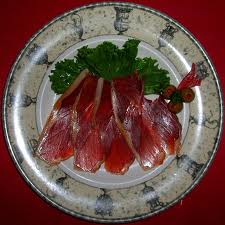
Serrano Ham has denomination de origin, like Manchego cheese and wine. Jamon de Huelva is the local denomination nearest to us, from northern Andalucia. Serrano Ham should be served at room temperature. It needs to be stored in a cool dry place, covered to preserve the aromas, and brought to room temperature prior to eating. It is best eaten in thin slices, but cheap Serrano can be diced and lightly fried in olive oil before being added to vegetables – baby broad beans for example.

For these and other delights, see us on http://www.vivasiesta.com

« Newer Posts - Older Posts »

Categories