Posted by: puebloman | August 1, 2011

How to buy, cook and eat Octopus

What is an octopus?

The octopus is a member of the Cephalopod family that includes squid and cuttlefish – all delicious eating.

O. vulgaris is is the most popular eating octopus. Twenty to one hundred thousand metric tons of this octopus is landed yearly. The octopus, though an intelligent animal,  easily yields to the octopus pot. Traditionally these were made out of clay but now they are made of plastic or PVC. You don’t put bait in octopus pots like crab and lobster traps. Instead you make the octopus feel like its nestling in a safe octopus home.

The octopus is a highly developed form of mollusc that has a centralised nervous system, a big head and a real brain. It can remember and learn. Although it looks like an alien from space, it is speedy and athletic in the wild and can rapidly change colour to hide or intimidate the predator.

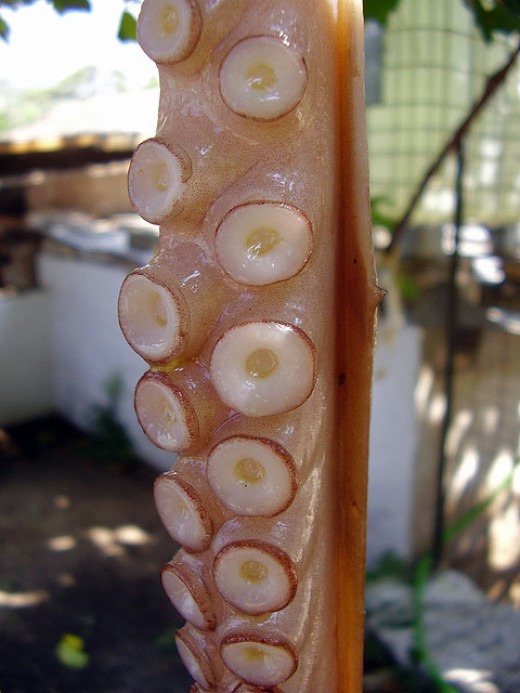
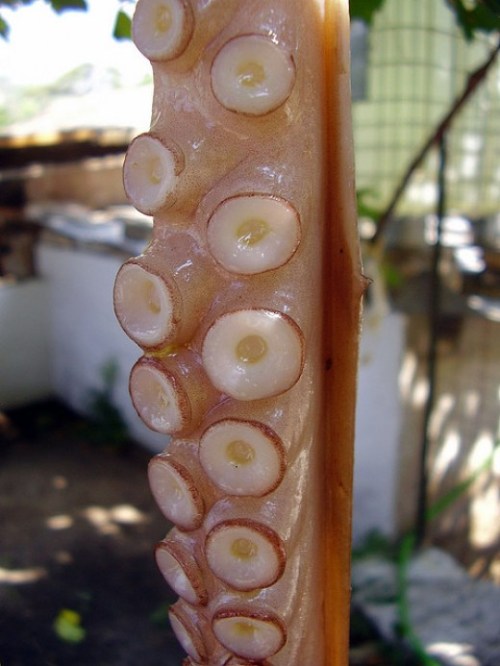
There are three edible species of octopus, but the common octopus, Octopus Vulgaris is the most commonly availble and the best eating. It can grow to 300 cm or nine feet long. On the fishmonger’s slab, look for the double row of suckers.

Preparing

From the cook’s point of view, the octopus consists of a sac, which is both its head and its guts, mouth parts like a bird’s beak, but with a file like construction that allows it to saw through the shells of molluscs. The “head” also has big eyes. Attached to this body are eight legs.

Octopus is always sold cleaned, but in case you get given one, you just have to open the head sac and wash out the guts. Remove the “beak”. There is no need to skin the octopus.

The stumbling block, according to reigning “wisdom,” is that octopus is so tough that extraordinary measures must be taken to tenderize it. And if you ask five different people what these measures are you are likely to get five different answers, all arcane – which goes a long way toward explaining why no one cooks octopus at home.

  1. A Greek cook may tell you to beat it against some rocks (actually a contemporary would probably tell you to throw it against the kitchen sink repeatedly).
  2. A Spanish cook will dip it into boiling water three times, then cook it in a copper pot – only copper will do.
  3. An Italian might cook it with two corks
  4. The Japanese rub it all over with salt, or knead it with grated daikon, then slice the meat at different angles, with varying strokes.
  5. My advice: freeze it for 24 hours or, better, buy it in legs, frozen

Fresh or frozen? How to buy

The best way to judge freshness is to smell – the aroma should be of seawater, nothing else. (An octopus that is going bad will reveal itself to your nose in an instant.) Most but not all fish markets carry frozen octopus, and any should be able to get it for you with a day or two notice.

Two to three pounds of octopus is about the right amount for four people (it shrinks startlingly). It doesn’t matter much if you buy one larger specimen or several smaller ones, though it will affect cooking time (see below).

Cooking

Like all Cephalopods, you cook them quick, or very slow. You can toss an octopus leg on a hot barbecue or deep fry it. I prefer it braised in equal parts water fish stock and white wine. Gently fry slivered carrot, celery and thinly sliced onion until nearly soft then add two or three cloves of chopped garlic and cook until they start to colour then turn up the heat and pour in the wine so that the alcohol bubbles off. Then add the stock and water. Then put in your fresh or (preferably) thawed octopus.

Like all Cephalopods, there are no hard and fast rules for timing. Some people say octopus should cook about 30 minutes per kilo (two pounds) but often the timing is longer. A 12- to 16-ounce octopus certainly cooks in less than an hour, and if you put four or even six of them in a pot together the cooking time will be faster than that for a four-pound octopus, which can take as long as two hours to become tender. Check with the sharp point of a thin-bladed knife; when it meets little resistance, the octopus is done. Do not cook further or it will begin to dry out and toughen again.

Cooking methods

It has long been a standard at sushi bars of course; and you have been able to find it at Spanish, Portuguese, Greek, and even some Italian restaurants for years, in salads, stews, or with potatoes or pasta. Now, however, you see dishes like octopus terrine, octopus confit, octopus risotto, octopus with pasta, and more. Then of course there’s grilled octopus, which – since it was first popularized at Periyali about ten years ago – has become downright trendy.

All of these dishes can be readily accomplished by the home cook. Cook your octopus slowly. No one wants rubbery octopus (although sushi-style octopus is nearly rubbery), but if octopus is properly handled, without fuss, it is reasonably tender. It remains chewy, but so does lobster, or sirloin steak.

Octopus is much like squid: If you keep the cooking time minimal, under five minutes or so, you get a chewy but not unpleasant texture; this is a good technique for octopus salad or sushi. But for most preparations, long, slow cooking, which yields a tender texture, is best. (If you cook it too long, it becomes dry and tasteless.)

Although octopi live all over the world, there is a common belief that the best octopus comes from Portugal. But since water knows no political boundaries (and Portugal is hardly a body of water), it can hardly be the whole truth. According to Vincent Cutrone, who owns The Octopus Garden, a Bensonhurst fish store specializing in the cephalopods (octopus, squid, and cuttlefish), “Whether Atlantic octopus is fished by the Portuguese or anyone else, most of it comes from the waters off the west coast of Africa.” But Mediterranean octopus is also common, as is octopus from Asia, especially the Philippines. (There is very little domestic octopus, probably because the domestic market is so small; it’s an incidental catch and probably thrown overboard as often as not.) After weeks of cooking octopus from all over the world, I detected little or no difference in quality between those from Europe and those from Asia.

Almost all of this octopus is cleaned and frozen before shipping, which is not the disadvantage you might think. For one thing, octopus spoils quickly, so it’s difficult to maintain high quality during shipping, especially since it’s not expensive and therefore rarely shipped by air. More important is that the quality of octopus, like that of squid, does not suffer noticeably when it is frozen.

Posted by: puebloman | July 31, 2011

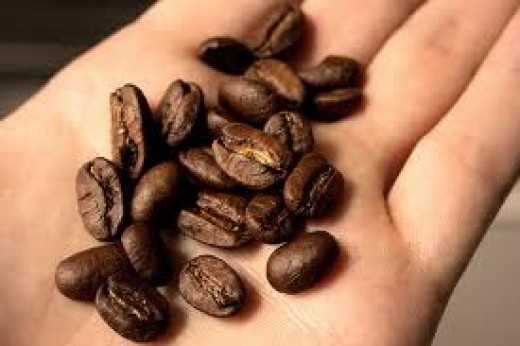
What is Spanish coffee?

How coffee came to Spain

  1. Coffee, like very many good things, was bought to Andalucia by Islamic Arabs.
  2. It was discovered by Berbers around the sixth century, in Ethiopia where it grows wild. The berries produced hallucinations and suppressed the appetite, so until the 10th century coffee was considered to be a food.
  3. Its uses in religion and medicine became well-known by the thirteenth century. It was traded across the Red sea to the Arabian peninsula. Coffee kept you awake. It was an “eye opener,” – it allowed Muslims to keep going during long prayer ceremonies.
  4. During the Muslim expansion between the 8th–16th centuries coffee appeared in Turkey, Spain and North Africa
  5. The Catholic church considered coffee to be a satanic concoction, and the Vatican argued that it was the spawn of the Islamic infidel,until Pope Clement VIII (1535-1605) tasted it, disagreed, and baptised it, pronouncing it a christian beverage (Catholic wankers!).
  6. Spain and Portugal then spread coffee cultivation across South America. Today coffee growers in Latin America account for nearly half of all the coffee exported; however, most Spanish coffee served in Spain comes from Angola and Mozambique.
  7. Today the FEC estimates that more than 24 million cups of coffee are drunk in Spain every year: the equivalent of 599 cups for every person. The following standard versions can be had in most bars

What makes Spanish coffee different?

You can roast coffee beans in two different ways. The most usual is ‘tostado natural,’ which is the simple application of heat to the bean. The second is sold almost exclusively to Spain and Portugal. It is called ‘torrefacto,’ where sugar is added during the toasting process to produce a darker-coloured, stronger-tasting coffee bean. This variety is known as Spanish roast

How to order a coffee in Southern Spain

In the little white villages in Andalucia, southern Spain where we live, you coffee comes in a glass and is made espresso method, very strong. Cups with handles are appearing, but they are for foreigners and for the posh.

Café Solo – single espresso – a “normal“ coffee, and
Café Doble – double espresso are the choice of men in bars. This is often drunk with a glass of water. 

Café con Leche – coffee with milk, half and half proportionally to taste – is breakfast coffee, but i’s much stronger than that soup bowl of tinted milk, the french “cafe au lait” – If you like coffee that weak, try

café nube – a thin stain of coffee in a glass of hot milk.You can also order

Café Cortado – espresso cut with just a bit of milk, or

 Café con Hielo – espresso served alongside a glass of ice, or after a hard day’s holiday making, a 

Carajillo – espresso spiked with brandy or whiskey.

For these and other delights of the Andalusian holiday, see http://www.vivasiesta.com

Posted by: puebloman | July 27, 2011

Understand Spanish Brandy

A brief history of Andalucian BRANDY DE JEREZ
The cultivation of grapes in Jerez goes back to at least Roman times but the Moors who followed and ruled most of Spain from 711 to 1492 were forbidden by their religion from drinking wine. However they clearly did drink, claiming as dispensation that the wine was “pudding”!

The cultivation of grapes continued in Jerez and the practice of distillation is known to have been introduced in the 10th Century mainly for the production of cosmetics, essences and antiseptics. The word ‘Al-Kohl’ is an Arabic term for the fine powder used in cosmetics which was a bi-product of the distillation process. In ancient Spanish the reflexive verb ‘alcoholarse’ did not mean to drink copiously, but to paint one’s eyes.

As the popularity of the wines of Jerez (‘Sherry’) increased, distilled spirit was added to fortify them for export and eventually the local wine producers must have realised what a wonderful evolution took place when these wine distillates were left to mature in the oak casks previously used for ageing Sherry.

In the 19th Century, an important export market with the Netherlands developed selling raw grape spirit (65% alcohol) matured in old Sherry casks that became known as ‘Holandas’. Once at its destination, this was either diluted and sold as ‘brandewijn’ meaning ‘burnt wine’ (brandy) or mixed to make different liqueurs.

In 1835 González Byass was founded and in 1844 the first alembics (pot stills) were installed. In 1845 in what was one of the earliest references to the sale of Jerez brandy, a shipment was sent by González Byass to Ireland. The following year, the Soberano name was selected due to the close friendship of the González family with the Spanish sovereign (‘Soberano’ in Spanish). By the turn of the century, the principal export market for Soberano was the British Isles partly due to the successful business relationship with the Byass family who had been both agent and partner since 1855.

Now with the introduction of Soberano Solera Reserva 5 and the increasing number of English people who visit Spain for their holidays each year, sales are on the increase once more – up 30% in 2001.

How to read your Brandy Label

Brandy has a rating system to describe its quality and condition; these indicators can usually be found

near the brand name on the label.

A.C. – aged 2 years in wood

V.S. – “Very Special” or 3-Star, aged at least 3 years in wood

V.S.O.P. – “Very Superior Old Pale” or 5-Star, aged at least 5 years in wood

X.O. – “Extra Old”, Napoleon or Vieille Reserve, aged at least 6 years, Napoleon at least 4 years.

Vintage– Stored in the cask until the time it is bottled with the label showing the vintage date.

Hors D’age These are too old to determine the age.

Spending time at an alcohol recovery center is less likely when a person consistently drinks in moderation.

Posted by: puebloman | July 26, 2011

Cheap Spanish food 2 What is Menu Del Dia?

Eating in Andalusia, Spain

The menu del Dia

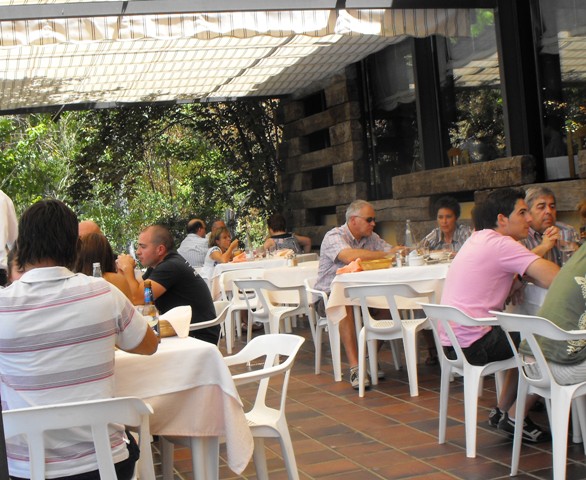
Lunch al fresco Spanish style

The Spanish menu del dia was invented during Franco’s dictatorship to provide working men with one substantial meal per day. Del Dias have a fixed price. The Axarquia, Andalucia has the reputation for the cheapest and best value del dias in Spain.

The fare is rarely written down or even chalked on a board, so you have to do the whole thing verbally with a waiter. While they rattle off the whole menu with a flourish, they,  like most Spaniards, are courteous and patient in repeating, waiting, explaining, even venturing into a little English. Many tourists find the bread, salad, three courses altogether too much, though you can always order a single plate, or even a plate and two forks, after all this is Spain not England, but your “poor” appetite may not find favour with your waiter.

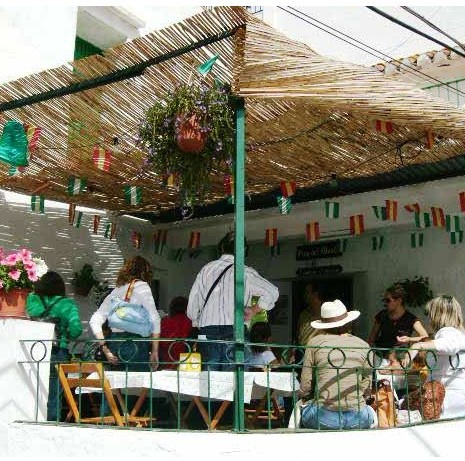
The village bar

Spaniards, like the French, eat a plate of soup, followed by a plate of veg followed separately by a plate of meat or of veg. Northerners on the other hand – the English, the Americans, the Irish, the Germans, Scandis, and the Lowlanders prefer to squash their food all together on a fork and stuff it into their gaping gobs. For this reason Spaniards have conceived of an alien plate called a “combinado” where you get, for example, fish or meat, veg and chips all on the same plate. Lemon is not usually served with fish. It is however served with pork, especially “filete” – thin slices from the leg. Don’t forget to ask for “allioli” – a small dish of mayonnaise heavily spiked with garlic and indispensable for chips and perfectly deep fried floured fish.

Spaniards eat late. 2.30pm for lunch (turn up at 2pm on paella day to make sure you get some!) and 9.30pm for an evening meal. Evening meals are for weekends and fiestas. On an ordinary day a Spaniard eats heavily at lunch time, works it off and eats light in the evening. The evening meal is so late because Spaniards work so late. They start at 8am, work til 2.30 pm, siesta til 5.30pm and work until 8.30 – 9pm. A long and punishing day. Northerners should not be so patronising about the “siesta” culture

LUNCH AT BAR FLORIDA

This is the best lunchtime eating house in Velez Malaga. People come from miles around for the best value (7.50€ in 2011) lunch. There is a large choice of dishes and you get three courses, bread and a drink for your money. It has upwards of 50 covers, and bustling and friendly service but you must speak some Spanish or use a dictionary  because there is no written menu

Whats the best day to go? Any day, Tuesday for paella, Thursday is market day

Whats the best time to go? 2 pm until 3.30 weekdays for the ‘Menu del Dia’, any time for rolls and coffee. Open evenings and weekends but no Del Dia.

Where is it? Velez Malaga – At the Paseo with the giant walking rubber trees, where the buses stop.

What do you get?

1. Para beber (to drink) cerveza, agua con/sin gas, vino tinto/blanco

2. Primero (first course) one of the following:

i. Sopa – (all year round) sopa de Moriscos (seafood), Picadillo (chopped bacon and egg in a rich chicken stock)

ii. Entremezas (cold starter: serrano jamon, manchego cheese, prawns, potato salad)

iii. Ensalada mixta (mixed salad: tomato, lettuce, olive, sweetcorn, tuna)

iv. Callos: (In winter – Chick peas with saffron, blood sausage, pigs bits) Bezas is like Callos, Col uses cabbage

v. Paella (Rice with saffron, seafood and chicken)

vi. Spaghettis (slightly overcooked spaghetti in sauce)

vii Gazpacho or Ajoblanco (Summer: Cold typical soups served in half litre beer jugs)

3. Segundo (second course) one of the following:

i. Pescados = fish (‘frito’ = fried in batter or ‘a la plancha’ = cooked on hotplate with parsley and garlic) You can have a plate of

a. Calamares, calamararitos, pulpo, jibia (squid, octopus, cuttlefish)

b. Rosada, bacalao, merluza (dogfish, cod, hake white fish)

c. Sardinas, bocarones (Fresh Sardines, fresh anchovies oily fish)

ii. Carne (‘a la plancha’ or ‘con salsa’ = grilled or in sauce) You can have a plat of:

a. Chuleta de Cerdo con patatas y huevo (grilled pork chop, fried egg and chips)

b. Pollo (grilled chicken) a joint or “filete” – thinly sliced breast cooked on a hotplate in a persillage of parsley,                               garlic and olive oil

c. Carne con salsa (pork meat in tomato sauce)

d. Albondigas (meatballs in sauce)

4. Postres

i. Natilla ( custard with soggy digestive biscuit)

ii. Arroz (rice with cinnamon)

iii. Flan (caramel custard)

iv. Frutas (Fruit in season – melon, peach, orange)

v. Helados (ice cream cornet)

vi. Café – ‘solo’ or ‘con leche’ (black or with milk).

Menu del dia price (2011) seven euros (yes – three courses and a drink!)


Posted by: puebloman | July 25, 2011

Cheap Spanish food 1: Patatas a lo pobre

There are certain foods that it would be a feckless extravagance not to eat, they are so cheap and such good value. UK Cornish mackerel, and mussels come to mind. These foods, among the best this world has to offer, are so cheap that they are largely ignored. If they were ten times dearer , the stinking rich would niche them, clique them and otherwise celebrate them while the wheedling poor would claim them as a human right.

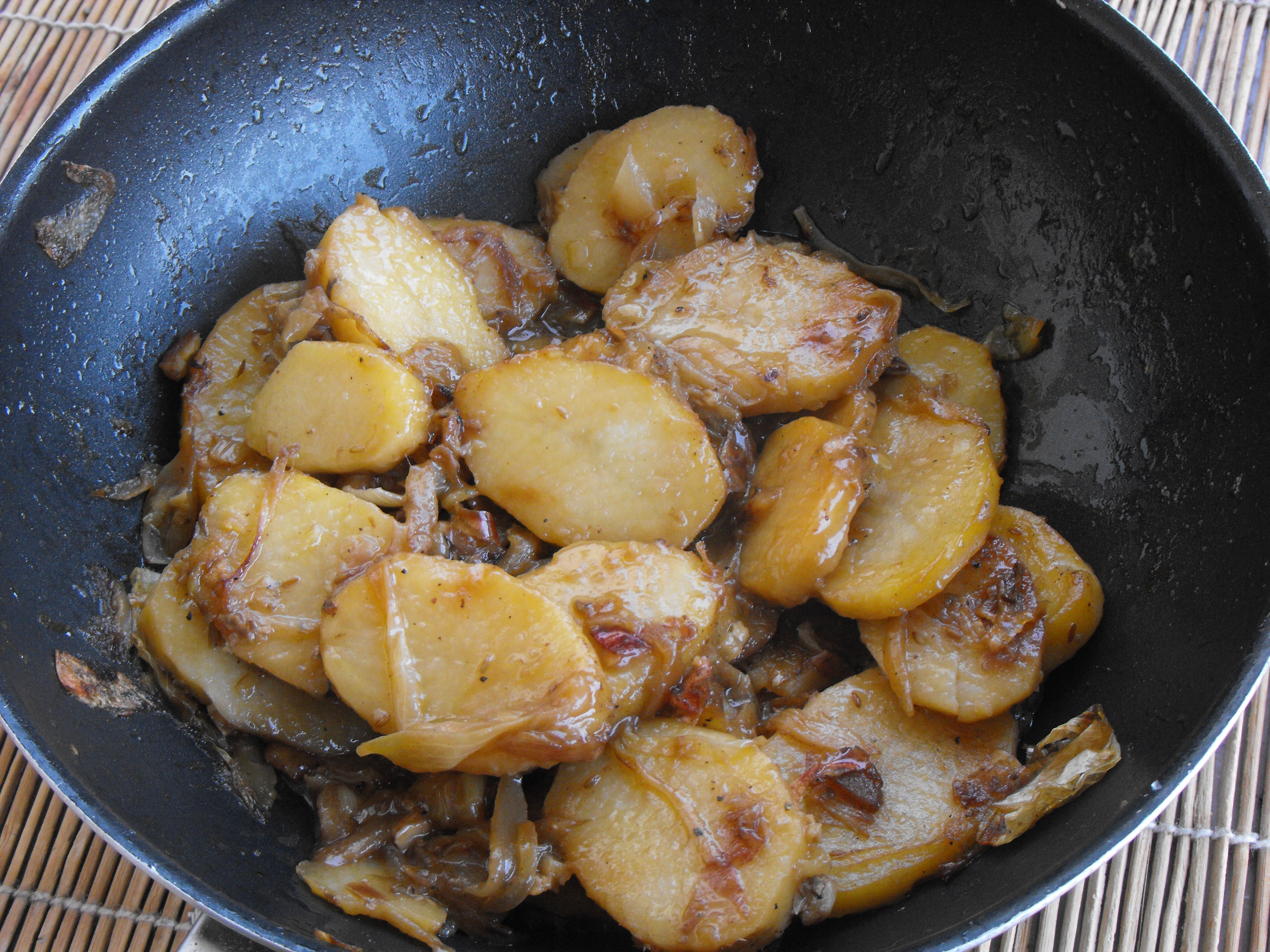
So before its too late let me sing the praises of one of Spain’s great humble potato dishes “Patatas a lo Pobre” – poor man’s potatoes. This has to be one of the world’s great peasant dishes. It’s a dish of onions and potatoes so no one is excused from eating it because of its price. It is delicious hot, cold and as a base for a wide range of Andalucian specialities.

Imagine your partner is out for the day, leaving you alone with a blank sheet of writing paper, a list of domestic tasks and the porn channel. What is the first thought that comes to mind?

“What’s for lunch?”

Exactly.  As a casual lunch it beats sardines on toast, beans on toast and toast. It also beats poncy elaborate dishes ( Yes I can cook) that are pointless if you have no witnesses or fellow eaters. “Lo pobre” requires 20 minutes of Tender Loving Care after which you can leave it to its own devices. For example you can pile it hot onto a hot plate, scatter pieces of bite sized serrano ham over it and top it off with two fried eggs. On the other hand you can just leave it in the pan and graze all day on it, stabbing your fork into it every time you pass by as it slowly goes cold.

  1. Take a deep frying pan or wok and pour in a wineglass full of well flavored olive oil. Extra virgin is a waste, but it ought to have sabor.
  2. Crush half a bulb of garlic cloves under a flat knife and put into the oil, skin and all.
  3. While they are gently sizzling, finely slice a large Spanish onion.
  4. When the garlic just starts to colour, remove it and put in the onion.
  5. While the onion is sizzling in the garlicky oil, peel and thickly slice a kilo or so of potatoes. Those huge white Spanish ones are best, that look like new potatoes but aren’t waxy.
  6. Add the spuds and turn them gently with the onions in the oil. Neither the onions nor the potatoes must brown, though a slight caramelisation is acceptable. The mixture should be slightly damp, not dry. Avoid burning the ingredients.
  7. When the potatoes are soft but al dente, turn the heat up and pour in a big glass of wine. The dry thin sherry called “Cobos” is best and gives the scent of Andalucia. White wine will do, resinated wine is good. I often use “Pasero” a very sweet sherry like local drink made from Moscatel raisins.
  8. Bubble off the alcohol, turning the mixture gently.
  9. Mash the cooked garlic cloves with a little salt. Remove the skins and add to the mixture
  10. Pour in half a pint (300 cc) of hot stock. Any old stock will do. I use old Knorr chicken cubes.
  11. Bubble the mixture at high heat, turning the mixture. Check seasoning. let it reduce until the spuds are just soft and coated with a shiny sauce.
This is the classic version. It can hardly be improved. Its just as good without the wine. Here are some variations:
  • In Velez-Malaga, where we live, this dish is served as “Broken eggs”. It is a Velez classic. The potato mixture is place in a small stainless steel frying pan – one pan per person and the mixture heated up up to frying temperature. Two eggs are broken into each pan. Once they have almost set, the mixture is gently stirred so that the eggs set round the potatos. The dish is topped with shredded Serrano ham, and each persons portion is served to the in their own individual pan.
  • Roughly chopped long green peppers are often fried in with the potatoes.
  • Add lightly crushed and whole black peppercorns at the frying stage
Non “classically” you can
  • Add Provencal herb mixture at the frying stage
  • Add a couple of rashers of chopped streaky bacon
  • Thinly slice two long sweet green or red peppers and add to the frying mixture
Posted by: puebloman | July 23, 2011

Cheap Red Spanish wine: reading the label – a crib list

Reserva, Grand Reserva and Crianza all under €4

Reading the label on a bottle of Spanish table Wine

Where we live, in the Axarquia, Andalucia, you can’t grow a good grape that produces table wine. It’s far too hot. Here we grow muscatel grape that produces a sweet white “digestif”or an “aperitif” these are not usually drunk with meals, though of course drinking is always accompanied by food, usually tapas.
West of us, around Jerez, they produce sherry of course. North of us, around Granada, it is colder and grapes can be grown that produce table wine. It’s said that the grapes must be kissed by frost to produce grapes for table wine.
The world class Spanish grape, on a par with Cabernet Sauvignon,  is the Tempranillo grape.
One of the great things about life in Spain is that you can talk about “Grand Reserva” wine and cheap red wine in the same breath. And this is not because Grand Reserva is a meaningless term. Very far from it. In fact the wine buying consumer with little or no experience of buying can have every confidence in the terms on the label.
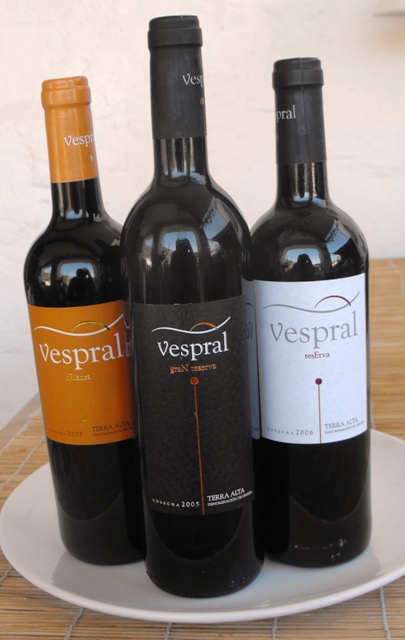
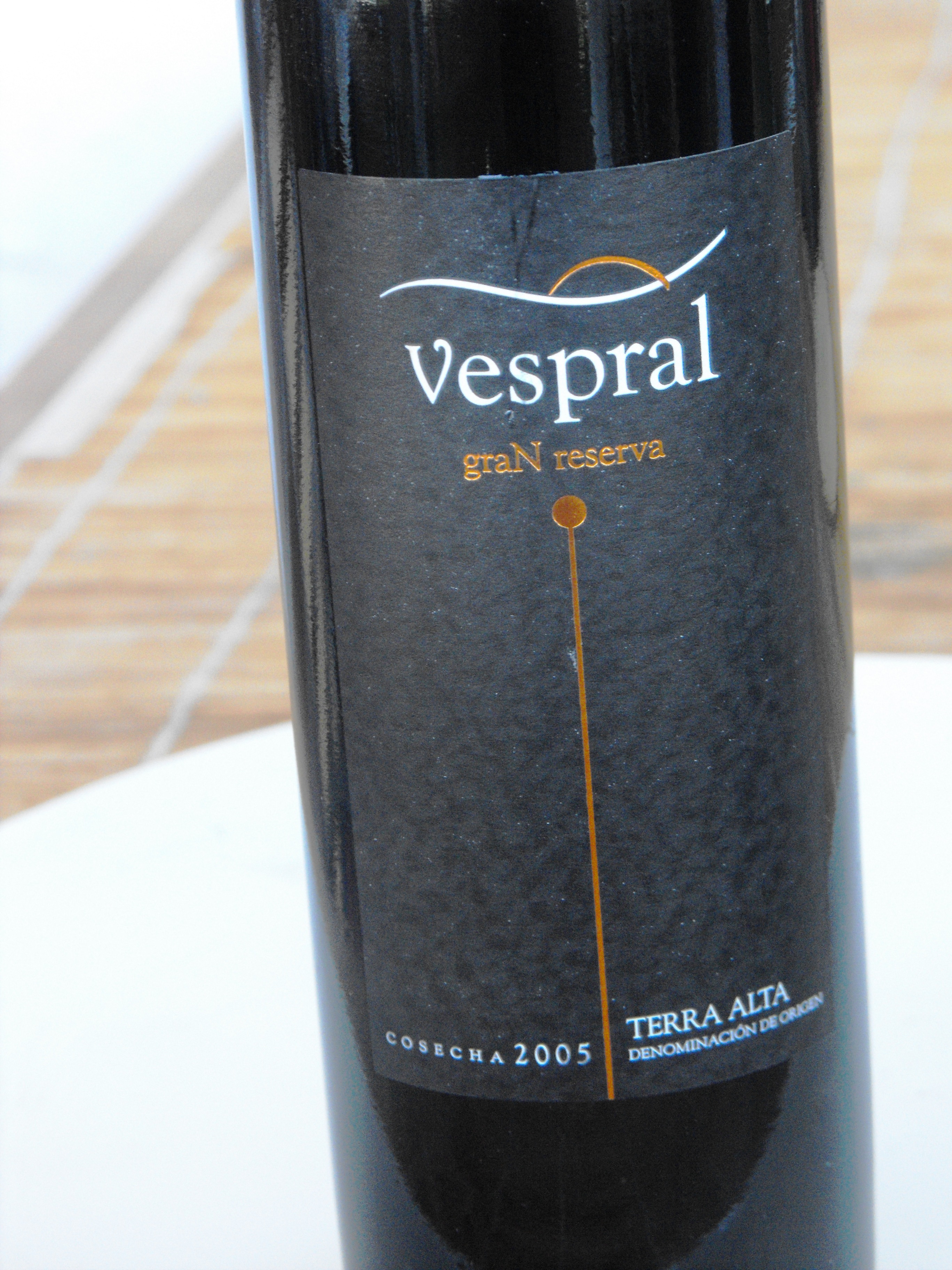
You may or may not like the taste of the wine, but this is, well, a matter of taste. You can however have no doubt about the quality of the wine, the expert assessment of its vintage, the work that has gone into processing it, or the commitment of the vintners. It is benchmarked at every stage, and each bench mark assessed by experts. Our favourite cheap red wine at the moment is called Vespral. The Denominatio d’Origen is Tierra Alta. That’s where it comes from, a region almost as famous as Rioja. The grape is tempranillo and granache. Native Spanish grapes. A Crianza is €1.99, A Reserva is €2.49 and a Grand Reserva $3.49.

Someone thought it worth investing 6 years of shelf space in this wine. Laid down in 2005

To find out the value of these wines, see the crib below.

Spanish wines: what it says on the label

  1. Vino de mesa: the cheapest table wine, often blended, with no indication of its geographic origin
  2. Denominacion d’Origen This little badge is found on all wine bottles whose wine has been tested and tasted by a committee of vintners and professionals from the area in which the grapes are grown, and been found to be of an acceptable standard and conforming  to the statutory processing standards.
  3. Vino joven: new wine, usually from a qualified Denominacion de Origen, occasionally with slight ageing, without qualifying as “roble” or “crianza”
  4. Roble: “roble” in Spanish means oak. Sometimes a wine is very lightly oaked and some regions are allowed to use this term on the label for wines that are oaked but don’t reach the requirements of a “crianza”.
  5. Crianza: Is a good D.O. wine, aged for two years, with a minimum of six months in oak barrels
  6. Reserva: Is a high quality wine at least three years old. At least one of these years must be in an oak cask, with a further 2 years of ageing after bottling, made from top vintage grapes.
  7. Gran Reserva: quality wines usually aged for at least two years in oak barrels with three more years after bottling, made with grapes from the exceptional vintage years

Supplementary information:

  1. Bodega = From a named winery, always named, usually a family business
  2. Añejo = Means aged or matured
  3. Cepa = The type of grape – tempranillo, cabernet for example
  4. Cosecha, vendimia = The year, or the vintage
Posted by: puebloman | July 16, 2011

The European Banking Authority shits on Spain

The European Banking Authority, an organisation commanding little respect among world investors, today sought to attack and undermine the Spanish economy by publishing a spurious and misleading report on Spanish Banks.

Headlines report that five of the eight banks that failed the “stress test” applied by theEuropean Banking Authority were Spanish.

There is of course, no room in a headline to observe that all of these apparently  failing banks – CaixaCatalunya Savings Banks, Unnim, Caja de Ahorros del Mediterraneo, Caja 3 and commercial bank Banco Pastor, are all little co-operative banks, largely set up to finance farmers whose businesses are collapsing for entirely temporary and passing reasons.

Germans lying about the cause of an e coli outbreak for example, causing Spanish farmers to dump their entire crop of cucumbers in the the river bed.

Such “investors” invest relatively miniscule amounts of money, so their failure to repay would have no affect whatsoever upon the security of the Spanish economy.

The Bank of Spain has correctly insisted that no injections of capital are required to sustain these banks. Nevertheless the headline “Five out of Eight banks that failed the stress test are Spanish” – strikes at the confidence of the reader, to the obvious detriment of investment in the Spanish economy.

The central bank has explained that the definition of capital did not include generic, or anti-cyclical provisions. These are unique to Spain, and are convertible bonds with mandatory later conversion dates. If these items are included, no further capital is required at all to sustain any Spanish bank. Nevertheless the headline “Five out of Eight banks that failed the stress test are Spanish” – strikes at the confidence of the reader to the obvious detriment for investment in the Spanish economy.

Of the 90 banks “tested” in 21 European Union countries, 25 were Spanish — almost the whole of Spain’s banking system and about 35% of the overall sample. One hundred percent of listed Spanish banks and all of the cajas (co-operative farmers banks) were “stress tested”.

By contrast only the great corporate banks in the United Kingdom, such as the Halifax were tested. It is well known that the Spanish Banking system is not only strong but it can and has eaten the British banking system for breakfast. Note Santander’s purchase of the RBS and the Abbey. Needless to say the main Spanish banks such as BBVA andSantander pass the “stress test” with flying colours. Nevertheless the headline “Five out of Eight banks that failed the stress test are Spanish” – strikes at the confidence of the reader to the obvious detriment for investment in the Spanish economy.

When will these pathetic euro-aparachiks learn? No-one is suggesting that the consumer should be deceived. To be sure deception has already happened, with the help and collusion of the European Banking Authority that is clearly too frightened to ruffle the fur of the big cats, and would prefer to state the obvious with regard to poorly capitalised local co-operative banks. All we ask is that these idiot “stress testers” take time and space to make their information accurate, or that they shut their stupid mouths. Any street cleaner taking a coffee in their local bar is better informed than these self-regarding besuited oafs.

Posted by: puebloman | July 14, 2011

What is Rosada?

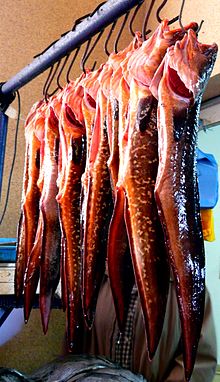
rosy fish on the slab

I guarantee you will find “Rosada” on every menu in every bar in Andalucía. You can get it “frito” (deep fried) or á la plancha (gently braised in a persillage of finely chopped parsley and garlic in olive oil). It is a white fish, flaky and juicy like Cod but of denser texture. Anyone who eats it will choose it again. Brits starved of the “fish and chip” experience can slake their nostalgia with Rosada. Like all great classic fishes it is best served plain.

But what is it? On the plate it is white, although its name translates as “rosy” or “Pink”. If you haven’t got a clue what this fish is or how to find out, you are not alone. We have seen it translated on menus as “Pollock” (wrong), Hake (wrong) and “Salmon” (ludicrous).

Descriptions of the fish as a dogfish (cartilaginous shark like fish) however, is down to the great fish aficionado Alan Davidson (Mediterranean Seafood, Penguin 1981 p26), who wrongly describes Rosada under “Sharks” thus:

. . . the Spanish “Rosada” (a pretty name applied to fillets of various dogfish). . . .

That’s it. No more information. He doesn’t even suggest you smother it with a “sofrito” (a sort of blokey concoction of tomatoes onions and garlic that he employs whenever the word Mediterranean threatens to border on the foreign).

Yes, this really is rosada

To call a fish “a sort of shark/dogfish” gives rise, of course, to all those Chaz and Dave chip shop English names – Huss, Dutch eel, Rock Salmon. These now join the catalogue of mistakes on badly translated Andalucían “cart” menus. Perhaps Davidson regarded this fish, possibly the most popular lunch in southern Spain, as falling below his culinary pretensions. Or perhaps he felt that the name itself is simply too unspecific and you can’t guarantee what you are going to get. I’d sympathise with that point of view.

Oh. It isn’t conger eel either.

To hunt down “Rosada” you have to gather what scant clues there are and aim for the Latin name. It’s the only way to pin the damn thing down.

It seems, for example that“Rosada” is not the fish’s full name. The full name is “Rosada del Cabo”. Rosada de Cabo means “rosy thing of the cape”. The Cape refers to South Africa

So it turns out that this fish, though massively eaten in Spain, is not Spanish at all but from “The Cape”. Spanish Salt Cod, the most eaten fish in Spain, comes from Nova Scotia. Now it turns out that Andalucia’s favourite  fish lunch has nothing whatever to do with Spanish fishing or fisheries.

Rosada comes from the temperate marine waters of the southern hemisphere, the south African Cape, the waters of Argentina and of Chile, the south Atlantic round Brazil and the waters round New Zealand and South Australia.

Rosada in fact, is Kingklip, but this doesn’t reduce the confusing flood of common names associated with it. In Europe it is known as cusk eel; in New Zealand as ling and in South America as congrio or cusk eel. Golden kingklip is also called golden Dorado, golden congrio and the red as pink cusk eel. There are three colours – Golden, Red and Black. The red or “rosy” is considered the best eating and with the best shelf life since the black version with its thin skin goes off quickly.

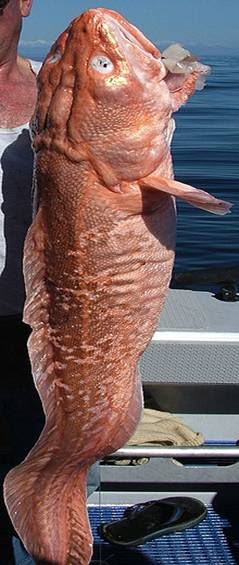
This is rosada too

Golden kingklip has skin of orange with brown and golden hues. Red kingklip has darker skin with strong red markings. The white meat is of good quality and firm-textured. The weight of whole fish averages 3-4 kilos (10 pounds).

Its scientific names are genypterus blacodes and genypterus chiliensis. The South African variety genypterus capensis was the first to be marketed. They hardly vary except in skin colour. The Rosada has the head of a Pollock with two whisker sensors under the chin, and the body of an eel. The skin is characterised by golden yellow to pink ground colour, overlaid with mottling spots and with irregular dorsal blotches. It hunts between depths of 22 m and 1000 m. feeding mainly on crustaceans like small crabs and scampi. It also preys on fish such as anchovies, sardines and cephalopods. It can be caught throughout the year.

The reason it’s not very well known to Spanish fishmongers even though they sell tons of it, is because it arrives on the fishmonger’s slab beheaded, filleted, gutted and skinned. It’s not caught around Spain so the fishermen don’t know what it is either. It is invariably frozen, which is why you can have Rosada and chips seven days a week, but fresh fish only on fishing days. Rosada is sometimes known as a “substitute” for local Merluza (Hake). Rosada is far superior to Hake both in texture and flavour, and freezing doesn’t impair it in the least. In fact modern freezing methods have the fish preserved more or less immediately it’s caught so that so-called “fresh” fish is often considerably older than the frozen.

Rosada is a good substitute for any recipe that calls for cod. It is not presently endangered. Its deep water rock habits make it difficult to kill en mass, and it is usually taken “on the side” during expeditions for other fish. Recipes follow!

Posted by: puebloman | March 28, 2011

Cheap Spanish wine: How to read a wine label

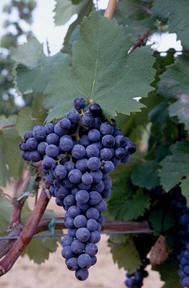
A bunch of Monastrell grapes

At the time of writing this wine can be bought in Lidls for 10€. Not 10€ each of course, 10€ for six bottles, with a free corkscrew thrown in. Corkscrews are still used here in Spain where wine is not always drunk the same year as it is laid down.

This is marketed as an ordinary wine to be drunk in quantity. In our household at €1.80, it would come in at about fourth bottle in a dinner party at the point where guests’ finer sensibilities had been somewhat blunted, but before they had got into a fight or lost the will to live.

At big parties/celebrations it comes middle to late night.

What can I say about it? It’s a good dark red and has a reasonable “body”. It’s “soft”. What I mean by this is that it’s not thin and sour like all the French wines I might buy at three times the price. It’s not “jammy” like those “full of fruit” southern hemisphere wines. It’s a “single note” wine, by which I mean – have a sniff, have a sip, drink some and swallow it. No point in embibing aroma or swilling it around your mouth. What you taste is what you get. No point in hanging around, this is not a wine to be savoured.

On prima fascie evidence, I would not take this wine as a present to a dinner party unless I actively disliked the hosts, which I often do. You might try a bottle in this category on the sort of host who whisks your bottle away saying he’ll save it for a “special occasion” as though your presence wasn’t special. He’ll then ply you all night with expensive but poor value wine in an attempt to convince you that he “keeps a cellar”. But I digress. . .

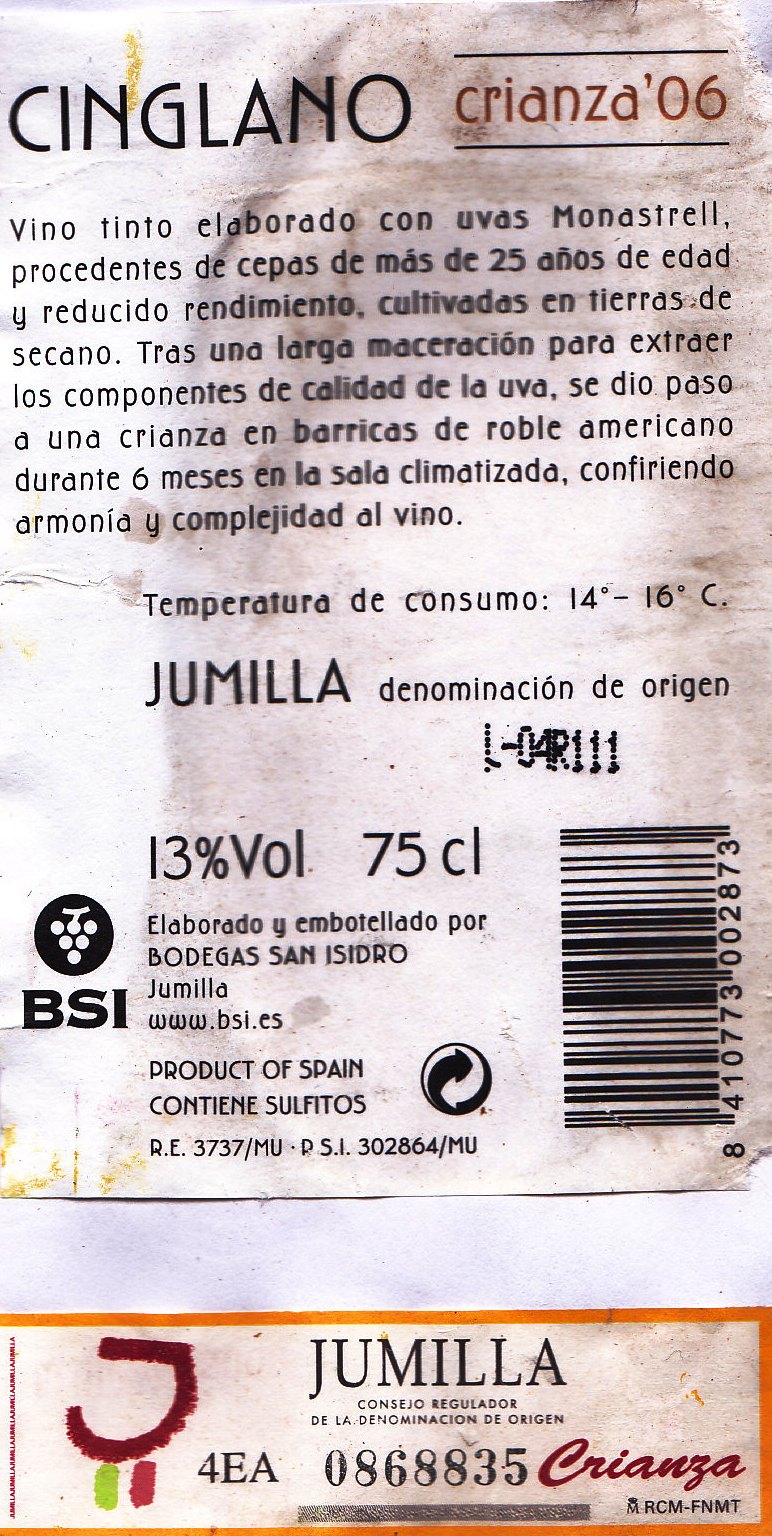
The wine in question is called “Cinglano” and in deference to John’s comment (see my last post) re the seductive beauty of wine labels, I’ll analyse the back of the bottle so as not to be distracted by the design on the front.

Here is the label:

Cinglano label

At the top right hand corner it says “Crianza ’06”. This simple cypher carries lots of information. This wine costs €1.80 or $2.50 or £1.50 a bottle remember, so it’s very inexpensive and yes I know it’s not cheapness but value that interests us.  So let’s consider the value. This is a five-year old wine. A wine must be laid down for five years if it is to become a Grand Reserva. Wines can only be designated “Grand Reserva” if the vintage is also up to scratch and a little research shows us that the year 2006 is indeed a vintage year. So, has the vintner laid it down in the hope or expectation that it might be sold as wine of the highest quality? For some reason the wine didn’t make it to Grand Reserva but has been through all of the processes of elaboration and quality control.

The description tells us that its made from the Monastrell grape, made world famous under another name (Mourvede) in France but the French can only just grow it because it needs a Mediterranean climate. It is a Spanish grape, drought resistant, bearing a small black berry with a heavy yeast bloom, which delivers a high tannin punch that mellows with age.

The description on the label says that the wine has been matured in barrels of american oak for 6 months, confirming that it is a “Crianza” –  a mark of quality. It must be at least 2 years old plus 6 months in oak for Crianza (18 months for Grand Reserva).

Further down the label, the word “Jumilla” denotes a well respected Denominación de Origen situated in the south east of Spain north of Murcia. This D.O. confirms a quality that  is reenforced by the additional little D.O. badge beneath the main label. No wine can be a Crianza without being D.O., and this is a special D.O.

Jumilla itself is a little known jewel of Spanish viticulture. The sandy soil kept down the phylloxera insect that devastated European all vineyards in the 1880’s, so Jumilla now posesses (though it fails to advertise) some of the oldest vines in the world and the largest number of ungrafted Monastrell vines anywhere.

On the down side, Cinglano is only 13% by volume, so wouldn’t pass Dad’s alcohol test. And it “contains sulphites”, which apparently do not go down well with those North London winos who like their liver failure to be organic.

All in all though, quite a lot of quality. Better not to waste it on dinner parties.

Posted by: puebloman | March 27, 2011

Cheap Spanish red wine. A users guide

It’s about time someone wrote a wine guide for those who, like me, drink red wine by the bottle rather than by the glass. The pleasures of red wine don’t necessarily require a nose or even a palate – not after a couple of glasses anyway. Those who live by the bottle, however,  need not live by any old bottle, and those who of us who are on the primrose path as opposed to being at the everlasting bonfire, can still distinguish between value and cheapness.

I was talking to Jancis Robinson only the other day. we were sitting on the terrace of my 1 bedroom cottage in Cútar, and she had just uncorked a bottle of Vespral Crianza 2007 ( Lidle’s at €1.99) . “John” she said “Wine has got to be the most honestly and comprehensively described consumer product in existence”. Jancis of course is right. The bottle tells you when the wine was made, where it was made, what the local wine makers think of it, how it was aged, the grapes used in the must, its strength and so on. There are several quality benchmarks, not just one, and this is true not just for expensive wines but for all wines, even the cheapest.

We all have our personal reasons for selecting a low-price-high-value (to us) wine. My Dad for example, will pay up to £4 (3 for £12), and will not drink anything under 13.5%. This leaves him deep in the jungles of south america, or in the australian outback.  Even when he and I go out and treat ourselves to an expensive pint of bitter, he always prefers the beer that flattens out at about 6%. Being near the end of his life, he sees little point in indulging in low proof alcohol.

I am always interested in the date that the wine was laid down. Dad thinks this is a poncey way of choosing wine. This is because he thinks I am referring to the vintage, in spanish the cosecha. I am not. I am literally talking about how old the wine is. In Spain you can easily buy a five year old wine for under €2.50. In England your 3 for £12 are likely to be no older than 2009. Now, if a wine maker is prepared is prepared to give shelf space to a wine for 5 years, he must rate it a bit? So I look at the year. Of course a five year old wine will have other badges and claims to fame but we shall come to that in future blogs . . .

« Newer Posts - Older Posts »

Categories