Posted by: puebloman | March 15, 2010

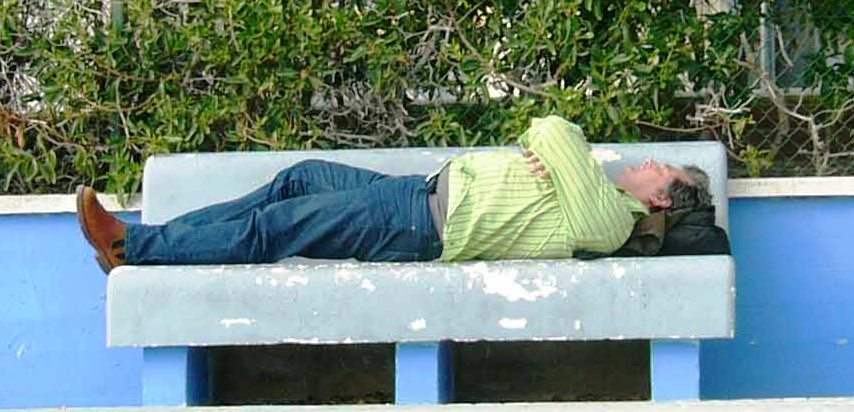
Viva Siesta!

Exploring the possibilities for "Siesta" on Nerja beach

The following report was carried in “Typically Spanish” 14th March

Following the intention of Esperanza Aguirre, the Partido Popular regional President of Madrid, to have bullfighting declared as a BIC Item of Cultural Interest, in order to block moves who want to ban the spectacle, now comes the suggestion that the Spanish Siesta should also be declared to be of cultural interest.

The idea comes from Daniel Dorado, a lawyer who specialises in the protection of animals. He has now presented an application in the registry of the Madrid Regional Government calling for the siesta to be declared a BIC, Item of Cultural Interest, considering it meets the same conditions for being so, as bullfighting.

In his arguments he says that the siesta is ‘a cultural fact of special relevance and significance, an art which deserves protection’. Following the claims made for bullfighting to the word he said ‘it has been for time immemorial part of Spanish culture’.

Nobel prize winning author, José Cela, described it as ‘Iberian yoga’ and said it should be carried out with pyjamas, the lord’s prayer and a urinal. The art was followed by figures such as Albert Einstein and Winston Churchill.

Daniel Dorado continues that unfortunately the siesta is threatened by our hectic way of life, and he claims that if it disappears the country will fall into chaos. He therefore considers the Madrid regional government is under the obligation to protect it by, for example, the installation of beds in the street.

Read more: http://www.typicallyspanish.com/news/publish/article_25415.shtml#ixzz0iHS4YjDC

Posted by: puebloman | March 13, 2010

A history of Cútar in Objects: 4 The Fountain of Paradise

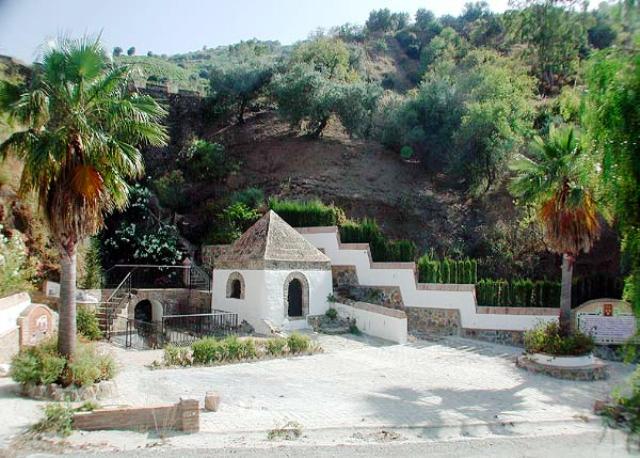
The word Cútar is said to come from the Arab word “Kautzar”, which means “The Fountain of Paradise”. Here it is:

Arab fountain and date palm

The fountain is the only surviving Arab fountain of its kind in the Province of Malaga. It is to be found at the entrance of the pueblo. Beautiful and understated, it is set off by two mature date palms. It has been restored and is carefully maintained by the village.

Behind the fountain, stone steps give way to a ricketty wooden staircase that winds up under the road that curls over it across an ancient bridge that fords a little gorge.

The elderly population of the village remember fetching water from it in their youth, and still do at times. Beatrice, who runs the village “farmacia” says the water is no longer drinkable because of the chemicals that are put on the fruit trees above. The hills are not high enough to filter out the pollution.

Nevertheless the fountain stands as a beautful object and a testimant to the benign rule of Islam. The village is developing arab gardens on the surrounding land to contextualise the fountain.

See more at http://www.vivasiesta.com

Posted by: puebloman | March 8, 2010

Occasional Diary 2

From http://www.vivasiesta.com Wednesday 3rd March

I am in the car by nine having had the exact same conversation I have with the neighbours every Wednesday

Where you going? Almachar?

No I’m going to school to learn Spanish. Haven’t done my homework!

Ha! He’s got homework! (hilarity) You don’t need to go to school – you can speak to us!

You don’t speak Spanish!

That’s right we don’t! We speak Andaluce! Don’t  learn from us, no one else will understand you (hilarity)

I’m in the car on my own. Judy is doing a course in Raku pottery with a wonderful group of Swedish potters who have come to Cutar to experiment with glazes.

Apparently you biscuit fire your clay, then you get a metal oil drum with the top cut off and a hole punched in it. You put in your pots – painted – and then fire them with a huge propane flamethrower that spirals a flame round the drum. Then when they’re quite black, you chuck them in cold water stuffed with straw and/or olive leaves. Then you spend ages cleaning them . . .

The weather forecast is, as always, wrong. Catching on to the fact that it’s rained continually since mid December, rain was forecast. It is, au contraire, a beautiful day as I drive away to Velez-Malaga.

It is like a bright breath of spring in a long miserable wash of seemingly endless drizzle, and springtime is characterised by the glorious Bermuda Buttercup that streams down the hills in its hundreds of thousands at this time of year. The Bermuda Buttercup behaves like a sulking cowslip in dull weather. It hangs its head and folds its petals and disappears from the landscape, which reverts to miriad variations of olive green. When the sun comes out the buttercup lifts up its face to the sky and the landscape streams with yellow. The white almond blossom, the flowers of winter, is starting to go over, but the blossom still hangs on the landscape like frost.

I look down to my left where the land falls almost sheer three or four hundred metres to the river bed. Usually dry as a bone and used as a highway or carpark, today the bed actually has a river in it – a twisted ribbon of boiling mud. In two places water has washed away the soil from under the twisting mountain road. The macadam has collapsed making the ride  momentarily eventful. Other events include boulders in the road, helpfully indicated by extemporary exclamation mark road signs. There are also mud slurries and falling trees (mercifully small, in these parts no tree is allowed to be taller than a Spaniard).

9.45 A breakfast of “Pan con tomate” – macerated tomato on a lightly toasted split roll with salt and oil on the side, plus cafe con leche. Absolutely delicious

10am There is a new person in our class, so we start by introducing ourselves again. Each time the challenge is to find a different way to do it. Or even to remember something that might distinguish you from the sludge of humanity around you.

We then revisit the subjunctive. Certain words and phrases throw one inevitably into the arms of the subjunctive. We were all given phrases and asked to talk for a minute on a subject given by the teacher. I get phrases like “It is possible”, “Most probably” and “It may be so” and am asked to extemporise on the subject “Is there life after death?”. My views on this subject are clear and very strong. Unfortunately I don’t know the Spanish for “superstition” “mendacious falsehood” or “lying priests”. To my horror I find myself meditating on the “possibility” that a spark of God resides in all of us and that “it is probable” that they return when we die to the eternal light . .

12am As I set off in the car to raid Lidles for 2€ chicken carcasses and cut priced red wine, I reflect on the possibility that I have been linguistically tricked into Catholic chat . . .

Posted by: puebloman | February 24, 2010

Recipe: Potage of spring vegetables, Andalucian style

The English word “potage” is the same word in Spanish. It means “substantial soup”, halfway between a soup and a stew. Here in the Axarquia it usually means a stew of beans or garbanzos (chick peas) mixed with unmentionable bits of pig and black pudding. If there is a vegetable in it, it’s usually cabbage. The dish is invariably delicious, delicately spiced, filling . . y muy economico . . .

Last week I ate a soup in Bar Andalucia in the town  of Velez Malaga. It was called “asparagus soup”. Rough, lumpy and lovely.

This potage uses the greens that are coming onto the market now in the Axarquia. At the moment they are forced, but in my garden I have several types of lettuce greens and beans that will be available in a couple of weeks. At the moment in the markets we have wild (thin) asparagus, artichokes, broad beans, potatoes and lettuce. At some point add a big knob of butter. Butter is French, not Andalucian, but it tastes good!

ingredients for 4

1 kilo broad beans, shucked.

8 small spanish artichokes, peeled and cut in quarters.

2 spanish onions or a bunch of “cebollitas”. Stripped.

Some good sliced bread and some strong flavoured olive oil

3 cloves garlic, skinned mashed and pulped to a paste with salt.

Bunch of thin asparagus, the “woody” part cut off.

1 lettuce chopped small.

2 handfuls rocket or watercress chopped small.

one and a half litres veg stock (your own or water with 6 teaspoons of Marigold bouillon stock powder).

4 good fresh eggs.

Bunch of flat parsley, chopped small.

Method

1 Dissolve the stock in  the water.

2 Finely chop the onion and stew in olive oil on a low heat til it goes gooey and golden.

3 Meanwhile make the croutons in the oven. Heat oil in a roasting pan with a crushed clove of garlic, put in crustless squares of good bread. Cook til golden and turn. When done, drain on kitchen roll.

4 Mix the garlic with the onion in the pan. Cook a couple of minutes. Heat the stock and pour over the onions and garlic. . . . .liquidise.

5 Bring to a slow simmer and add the asparagus chopped into 3 cm lengths and the artichokes chopped into four. Simmer for fifteen minutes until almost tender.

6 Add the lettuce and rocket or watercress and bubble for a couple of minutes, add the beans and poach the eggs in the soup for four or five minutes.

7. Serve the potage, each dish with a poached egg and croutons scattered over. Finish with the parsley.


Posted by: puebloman | February 22, 2010

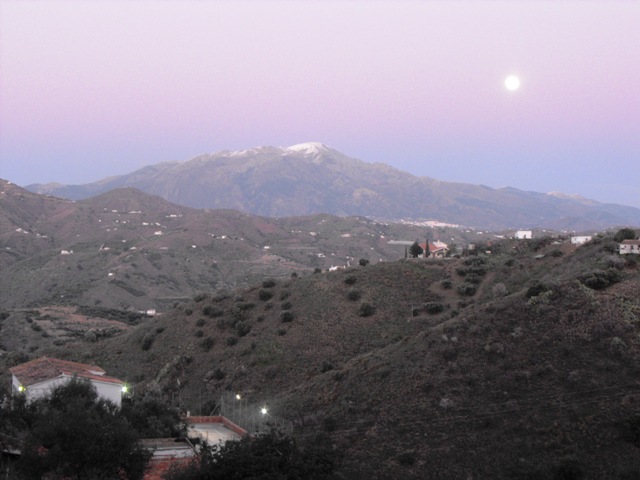
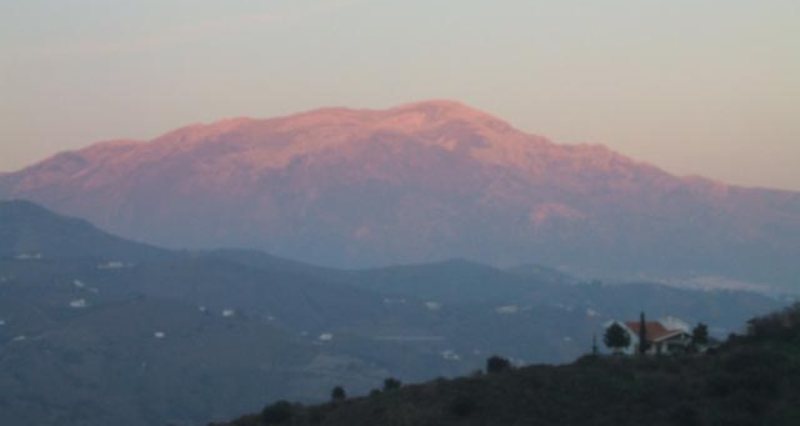
Room with a view

Mount Maroma at dusk

The mountain at dawn

You can see the big mountain (2000metres) from all of our terraces in Almachar and Cutar. It’s particularly beautiful at sun and moonrise.

Posted by: puebloman | February 22, 2010

Let the little children suffer

The Pope covering up

And whosoever receiveth such a child in my name receiveth me. But whosoever offend one of these little ones which believe in me, it were better for him that a millstone were hanged about his neck, and that he were drowned in the depth of the sea. Woe be unto the world because of offences! Howbeit it cannot be avoided that the offences shall be given; Nevertheless woe be to the man by whom the offence cometh! Matthew 18: 6 (Tyndale trans. 1534)

If Jesus hated anything during his brief life it was churches. And if he hated anything more than churches it was priests –  “whited sepulchres” he called them. When you look at the actions of the present Pope you can see why.

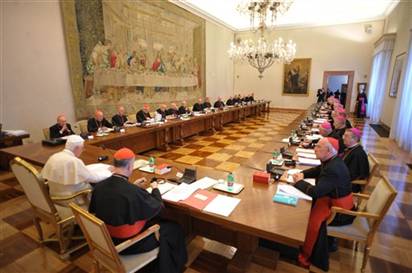
Last week Irish bishops were called to the Vatican to discuss the rape sodomy and buggery of little children by priests. Among the general junketing, the blushing, the curtseying in robes, the eating of expensive food, the kissing of rings and the mutual flattery, one group of people was significantly absent and that was the victims who have struggled for decades to make their voices heard. Apparently they are not be received or heard by the Vatican.

The pope has attempted to contain the Irish scandal by bemoaning the general breakdown in social moral authority – in other words it’s our fault – and on the other hand containing it as a specifically “Irish” problem. He conveniently forgets that the Catholic church is catholic. That is universal, not national, and that what is happening in Ireland is happening everywhere – and will surface in due course – in Italy for example, and in Spain.

The pope’s moral inadequacy  in dealing with these crimes can best be understood by examining his career:

On 25 November 1981, the then Pope John Paul II named the present pope, then Cardinal Ratzinger, as Prefect of the “Congregation for the Doctrine of faith”, formerly known as the Inquisition.

In office, Ratzinger defended and reaffirmed Catholic doctrine on topics such as birth control, homosexuality, and inter-religious dialogue. This “Congregation” also has jurisdiction over cases involving the secrecy of the confessional and on clerical sexual misconduct.

Like the inquisition, it functions as a court.

During this period Ratzinger made sure that all complaints of childhood sexual abuse were “fast tracked” directly to the Vatican. It was a move both to inform the vatican of trouble on the horizon, control the response and to bring the full force of the institution of the church down on the necks of potential trouble makers.

In his capacity as Prefect, Ratzinger wrote a notorious letter in 2001 called “Crimen Sollicitationis” which said that all Church investigations concerning accusations made against priests such as the sexual abuse of minors, should be dealt with in secret. This action became controversial during the Irish sexual abuse scandal. Subsequently Ratzinger, now the Pope, was accused in a lawsuit of conspiring to cover up the molestation of three boys in Texas, but he sought and obtained diplomatic immunity from prosecution.

Posted by: puebloman | February 22, 2010

Dancing Peacocks

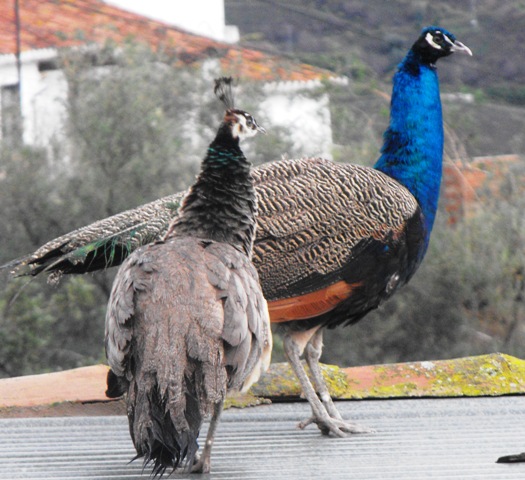
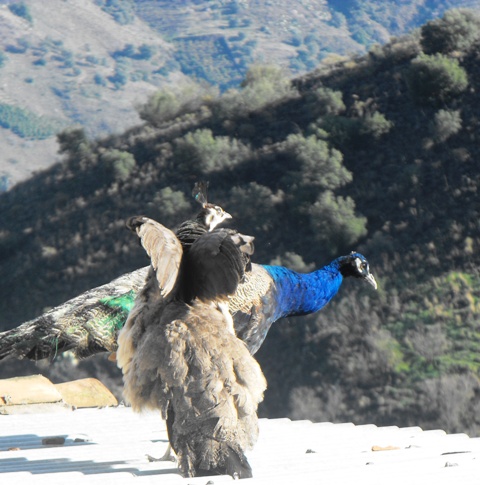
we didn’t have too many guests this January, though someone comes every month, unlike the UK where its August or nothing. However, a couple of peacocks dropped in on us for a week until a Spanish child, masquarading as an adult, threw rock at them and drove off the hen. The cock cried for three days, a sound like a strangled cat that mixed with the all night full moon crowing of cocks and the endless bickering of beshitten Spanish dogs.

We fed them on rice, linseed and bread rolls, and in return they danced for us. .

Dancing Peacocks

Posted by: puebloman | February 19, 2010

Floody Hell!

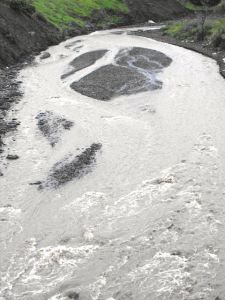
River bed near Almachar. In September it was a car park!

It’s still raining!!! We have had the most rain since 1942! Who says the Axarquia is turning to desert? The reservoirs are 70% full – twice the 2009 figure!

Posted by: puebloman | February 18, 2010

A history of Cutar in objects 1,2, and 3

Sometime in 2003, a house in the old part of the pueblo of Cutar was being reformed. The builders knocked through a wall and found a large space in the middle of it, thought to be a sort of larder. Three books, laid with some care in straw were discovered. Professor Esther Cruces, who manages the investigation into this evidence and the restoration of the manuscripts thinks that the care with which they were hidden and preserved, suggests premeditation. She dates the concealment at around the date of the Christian reconquest and believes the owner was a Moorish lawyer living in the years 1500-1501, or a Morisco forced out during the general expulsion of Muslims and Jews after the Moorish rebellion in the years 1568-1570. They are thought to have belonged to an Imam from a Mosque, or a lawyer from the pueblo which was much larger then than now.

The three books discovered were as follows:

A book of the laws and customs of the pueblo – for example family trees, heredity, matrimonial and trading laws. Consisting of 170 pages each 16 by 20 centimetres. The binding is of parchment.

A book on a variety of topics, many of them miscellaneous concerning “ everyday” things also but some essays on esoteric subjects. Consist of 133 sheets of paper 16 x 22 centimetres

The Islamic Koran: 135 pages without binding, illuminated with inks of diverse colors. An initial inspection reveals that the inks are specific to Andalucia and the writing is in “cúfica andalusí” specific to Andalucia. Some of the characters in the writing are unique in the whole of Spain. Because the last few pages of the book have been lost, the name of the copyist is unknown and the exact date of the document uncertain.

The Koran is the most important of the documents. Investigators of the University of Granada consider that this Koran andalusí dates of the XIIIth century. They regard it as one of two most ancient copies that survive in Spain. It seems to have been handed down the generations like a family bible. This accounts for the greater age of this book.

Reference: ESPEJO ARIAS, T. y ARIAS TORRES, J.P.: “Estudio descriptivo y caracterización material del Alcorán de Cútar”, en El Corán de Cútar. Edición facsímil y Estudios, Ed. Junta de Andalucía -Consejería de Obras Públicas y Transportes, y Consejería de Cultura- y Fundación Tres Culturas del Mediterráneo, Sevilla, 2009 (en prensa).

Posted by: puebloman | February 12, 2010

Occasional Diary 1

7am Woken by the howling of my neighbour’s dog. It lives in a big windowless garage next to our bedroom with eight goats and has taken to fits of barking as the sun breaks over the mountain. This, combined with the cockerels who crow all night during a full moon , makes a lie-in impractical

8am Breakfast of porridge. Just whole oats, water and salt. It steadies my diabetic blood sugar for the day. Slight spat with Judy. We have planned two building days on the bedroom, but Jude says we need to clean up and clear away before we can start. Preparation is everything. She’s right of course, as always. That’s what pisses me off. We have too much stuff. What we need is a bonfire. I tell her this. She pretends she hasn’t heard. None of my stuff burns, actually – not healthily anyway, it’s all plastic. Her thousands of jumpers on the other hand . . .

11am We have moved all of our clothes into the two-bedroom cottage, which is free for the next few days. We can sleep in the double bedroom. Our clothes are in the other one – Judy’s take up both single beds and the linen press, and mine a chair. We have discovered bags and bags of shoes, some single, some gently composting. Now what about that bonfire?

12am We have draped the room with dust sheets, covered the bed and shielded both doors. The worst thing about this work is that you end the day filthy and with no place or means to get clean. We have been living under a thin film of dust for three years.

1pm I am off to Almachar to buy 4 bags of “Capagris”. It s a strong grey mix of plaster and glue. We are going to smooth out the pock marked walls of the bedroom

2pm Lunch. My homemade pasties. Finely chop onion, swede, potato. Very finely chop some thinly sliced roasting beef (“Filete” is the cut in spanish). Roll out some shop bought puff pastry thin and cut to circles with a plate. Put a mixture of the veg in the middle and sprinkle with beef – all uncooked. Put a knob of butter on top and a sprinkling of flour.  Season with lots of black pepper. Turn over and seal to make the pasty. Bake at 200C for 15 minutes then 170 for an hour. Cool and freeze.

2.30 Judy starts to plaster the wall. I am going to drill out and remove a long ledge of earth and rubble at the base of one of the walls. I have a little kanga drill and a couple of those bendy buckets that are builders’ fashion accessories in the UK but are part of the trade here. . .

5.30 The ledge is made of earth and boulders with rubble infill. There’s a ton of stuff. I loosen it with the kanga, separate the boulders from the rest, and carry both out to the back door where, one a glorious day in the future, I shall turn them into a beautiful stone stairway from the back door down to the figs.

6.30 Mustn’t overdo it. My nearly 60 year old hip is starting to complain. So is my nearly 60 year old knee. . . I think of myself in the noble tradition of stone age man, manipulating and improving his palace of mud and boulders. Vaguely hoping to come across a hoard of gold buried in the wall. So far only mouse droppings. Could be worse. Could be rats.

8.30 Still drilling. Outside it’s dark, and the rain is steady. As I slip out of the back door and stumble blindly across the rubblish, a bucket of mud in either hand, I think of myself in the noble tradition of a solder at the Somme, up to his neck in muck and . .

« Newer Posts - Older Posts »

Categories