Posted by: puebloman | November 13, 2009

Blood Sweat and tears

I’m at the Comarcal Hospital in Velez-Malaga and I’ve come to have some blood taken.

When you get to the blood queue you have to take a ticket from the machine, like when you go to the fish stall at Euroski’s – though at Euroski’s you have to be careful to get the right colour ticket, orange for fish to be prepared, green for insti-fish. But I digress.

The hospital blood queue is at once more and less complicated than the fish queue. It’s 8.30 am and I’ve come early because I’ve learned from experience that the ticketing is not as predictable as a Brit might expect. In the UK you find you’re always 100 away from being seen. You despair, or you go shopping, or both. But when in Spain you see you are only 25 away, it can raise dangerous false hopes in you unless you know that, as with the fish queue, the numbers aren’t absolute. For example, people  who are called by name slip mysteriously past you in the queue regardless of ticket number. Children likewise go through. They are swept up by the receptionist, smothered in kisses told they are muy guapa (gorgeous) and whisked to the childrens’ desk where a post-adolescent para medic with glazed eyes and two-day stubble chats  to them until, apparently numbed and hypnotised by the inconsequential one way banter they fail entirely to register that blood is being taken out of them. Likewise, people who seem to be the friends and family of the staff glide past you and through the door, deep in chatter.

The queue is immaculately polite, but you feel in them the occasional surge of panic as time plods on. Those in the know are aware that the portcullis slams down at 12.30 and no one else will be seen that day. Well, actually 12.15 because the staff don’t want to be pitched into lunch without having a little time to prepare. In order to avoid disappointed customers, only a very limited number of tickets are placed in the machine, which quickly runs out. This leads to flurries of distress from patients who have been sent by specialists to get a blood test only to discover that their are no numbers left. This can lead to incidents, especially when the patient in question comes from afar and is accompanied by their entire family, all pitching in on their behalf. I was in a state of panic once myself when, as a rookie blood queuer, I realised I was not going to be seen that day and that my sample might not reach the consultant in time for my appointment. I remember being saved by what I can only describe as a female ticket tout, who slipped me a very desirable number saying  “Have that dear. I always take several, just in case”.

So I get in. Not for me the unshaved adolescent. I am directed to a very large blonde woman who has not done her roots for a long time. She is wearing a white coat that looks like it might have been owned by a surgeon in the Crimean war. “My” seat is occupied by her large friend, and they are deep in hilarious conversation. Eventually she sees me “Urino?” she shouts “Urino?” then seeing I am a foreigner she slips deftly into English “Pee Pee?” “Pee Pee?”. I seek to explain, in my halting Castilian, that no one has in fact asked me for a urine sample but she waves me away, thrusting a huge sealed bag of plastic implements and telling me to go and find a lavatory.

When I get there I sit down and examine the kit. There are wierd shaped flasks presumably to accommodate a range of women, medium and large buckets I guess for men who have forgotten how to hit the toilet bowl, let alone the test tube. There are funnels, pouring flasks and, at last, the sample bottle. A truly socially inclusive kit.

As I sit there I start to worry. Last time I had blood taken was at the “Orchard Practice” in Surrey. A “phlebotomist” had dug around in my right arm to get blood, and then in my left arm to no effect, and had then called in an “expert” (excuse me? wasn’t she the phebotomist?). They had drawn off the blood by putting a catheter between the first and second fingers of my left hand, and had looked at me throughout as though I was being awkward. How was I going to deal with all this in Spanish? I stuffed all the spare plastic stuff  into the pedal bin by the toilet . . .

When I returned it was as though I’d never left. The “friend” slipped out of my chair although the conversation didn’t abate and was apparently reaching some sort of hilarious climax. The blonde woman pushed up my sleeve and slapped my arm around with her meaty hand. Just for fun I supposed. As they both burst into gales of laughter she slipped the needle into my vein, drew off three substantial vials of dark blood, sealed and labelled them. She hadn’t even looked at me, let alone my arm.

“Go and see your doctor in a week. Eight days. Or nine. More or less”

Elated, I left for the hospital canteen. I’d get a coffee, a pan con tomate or a pitufo with serrano ham. When I got there, I learned from another customer that you don’t just go to the bar and order. You queue at the till and the checkout staff gives you a ticket marked with the items you require then you queue at the bar and when you get that order the camarero marks your ticket to say you have received your order, then you queue at the till with your ticket to pay . . . I made my excuses and left.

Posted by: puebloman | November 12, 2009

Fishy business 3

Phone Call . . .

Long Ring , Long Ring,

She: Hola?

Me: Hello, is that the British Embassy in Malaga?

She: It is

Me: Can I talk to the person who deals with spanish fishing licences?

She: No one here does that sir, that’s a matter for the spanish authorities.

Me: But I understand that someone at the Embassy could write me a letter? I have  an English fishing licence, you see.

She: Well there is someone who can write you a letter which simply affirms that your licence is in fact a licence, but I couldn’t say to you that the Spanish department of the environment could grant you a licence based on that . .

Me: I understand that there is a charge for this lett . .

She : 40 euros

Me: And what do I do with . .

She: You take the letter across the road to the “Media Ambiente” the department of the Environment fourth floor, and they may regard our headed notepaper as sufficient authority to grant you a licence in which case you will be on their list of applicants who have been granted a licence and the next time you apply . .

Me: But I have already applied with my licence and passport and been rejected

She: I’m afraid I couldn’t comment on that sir, although you may now be regarded as a failed applicant and that may prejudice any further applications on your part. I really couldn’t say. We are an Embassy, we may not interfere or attempt to interfere with the administrative processes of a host country . .

Me : 40 euros

She: 40 euros. Its very effective. The last bloke who came in got licenced till 2011. . .

Posted by: puebloman | November 12, 2009

The “Rat” rats on Spanish democracy

“Heresy, mortal sin, moral barbarism, idiocy… “. These were the words of the spokesman for Spanish bishops, the Jesuit Juan Antonio Martínez Camino, who today put more direct pressure on those catholic members of parliament who are expected in the next few weeks to support reform of the abortion law proposed by the Socialist Government. ” Anyone who supports, votes for or promotes this law is in a state of mortal sin and cannot be admitted to Holy Communion “, says Antonio Maria Rouco, secretary of the Episcopal Spanish Conference. Developing his theme, he said ” To take the life of a human being contradicts the catholic faith. Anyone who supports it is a heretic and therefore excommunicated “. In case there is any doubt as to whom this dictat alludes, the bishop has proclaimed that the doctrine ” applies to all Catholics, whatever party they belong to and whatever their political party might tell them to do”. (Quoted from El Pais today. My translation).

So. Pope Benedict XVI, Joseph Alois Ratzinger,  known by those who dislike him as “the Rat”,  is up to his old tricks. On the face of it, this issue is about abortion. Of course  in Spain women get around their draconian abortion laws as they used to in the UK during the 1950’s – they find a doctor who’ll plead psychological damage, they’ll risk back street remedies or they pay a lot of money – the rich, as usual, get away with it.

Although the single issue is extremely important, these bishops go way beyond it. They are attempting to spiritually criminalise a voting public. The Rat is once again inducing his acolytes to interfere with Spanish Democracy. Not only are the voting representatives in the Cortes to be damned if they disagree with his holiness, but all of those who supported or voted for them are likewise damned.

As an Englishman, I can hardly claim superiority for my country. As I write, there are up to twenty-six hilariously named “Lords Spiritual” nancing around the Upper House in surpluses, suspenders and other items of womens’ clothing. They are not, of course, allowed to do anything beyond making the odd eccentric speech and saying prayers. Nevertheless they are an affront to a modern european democracy and the sooner they are got rid of the better.

The Spanish catholic church on the other hand has power. It is a study in barefaced evil. I will not rehearse its traditional support for wealth and privilege against the needs of the poor, its opposition to literacy, its support for fascism. I will not even observe that it is a blasphemy against the life, words and teachings of Jesus Christ.

One of the reasons why the Republic foundered in the 1930’s was that the voting population expected that all the medieval oppressions that bore down upon it could be swept away by a democratically elected government without the benefit of a guillotine. It proved not to be possible. Action against privilege, shattering centuries of custom, can only be achieved by revolution. Anti democratic power centres were as always the church, the armed forces and the aristocracy. The republic failed to contain their  disproportionateprivileges and therefore failed its voting public. But the issue was always time. It could not achieve revolutionary objectives to a time scale that would convince the population that it was in charge of the country. So in ’36 Franco could begin to cultivate the pernicious lie that the Spanish people are “ungovernable”.

Forty years of repression that held Spain in cultural suspension were followed by thirty years of “forgetting” . A collusion of unconsciousness to allow the combatants of the Civil War to grow old and die before the issues of the war could be addressed.  This means that the bigotry and superstition of the church continues to create obstacles to rational government, keeping alive issues that were current in the 1930’s.

Prime minister Zapatero however, has time. And time is a great weapon. He knows how to select those  issues on which he can  make a stand. He knows for example, that in education, good decent Spanish catholics want their children to be discursive informed citizens, able to hold their own with any other bright young citizen of any other country. They want to inculcate moral values too, as all of us do in our children.

So Zapatero has a real chance to grind away at this evil edifice like water dripping on a rock. Good luck to him!

Posted by: puebloman | November 11, 2009

Fishy business 2

Futher to the rejection by the the Andalucian department of the environment of my application for a fishing licence (freshwater fishing, trout included), I approached the market trading “John” who has a shop in Torre and trades at the Sunday ex-pat market in Nerja. He had sold me a (quite a good) carbon fibre fly casting rod the pevious week.

Me                     Hi, you sold me a fishing rod last week

Him                  Did I?

Me                     Yes, it was a fly rod. A very good one!

Him                    Oh.  Yeah, I remember now. Alright is it?

Me                     Yes its great. Its just that, when we talked last week you said you went fishing on lake Vinuela.

Him                   Did I?

Me                      Yes. Have you got a licence?

He doesn’t say anything

Me                       Only I’ve been trying to get a licence. Its really difficult.

Him                     (Pause) No I haven’t got a licence

Me                       I have to enrol on a course, take an exam, wait 40 days while they mark it, take out personal liability insurance and then I might get a number so I can buy a permit at a bank.

Him                     (looking tired) How long have you lived in Spain?

Me                       Four years

Him                    Well if you’ve lived in Spain for four years you ought to know that the Spanish have got their heads up their bloody arseholes. I know a lot of people who fish Vinuela. A lot. And not one of them’s got a licence. Whose gonna police it? The lake’s huge. I mean I wouldn’t mind paying something . . a couple of quid, but this lot are taking the piss . .

Two people are browsing “John’s” knocked off DVD collection

He                       I’ve got a fishing licence

She                     Yes, we went to the British Embassy in Malaga. They wrote us a letter, soon sorted them out

He                       You have to pay them mind. You show them your UK licence and they give you a letter saying it’s a proper licence. Because they can’t read it see?

Posted by: puebloman | November 10, 2009

Blue and Green . . .

In the interest of balance, I think I ought put the other side of “Green” ( post Nov 4th).

Green is the colour equivalent to “Blue” in English – as in “Blue movie”

Bawdy, hot, crude, ribald,

Libre, indecente, obscena u obsceno, de temática erótica o sexual. ; Referido a la persona que galantea a otra impropiamente o para fines sexuales.

contar chistes verdes to tell dirty stories

viejo verde dirty old man

Posted by: puebloman | November 9, 2009

Rainbow politics: the mayors of the Axarquia

Spanish mayors (Alcaldes) like French mayors are powerful local politicians that shape not only the direction but the very culture of the community they represent. Their campaigning style is intensely personal and can be misunderstood by foreigners as corruption. In fact the culture here is to be enchufe – “plugged in”. The tradition of caiques in Spanish politics – political cliques that develop to advantage their single issue interest might lead the cynical stranger to feel that the community is sewn up against him.

There is however another side to all this. The Alcaldes who run our cluster of villages come from a rainbow spectrum of political affiliations and their personalities hone and condition the political and cultural life of the community that they run.

Almachar, where we live, recently threw out its PSOE   (Zapatero’s party, sort of “new labour”) Alcalde of 18 years and brought in the United Left.  This Alacalde, who assumed he had been elected for yet another term, was ascending the stairs to the stage where he was to give his acceptance speech, when he picked up the text on his mobile phone telling him he’d been defeated. There was literally wailing, tears and gnashing of teeth in the village, which had only wished to “teach him a lesson”, not to put him out of office (or so they said). But of course, power for 18 years is power for a very long time and, as we know, power corrupts. Some people in the village blamed us, the foreigner community, for swinging the vote ( the Alcaldes voted to  allow foreigners voting rights in local elections), so I’d like it noted that I voted PSOE, in spite of my strong conviction that two terms in office is quite enough for any politician.

Move up the hill to “El Borge” and you encounter the communist and highly theatrical mayor, the fabulous José Antonio Ponce. Ponce famously cut the electricity of the pueblo during a royal wedding, sent a box of condoms to the Pope, went on television to declare that 10% of all men of all pueblos are homosexuals ( the men of El Borge stoned him through the village shouting “which 10% of us?” but they voted him back in again). imagesHe has offerd the first gay couple to marry in El Borge a free holiday. Recently he has severed diplomatic relations with Israel, declaring that El Borge is the first “state” to do so. No doubt the Israeli cabinet is having to cancel all its planned holidays in El Borge! For renamed streets and squares El Borge boasts  el Avenuda Che Guevara and la Plaza la Passionaria. I love him!

Move up one village and you come to Cutar (where we work). The Alcade is PP – Partida Popular – the Franquista party. Everyone you talk to will tell you that they vote for the man and not for the party. Well . . the Alcalde doesn’t actually live in the village, he lives in Torremolinos – a sign of prosperity (to have escaped from the village) and we all know that this is a sign of strength if you are a conservative. Enough said.

Move down the hill and turn left and you’ll come to Benamargosa, whose mayor is PA – the Andalucian party. The great founder of the Andalucian Independence Party, Blas Infante was murdered by Franco in 1936. In Benamargosa, there are English representatives on the council so there’s hope for all of us.

Turn right down the same road and you come to Benamoccara, the village of the poets. Benamoccara is run by the glorious Abdeslam Jesús Aoulad Lucena. Ade, as his friends call him, is a Muslim. He is 23 years old, son of a Moroccan father and a Spanish mother. He is the youngest chief councillor in Andalucía. None of his council is more than 26 years of age .Benamocarra

Lest this council be thought to be a little young for the responsibilities of State, lets remember that historically it’s at this age that young men risk their lives for their beliefs.  Certainly, if fascist trucks were rumbling to olive groves for dawn executions as they were only 70 years ago, Abdeslam Jesús Aoulad Lucena and his friends might have been put onto one.

And it may be that those who shape the coming  world are young men in their prime . . .

Posted by: puebloman | November 7, 2009

A touch of wind

The south wind has been bashing up the countryside for the last week. In autumn we get benign winds that come from the north and pernicious winds from the south. Last year a ferocious 100km per hour wind blew sand from the Sahara desert across southern Spain, turning our white villages pink. A haze hung around the rising sun as though a meteor or a bomb had struck the earth and shifted the climate.

This year we have had nothing so theatrical. The weather is positively Welsh – oppressive, relentless, depressing. We have had not had a drop of rain since the small cloud burst in early September.  Nothing at all substantial since mid June. The sky is positively constipated. Clouds gather, condense, there is the beginning of an eerie silence, the wind suddenly calms and then . .and then. . the sun comes out again! The clouds disperse! It is as though, in our little valley the sky cannot gather a sufficient weight of water to let it fall. It is depressing. oppressive. We are all living under the shadow of something that is trying to happen – but not trying quite hard enough. As though God could deliver divine relief but he just can’t be assed.

Wind itself is a miserable element. Wherever it predominates the suicide rate is high. In Tarifa for example. They all kill themselves there, sooner or later. Anything to stop the relentless whistling and banging and splintering. We sit in our flat and watch the wind gently test all of our summer work to destruction. A little greenhouse gently smashed to pieces, a sun blind made of canes slowly taken apart like a delinquent child unpicking a cardigan. It is the day-after-dayness of it that makes you want to beat out your brains on the wall. The beshitten spanish dog population, too dim-witted to distinguish between a strange wind and a stranger, begin their howling . . .

Oh yes I know there are benefits of the wind if your electricity is run by turbines. Even so you may blow your brains out while your batteries are charging. And these so called benefits can only be appreciated intellectually. Water you can drink, sun you can bask in, but wind?

We live at the bottom of the village, so every fag packet and fag butt, every bit of discarded packaging, every ripped up bag of household rubbish is wafted in our direction by the autumn winds. I feel for the local dogs who parade down the hill every morning to shit in the street and on our doorstep. They have to pick their way through the rubbish, poor things. . .

I long for the moment when the first cloud bursts, and torrents sweep everything down, down, down and away in one mangificent watery gesture . . .

Posted by: puebloman | November 4, 2009

Green

Green by Garcia Lorca (my translation)
Verde te que quiero verde,
Verde viento, verdes ramas.
Los dos compadres subieron.
El largo viento dejaba
en la boca un raro gusto
de hiel,de menta y de albaha

Green, how I love you green,
green wind in green branches.
The two friends emerged
as the long breeze was trailing a rare flavour in the mouth
of gall, of mint and of sweet basil . . .

Lorca is talking here about the Vega, the fertile countryside around Granada, green and perfumed. Referring to awaking after summer evenings at his parents’ house “La Huerta” he said “We awoke, our heads aching with perfume and poetry”.

Sobre el rostro del alijibe
se mecia la gitana.
Verde carne, pelo verde,
con ojos de fria plata.
La carambano de luna
la sostiene sobre el agua . .

Over the mouth of the well
the gipsy girl swayed gently
Green flesh, green hair,
with chilled silver eyes.
An icicle of moonbeams
Suspends her above the water . . .

Andalucia is usually surprisingly green, but not in the English sense. The grey green of the olive mixes with the deep verdence of the avocado, the exotic fronds of the mango tree and pale washed green of the “gumbo” – the prickly pear.
At the beginning of November we remain gripped by the iron fist of summer with the landscape many shades of rust from the bare earth and the dessicated vegetation, and still hardly a cloud in the sky.

Nevertheless the word “verdiales”, meaning “the greening” is prevalent and powerful here and attests to the green that always lies under this temporary desert. The term refers, for example, to the local Malaga olive oil, which has a particular colour and flavour. A deep green oil. The best is supposed to be found in Periana, which has a famous old mill still operating and celebrates its oil and peaches in an annual festival, but I like Almachar oil the best, cold pressed and sold in 5 litre flagons from the co-operative in the top square of the village.

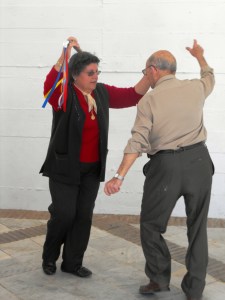
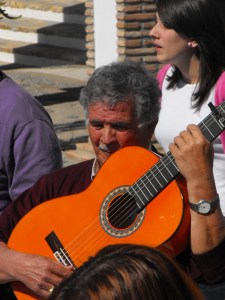
Verdiales also refers to the local folk music played at every festival. It is real live folk music. Its home is Comares and each village has its Panda or club. A circle is formed of musicians, one of whom also sings. A conductor stands outside of the circle and holds a stick over the heads of the players to indicate when to start stop and shift tempo. The instruments vary, as is traditional. There are usually a couple of gut strung spanish guitars, finger cymbals, castanets of course and a fiddle and anything else lying around – a drum, a twelve string lute, but not usually anything blown. Cutar had its Verdiales Panda properly accredited this year, a matter of great pride to the village.

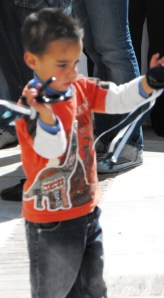
Here are some scenes from the last festival:

Miguel and Maria

Miguel and Maria dance the verdiales

Antonio Pino with guitar

Antonio Pino poised for action

Demonstrating the castanets
Posted by: puebloman | November 3, 2009

Spend, spend, spend!

We recently hosted a Canadian couple – I will call them M&M –  two of our favourite guests. They are wonderful people – true pioneers. They stayed in our one bedroom cottage last year and came back to stay in the two bedroom cottage this year they liked it so much. The most successful holidaymakers who stay with us are those who really invest in their holiday.

M&M were that sort of people. Up at six a.m. to be at the Alhambra by 8, on the road for Rhonda the next morning, to Cordoba the next . . walking the mountain, walking El Torqual, flamingo spotting, eagle spotting . . .we would also get notes asking us if we could print up some copies of Canadian folk songs, so that they could make an input into the folk session at Comares on Sunday morning. They went up in a twin prop aircraft (only 50€!) they nose-dived to photograph the cottages, copies of which they gave us.

Their son on the other hand has just come over to complete a retreat at the Buddhist Kalachakra stupa which is between Triana and Trapiche, just down the road from us. Stupas are made to protect people against outside negative energies. The model is from Tibet. This stupa has been built in our neighbourhood with the same purpose – to protect people. Woitek Kossowski was the architect, and under the guidance of the Venerable Lopön Tsechu Rinpoche the Kalachakra stupa was constructed in the summer of 1994, from July 18 to September 12. This kind of stupa is rare, and this one is only the third of its kind to be built in the world. It is 13 meters high, and has a ground area of 49 square meters. Inside are many relics from the present and former Buddhas, including the complete Kanjur and Tanjur (Buddhas teachings) as well as other numinous objects from modern life. In October 1994 the Stupa was inaugurated in the presence of significant religious teachers from all over the world, who apparently witnessed the  many auspicious signs which appeared on that occasion.

M&M’s son is a pioneer of the inner life, different from his Dad, who is a pioneer of the outer life – he is a hedge fund manager.

“M” senior and I were watching the extensive road works taking place in Cutar.  Zapatero, by way of a response to “EL crisis” has given lump sums to all of the white villages to improve their infrastructure. It’s not exactly employment, more like patronage, to see the many unemployed builders through a very thin time. Nevertheless it is a very significant contribution to the daily lives of ordinary people here. It’s to be hoped that these injections of capital will help to establish something more permanent in the community. Cutar has decided to use its money to reverse a decision taken in the 70’s, to smother the cobbled roads with concrete, and the stone and brickwork of the village is now being painstakingly restored by skilled craftsmen.

“M”senior gave me a brief but brilliant analysis of the situation from his point of view. “All this” he said, indicating the roadworks “Is Keynesian economics. You invest in infrastructure, bricks and mortar, you employ people so that they can pay taxes and spend in shops. And what is your total possible gross return on a Keynesian investment? 1.5 to one. And what is your total possible gross return on a Brownian investment in the UK? By Brownian I mean a monetarist investment?  Where you invest in banks who know how to handle money without making it make anything? The return is ten to one! Invest in the banks, that’s where the returns are!

Of course, if a single investor starts to lose confidence, it all goes wrong . . .

Posted by: puebloman | October 17, 2009

“Por Favor”

Brits in this part of the world are known as Los “Por Favors” (pleaders)on account of our excessive politeness.

For example:

British person receiving the bill in a restaurant.

Brit person: “gracias”

Bemused waiter: “De nada” (dont mention it)

British person then hands money over to waiter

Brit person: “gracias”

Apalled waiter: “De nada – no pasa nada”

Lesson – You are handing over the money. He is glad to receive it. You don’t have to thank him.
If you must ingratiate yourself, do it with a bit of hauteur.  The correct expression is “Muy buen” (very good).
Say Muy buen when the waiter takes your order,

Say it when you get your food,

Say it having perused the bill and at any point when you are tempted to say “please”or “thank you”.

Spaniards rarely use “please” and “thank you” words though they are actually much more polite than we are. So are Norwegians actually – they don’t even have words for please and thank you. We on the other hand are hypocrites, so it doesn’t matter what we say because we don’t really mean it. A Spanish waiter is both appalled by and despises such English toadying because he knows that ingratiation demeans one’s honour . . .

« Newer Posts - Older Posts »

Categories